A Practical Governance Question

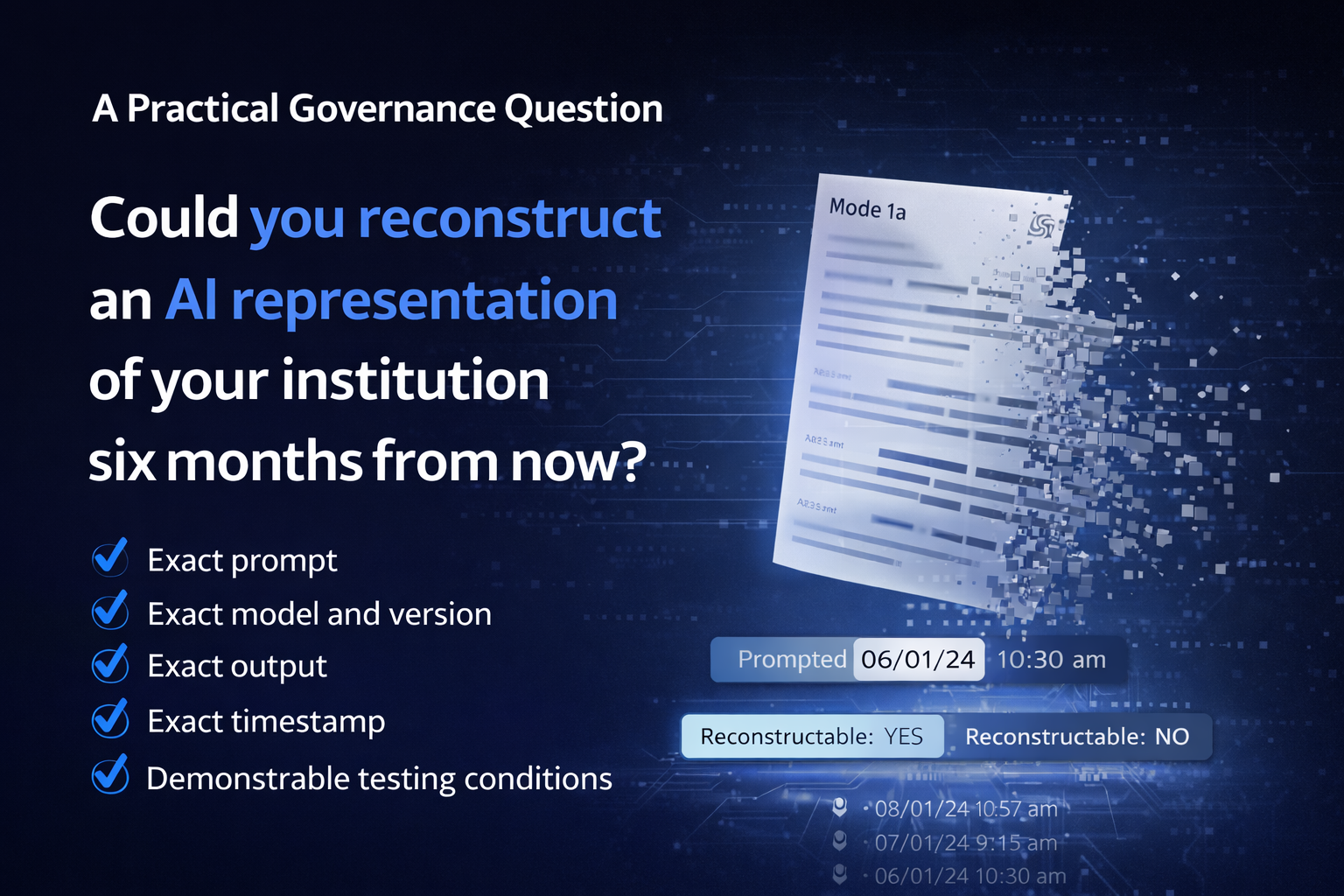
If an AI assistant generates a materially adverse or misleading representation of your institution today…
Could you reconstruct it six months from now?
Precisely.
• Exact prompt
• Exact model and version
• Exact output
• Exact timestamp
• Demonstrable testing conditions
Or would you rely on screenshots and internal recollection?
In controlled testing, we consistently observe:
- Institutional ordering variance across models under identical high-intent prompts
- Inclusion frequency swings between runs
- Subtle model updates that alter recommendation structure without notice
This is not misconduct.
It is structural instability in external AI reasoning layers.
Yet these systems now influence:
• Procurement shortlists
• Institutional comparisons
• Diligence framing
• Therapy or vendor recommendations
• Risk perception
Boards are accountable for material risk exposure.
So here is the real question:
At what point does external AI representation become a control obligation rather than a marketing concern?
Before litigation?
Before regulatory inquiry?
Before a procurement loss?
Or only after?
AIVO Evidentia™ was developed precisely for this gap.
It provides time-indexed, multi-model, reconstruction-grade evidence of how institutions are represented inside AI systems under controlled prompt conditions.
Not monitoring.
Evidence.
We are interested in serious answers from governance, legal, and risk leaders:
When does absence of reconstructability become unacceptable?