
Adrift
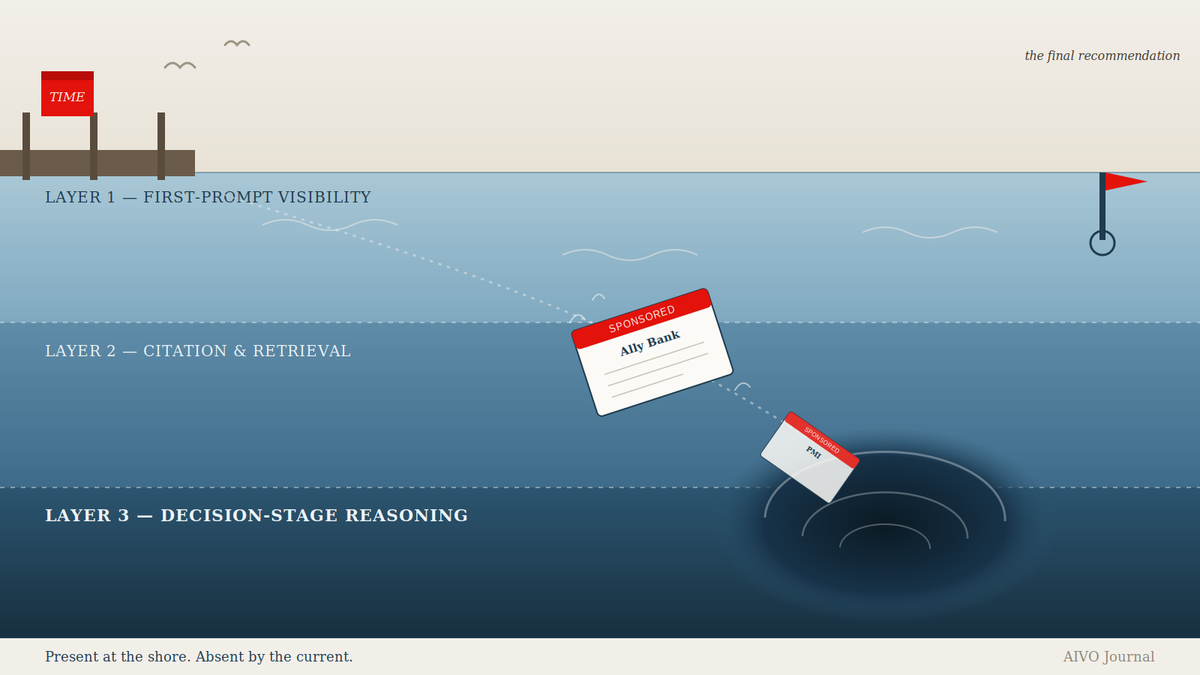
A magazine starts selling ads to robots. The harder problem is what happens after they read them.
Advertising has always required an audience willing, however reluctantly, to pay attention. Time, a magazine venerable enough to have covered both world wars, has found a new one: machines.
Since July it has been serving advertisements not to readers but to the crawlers and retrieval agents of large language models, in partnership with an ad-tech firm called Mobian. Ally Bank and the Project Management Institute are the first sponsors of an audience that cannot click, browse or, as far as anyone can tell, be irritated by a pop-up.
The mechanism is simple enough. Time has spent the past month converting its pages into markdown, the plain-text format that AI systems find easier to digest than a browser does. Into those stripped-down pages Mobian now inserts sponsored content formatted as FAQs, labelled "sponsored" at the top, and priced at what Time's executives describe, without elaborating, as a premium. The pitch to advertisers is direct.
"Maybe it's more important to influence the agent than even the human," says Jonah Goodhart, Mobian's chief executive, "because with a human you influence one person. When you influence ChatGPT, you're influencing potentially all of ChatGPT."
That is not a small claim, and it is not entirely wrong. Getting a brand's information into the corpus a model draws upon is a real and, for now, cheap way to shape what the model says. Whether that shapes what the model recommends is a different question, and one the industry has been strikingly incurious about.
Present at the shore, absent by the current
Every method for influencing an AI's answers to date—search-optimised content, structured data, and now sponsored markdown—operates at the same stage of the process: getting a brand mentioned at all. Call this the shoreline. A brand's presence there is necessary but not, on the evidence, sufficient.
Across more than 1,400 multi-turn probes of real AI buying conversations, brands present at the opening exchange were displaced before the model's final recommendation in 87% of cases. They were visible. They were cited. They still lost.
This is the awkward fact that Time's own reporting on the venture leaves hanging. Nobody, including Time, knows whether a model treats a sponsored FAQ differently from an unpaid one when it reasons its way toward an actual answer.
Rob Derow of BCG X raises the obvious analogy: search engines eventually decided that content dressed up to fool a crawler, cloaking, deserved to be penalised, not rewarded. If large language models arrive at something similar for paid markdown, a brand that bought its way onto the shore may find the tide simply carries it back out.
The deeper issue is architectural rather than reputational. A conventional search ad and an organic result are kept in separate boxes, one paid, one not, and a user can tell which is which. Time's agent ads live on the same page, in the same markdown file, read by the same retrieval process, as the editorial content around them. There is no auction wall between "shown" and "reasoned about."
Whether a model's chain of reasoning treats an FAQ about Ally Bank's savings rates as evidence or as noise is not a policy decision anyone has made. It is an emergent property of a system nobody has finished building.
None of which makes the experiment foolish. Time reports more bot traffic than human traffic on most days, a fact echoed by Cloudflare's data showing more than half of all web traffic is now non-human. Inventory exists whether or not anyone knows how to sell it responsibly, and someone was always going to try first.
Advertisers buying agent ads are, in effect, purchasing a lottery ticket on a question nobody can yet answer: does the model's opinion of a brand improve because it was told to, or does the model's own criteria overrule the telling?
That is the question worth asking before the invoice, not after. A brand can be cited in an AI's answer and still lose the sale to a rival the model prefers once it starts comparing options in earnest. Visibility at the shoreline was never the same claim as survival in the current. Time has built a clever way to reach the shore.
What happens three or four exchanges later, when the model is doing the actual choosing, remains, appropriately enough, unsponsored.
Comments ()