
Agentic Commerce: The Networks Recruited Issuers First. Where Are the Acquirers?
· Agentic Economy Atlas series · By Tim de Rosen, AIVO, Inc.
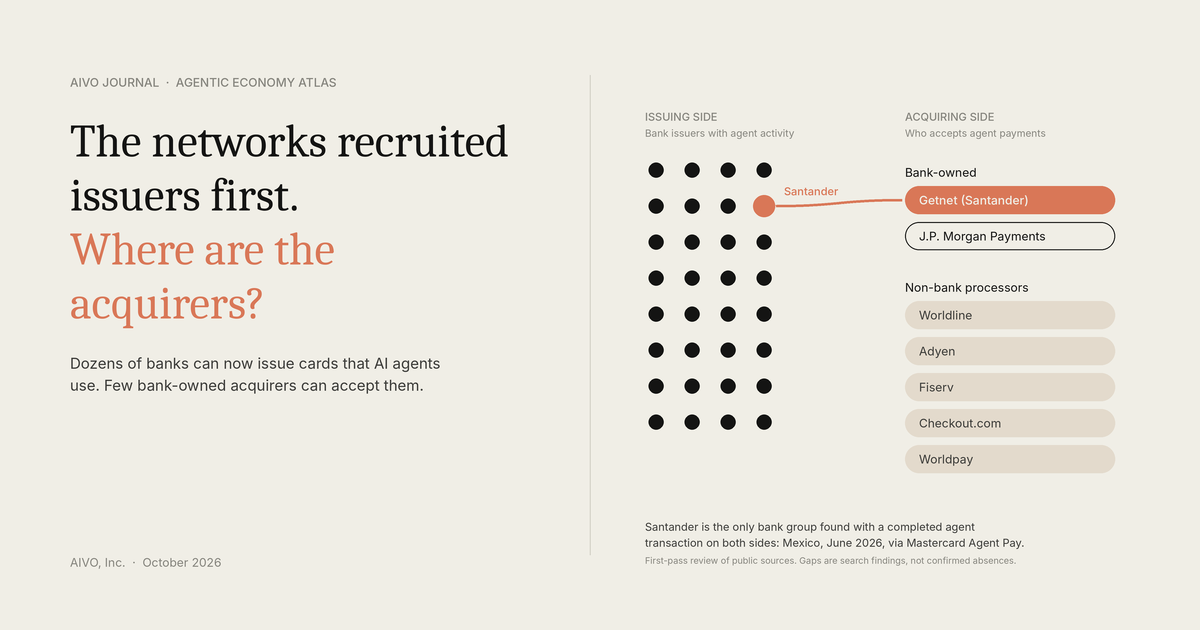
Santander is the only banking group for which we found primary-source evidence of a completed agent-initiated card transaction on both the issuing and the acquiring side. Dozens of banks now issue cards that AI agents can use. Far fewer bank-owned acquirers have shown they can accept those payments, and most documented merchant-side activity sits with non-bank processors.
Three findings frame the piece. First, the issuer side is crowded because Visa and Mastercard recruited issuers first, so issuer counts say little about bank appetite for acceptance. Second, Santander closed the loop in Mexico in June 2026, with a Santander card paying a merchant whose payment was accepted by Getnet, Santander's own merchant platform. Third, Worldline, Adyen, Fiserv, Checkout.com and Worldpay have moved faster on acceptance than most banks' acquiring arms, with J.P. Morgan Payments and Getnet the bank-owned exceptions we found.
A reader's question
On the day we launched the Agentic Economy Atlas, a reader asked which banks sit on both ends of agent checkout. The Atlas mapped rails and protocols. It did not map banks.
So we built a bank layer. It lists every bank and payment processor we could find with documented agentic payment activity, sorted by the side of the transaction each sits on and by the strength of the evidence. This article reports what that first pass shows.
The networks recruited issuers first
The crowded issuer side is largely by design. When Visa launched Agentic Ready in Europe in March 2026, its first phase focused on issuer readiness, with 21 named early issuing partners including Barclays, HSBC UK, Santander and Revolut. By July, Visa reported live agent purchases with more than 30 European issuers at merchants including lastminute.com and Frasers. Barclays, HSBC UK, Lloyds and NatWest were among the issuers it named as having completed transactions.
Mastercard followed the same order. Agent Pay's first US pilots were announced with Citi and U.S. Bank cardholders. Mastercard then ran first transactions with Commonwealth Bank of Australia in January 2026 and Westpac in February, with Santander in Spain in March, and with 17 issuers and processors across Latin America, Santander among them, also in March.
A long issuer list therefore reflects how the networks sequenced their programs, and should be read that way. Bank appetite for accepting agent payments on the merchant side needs separate evidence. That gap, between many bank issuers and few bank acquirers, is what the rest of this article examines.
Who sits on both ends
Santander is the only banking group we found with a completed agent transaction on both sides, confirmed by a primary source. In Mexico in June 2026, Mastercard reports that a Santander card was used and that Getnet, Santander's merchant payments platform, accepted and processed the payment through Agent Pay. The issuing entity and the acquirer are separate Santander companies, which places the group on both ends.
Organization | Issuing side | Acquiring side |
|---|---|---|
Santander group (bank) | Completed transactions with Mastercard in Spain, Mexico and Latin America | Completed transaction via Getnet in Mexico |
Crédit Agricole (bank) | Completed transaction in production with Mastercard in France | Not documented; the payment ran on Worldline's infrastructure |
Revolut (bank) | Completed transaction in a controlled pilot with Visa in France | AP2 compatibility announced; no completed transaction found |
Nexi (non-bank) | Completed transaction as a managed issuer with Visa | Merchant pilots in the Nordics and Italy |
ING (bank) | Completed transactions with Mastercard in the Netherlands and Visa in Germany | Not acting as acquirer; Worldline processed both |
Crédit Agricole comes closest to joining Santander. It was the issuing bank in what Worldline, Crédit Agricole and Mastercard describe as France's first agentic payment in production, in June 2026. The payment ran end to end on Worldline's infrastructure, and the release names no acquirer.
Five days later, Crédit Agricole took full ownership of CAWL, its merchant-acquiring venture with Worldline. If CAWL begins accepting agent payments, Crédit Agricole will sit on both ends.
Revolut and Nexi are partway there. Revolut authorized an agent purchase on a French card at Cleverbridge in September, and the merchant's release confirms Revolut acted as issuer only. Its merchant-side claim rests on Revolut's own January announcement that Revolut Pay is compatible with Google's AP2. We found no completed merchant transaction.
ING illustrates the distance between issuing participation and acquiring capability. Worldline describes a June transaction, in which an ING cardholder paid a Dutch webshop, as Europe's first end-to-end agentic payment in production. That is Worldline's own description, and Santander made a competing European first claim in March. In a second transaction in Germany on Visa, Worldline again supplied the acquiring infrastructure. Both transactions involve ING cards, and neither shows ING acquiring.
Where the acquirers are
The acquirers exist, and most of them are not banks. Non-bank processors have announced merchant-side support faster than the acquiring arms of most banks.
Processor | What it has announced | Date |
|---|---|---|
Worldline | Completed agent transactions with ING on Mastercard and Visa | June to July 2026 |
Adyen | Adyen Agentic, in limited availability for US enterprise merchants | June 2026 |
Fiserv | Mastercard Agent Pay Acceptance Framework, plus a separate Visa collaboration | December 2025 |
Checkout.com | Support for OpenAI's Agentic Commerce Protocol | November 2025 |
Worldpay (now owned by Global Payments) | Support for the Agentic Commerce Protocol | October 2025 |
Among bank-owned acquiring businesses, Getnet and J.P. Morgan Payments stand out. J.P. Morgan Payments is running a closed beta of agent checkout with select retailers through its Mirakl partnership.
JPMorganChase is the instructive counterexample to Santander. It shows substantial acquiring activity and engagement in industry standardization, and we identified no issuer product in this review. American Banker describes its approach as slow and steady.
We found no public merchant-side agentic activity for Barclaycard Payments, CaixaBank's acquiring business or Wells Fargo in the sources reviewed. These are search findings, not confirmed absences.
Why it matters
An agent can find a brand and choose it, but the sale completes only if a payment can be issued and accepted on rails that recognize the agent.
A bank on both ends sees the cardholder's instruction to the agent and the merchant's acceptance of it. That position matters for disputes, for fraud models trained on agent behavior, and for the commercial terms that will follow once volumes are real.
Today that position is mostly split. Banks hold the cardholder side, while processors, many of them non-banks, build the merchant side. Whether banks treat acquiring as part of their agentic strategy is the open question for 2027.
Method and limitations
This is a first-pass map of documented activity. It is not a census of operational readiness, and it has not been peer reviewed.
Each record in the bank layer carries three separate labels. The evidence state records whether the organization is a listed participant, has announced a capability, has completed a transaction, or has no activity found. The provenance label records whether the organization's own release supports the claim or only a secondary report does. The deployment stage records whether the activity was a controlled test, a pilot, a demonstration or production.
Three cautions apply. Most completed transactions so far are controlled tests rather than consumer features. Every first cited in this article is the company's own description. Where we found nothing, that reflects the limits of our search and is not proof that nothing exists.
Help us complete the record
The full bank layer, with sources for every record, is live in the Agentic Economy Atlas. If your organization is missing or misclassified, we want to hear from you. We are particularly interested in primary-source evidence of completed transactions, the identity of the issuing and acquiring entities, and whether the activity took place in a controlled test, a pilot or production.
Submit corrections through the Atlas Contribute page. Changes are logged in the Atlas under What's changed. In line with AIVO Journal policy, any correction to this article will be published as a dated addendum, and the original text will remain.
Sources
- Visa: Agentic Ready launch, March 2026
- Visa: live agentic transactions with 30+ European issuers, July 2026
- Santander: Europe's first live agent payment with Mastercard, March 2026
- Mastercard: Getnet, Neivor and Santander in Mexico, June 2026
- Mastercard: live agentic transactions across Latin America and the Caribbean, March 2026
- Mastercard: Commonwealth Bank of Australia and Westpac, January 2026
- Mastercard: Westpac in New Zealand, February 2026
- Banking Exchange: Citi and U.S. Bank to pilot Agent Pay, September 2025
- Worldline: Crédit Agricole and Mastercard, France's first agentic payment, June 2026
- Worldline: Crédit Agricole acquires 100% of CAWL, June 2026
- Cleverbridge: Revolut and Visa in France, September 2026
- Revolut: Revolut Pay and AP2, January 2026
- Nexi: agent transaction with Visa, July 2026
- Nexi: agentic commerce capabilities, March 2026
- Worldline: ING production payment with Mastercard, June 2026
- Worldline: ING and Visa in Germany, July 2026
- Mirakl: J.P. Morgan Payments partnership, March 2026
- American Banker: JPMorganChase on agentic commerce, October 2026
- Adyen: Adyen Agentic, June 2026
- Fiserv and Mastercard, December 2025
- Checkout.com and ACP, November 2025
- Worldpay and ACP, October 2025
Tim de Rosen is CEO and co-founder of AIVO, Inc. AIVO maintains the Agentic Economy Atlas, an open research map of the agents, protocols and payment rails shaping AI-mediated commerce.
Comments ()