
Agents Decide Before They Buy
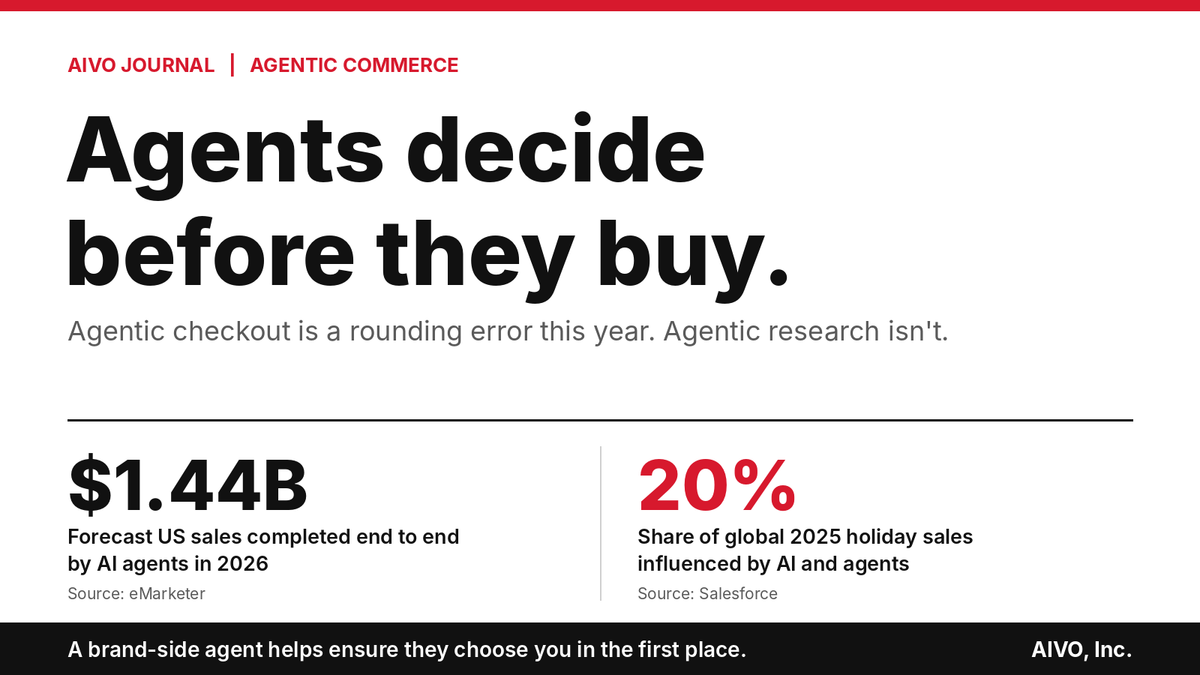
Agentic checkout is a rounding error in 2026. Agentic research is not. AI agents already narrow the shortlist before anyone buys, and brands that can't answer an agent's deciding question drop off it without ever knowing.
That is the case for putting a brand-side agent, such as AIVO Assist, on every high-consideration website now, not when agentic checkout scales. It also creates a measurable link between an agent's product inquiry, its assessment and a subsequent commercial outcome, which is the attribution GEO and AEO still lack.
The honest number: checkout is still a rounding error
US retail sales completed end to end by an AI agent will reach about $1.44 billion in 2026, according to eMarketer's forecast reported by Modern Retail. That is a rounding error against a US ecommerce market measured in the trillions.
The same forecast doesn't expect fully delegated checkout to take off quickly. It has end-to-end agentic sales at $1.59 billion in 2027 and $1.76 billion in 2028. Shoppers aren't ready to hand over the card. A Product.ai survey in October 2026 found only 21.6% of AI-using shoppers had let an assistant complete a purchase, and 89.9% checked its recommendation elsewhere before buying.
Anyone equating the immediate agentic commerce opportunity with autonomous checkout is missing the much larger market.
The number that matters: agents already decide
The purchase is still human. The research increasingly isn't. That split is the whole story.
- Influence is already large. Salesforce reports that AI and agents drove 20% of global retail sales in the 2025 holiday season, or $262 billion. AI-referred shoppers converted nine times more often than social media referrals.
- Decisions are made before the visit. L.E.K. Consulting found about 30% of US consumers used AI to inform a purchase in April 2026. Of those, 31% said the decision was largely made before they reached a brand or retailer site, up from 26% two years earlier.
- The traffic that does arrive is ready to buy. Adobe reports that AI traffic to US retail sites converted 90% better than non-AI traffic in September 2026 and generated 83% more revenue per visit.
This is what AIVO, Inc. calls Shopping Augmentation: agents take over the slog of product research and narrow the field, and the shopper still makes the final pick. The shortlist is now built by machines. A brand that isn't on it never reaches the checkout, agentic or otherwise.
The next two years: the curve bends
AI-driven sales climb sharply from here, even if fully delegated checkout lags. Forecasters define the market differently, so their numbers aren't directly comparable, but they all point the same way.
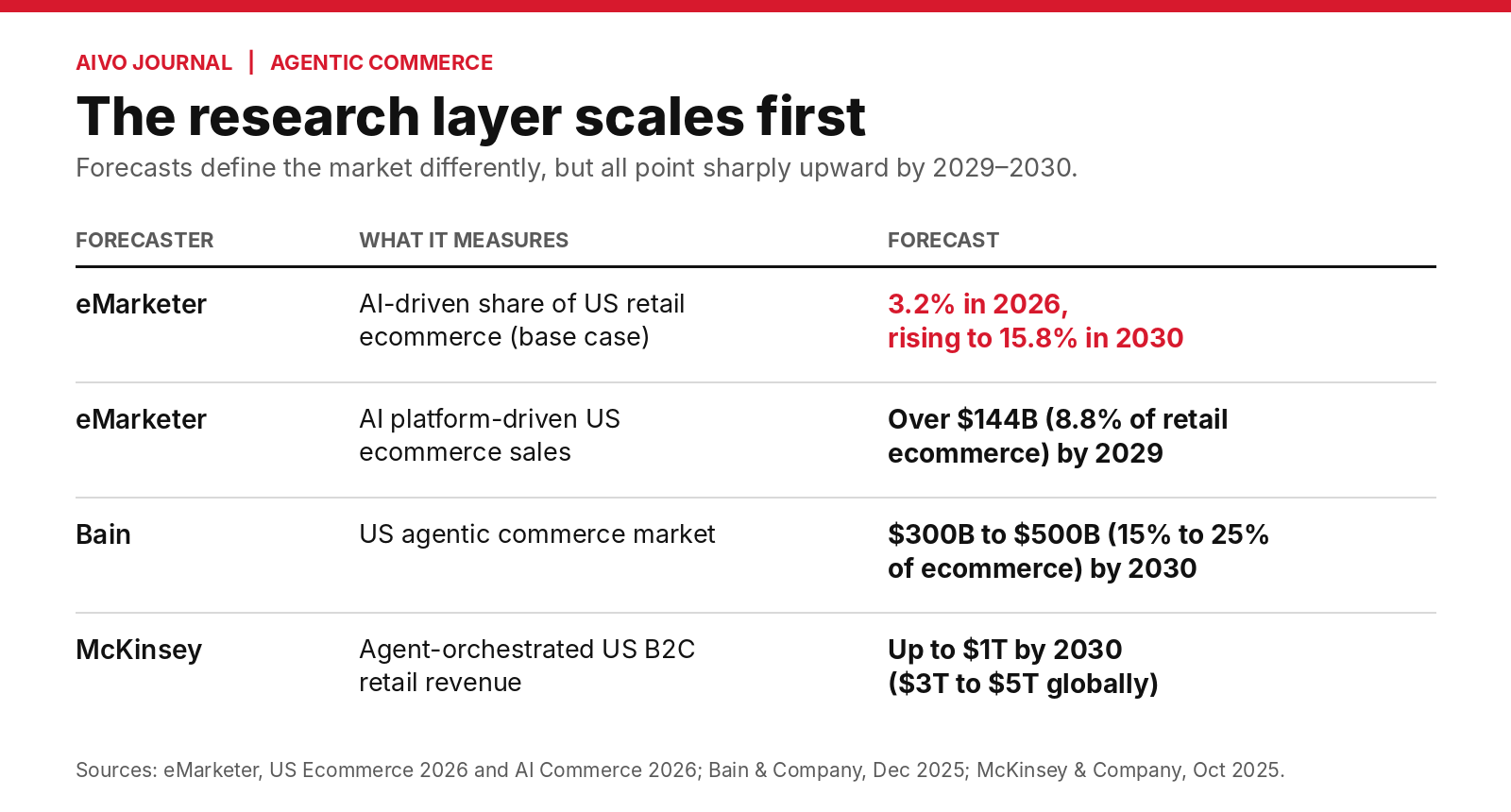
Three things drive the climb. The agents are getting better at multistep tasks. The rails are being laid: protocols such as MCP, A2A, AP2 and ACP let agents talk to merchants and pay. And habits are shifting: Adobe found AI-referred retail traffic went from converting 38% worse than other traffic in March 2025 to 42% better a year later.
The practical point for brands: the research layer scales first, and it is already scaling. By the time checkout catches up, the shortlists will have been set for two years.
Where shortlists are lost: the deciding fact
An agent recommends a product when it can establish the facts that settle the shopper's need. Does it fit a wide foot? Is it safe with this medication? Will it work with this camera body? If the agent can't confirm the deciding fact, it moves on to a brand where it can.
Most websites make that hard. Adobe's AI Content Visibility Checker found that LLMs could read only 66% of the content on the average US retail product page in early 2026, the lowest of any page type it scored (Adobe). The facts are often on the store. Agents just can't find, read or match them.
The loss is invisible. When an agent visits, decides against you and leaves, nothing shows up in a standard analytics dashboard. Zero-click was the search problem. Zero-sight is the agent problem: decisions about your brand made where you can't see them.
The case for brand-side agents
A brand-side agent gives visiting AI agents a direct, authoritative place to ask. AIVO Assist is the brand's own product expert. An agent passes the shopper's need, with no personal data, and gets a judged answer in about two seconds: Fits, Fits, if…, No suitable option, or Need a little more information. Each answer comes with the deciding facts and their sources.
The answers are assembled from a knowledge repository the business has signed off, so the agent gets the brand's verified facts rather than a guess. Agents can reach it through an expert page on the brand's own domain, a WebMCP tool, Ask links, an MCP server or a REST API. It is a pull service for agents, not a chatbot and not a product feed.
The early evidence is strong:
- Better choices. In a controlled test on October 26, 2026, agents picked the right business 93% of the time with Assist (157 of 168) versus 47% without it (79 of 167). All 149 agents that consulted Assist chose correctly (Sheals & de Rosen, working paper).
- Agents use it unprompted. In live tests, ChatGPT agent consulted Assist without being told to, and on a Shopify store agents chose Assist over the platform's own agent endpoint.
- Brands with their own agents grow faster. Salesforce found retailers that deployed their own AI agents grew holiday sales 6.2% year over year versus 3.9% for those that didn't (Salesforce). That is correlation, not proof, but it points the same way.
The cost of waiting is the case for acting now. Building a signed-off repository of deciding facts takes time, and the shortlists are being set today.
One step closer to attribution
GEO and AEO tools can tell a brand how often it is mentioned in AI answers. They can't tell it whether an agent visited, what it asked, what it decided or whether a sale followed. That gap makes AI visibility spend hard to justify to a CFO.
Web analytics doesn't fill it either. Adobe notes that analytics tools don't classify AI referrals consistently (Small Business Trends, on Adobe's data). In AIVO, Inc.'s controlled test, standard analytics recorded none of 314 agent visits.
A brand-side agent changes what can be measured. Every Assist answer carries a reference code and a tracked link, so the brand can see which agents asked, which questions in the shopper's own words, what verdict they got and which visits followed. In the controlled test, 14 of 14 agent-driven outcomes were credited correctly, with no false credits.
This doesn't solve attribution. Agents that never consult the brand stay out of view, and a shopper can still buy elsewhere. But it turns part of the zero-sight problem into data a brand can act on, which is more than mention-tracking offers.
What brands should do now
Don't plan for agentic checkout in 2026. Plan for agentic research, which is already here.
- Find the deciding facts. List the questions that settle a purchase in your category, then check whether an agent can establish each one from your site.
- Give agents an authoritative source. Put a brand-side agent on high-consideration product sites first, backed by facts your business has signed off.
- Measure what agents ask and decide. Treat agent questions as demand intelligence, and track the visits and outcomes that follow.
- Re-measure. Check whether agents choose you more often after the fix, and close the gaps they reveal.
The limits should be stated plainly. Forecasts for 2028 to 2030 vary widely and define the market differently. AIVO Assist's results so far come from controlled and live tests run by AIVO, Inc., not yet from a large base of outside customer traffic. Agents behave differently from one another and change quickly. None of this weakens the core point: agents already decide who makes the shortlist, and most brands can't yet answer them.
An agentic checkout strategy helps agents buy from you. A brand-side agent helps ensure they choose you in the first place.
Sources
- Adobe, AI traffic surge, retail sites not machine readable, April 16, 2026
- Adobe, AI traffic drives 83% higher revenue per visit, October 29, 2026
- Bain & Company, 2030 forecast: how agentic AI will reshape US retail, December 17, 2025
- eMarketer, US Ecommerce 2026
- eMarketer, AI Commerce 2026
- L.E.K. Consulting, Thanks to AI, consumers are arriving at brand and retailer sites ready to buy, July 13, 2026
- McKinsey & Company, The agentic commerce opportunity, October 2025
- Modern Retail (Digiday), Welcome to the agentic commerce quarter, November 19, 2026, citing eMarketer
- Product.ai, Trust in AI Commerce Report, October 2026 edition (via PR Newswire)
- Salesforce, AI and agents account for $262 billion of 2025 holiday spend, January 6, 2026
- Sheals, P. & de Rosen, T., AIVO Assist working paper, Zenodo, October 27, 2026, DOI 10.5281/zenodo.23694598
- Small Business Trends, AI-driven retail traffic surges 71%, converts 90% better, October 2026
Comments ()