
Agents Will Spend the Money in B2B. Who Measures Which Vendors They Choose?
Where the money is
Almost all of the public conversation about AI agents has centred on the consumer. Agents that book a table, reorder household staples or plan a family weekend have taken most of the headlines and launch attention.
A larger commercial opportunity is forming inside businesses. Agent systems are being built to coordinate teams, plan events, run marketing programmes and automate procurement workflows. Each of those tasks can end in a purchase, and the agent can shape which suppliers enter the decision set.
The distinction that matters is between AI-assisted procurement and agent-mediated procurement. In the first, a model helps a human compare vendors the human has already found. In the second, the system determines which vendors the human sees and may complete the transaction itself.
That second model changes the problem for vendors. The first reader of a supplier's offer is becoming a machine, and few suppliers are measuring how that machine decides.
Every orchestration task can become a vendor decision
Consider an agent asked to plan a 300-person sales kickoff in Lisbon. It can filter venues, hotel blocks, AV providers, caterers and transfer companies against the brief it has been given. A planner may approve the result, but the options in front of her are already the output of an agent's selection.
The same pattern can extend to distributed teams, where an agent might source coworking space, arrange travel, select equipment suppliers and find contractors when capacity runs short. In marketing, agents can brief freelancers, compare agencies, source research partners and evaluate software.
Many of these decisions carry higher values than a consumer basket, and many recur. A venue selected for one regional event may become the starting point for the next, and a supplier left off the initial shortlist may never get the chance to compete.
The Three Gates inside procurement
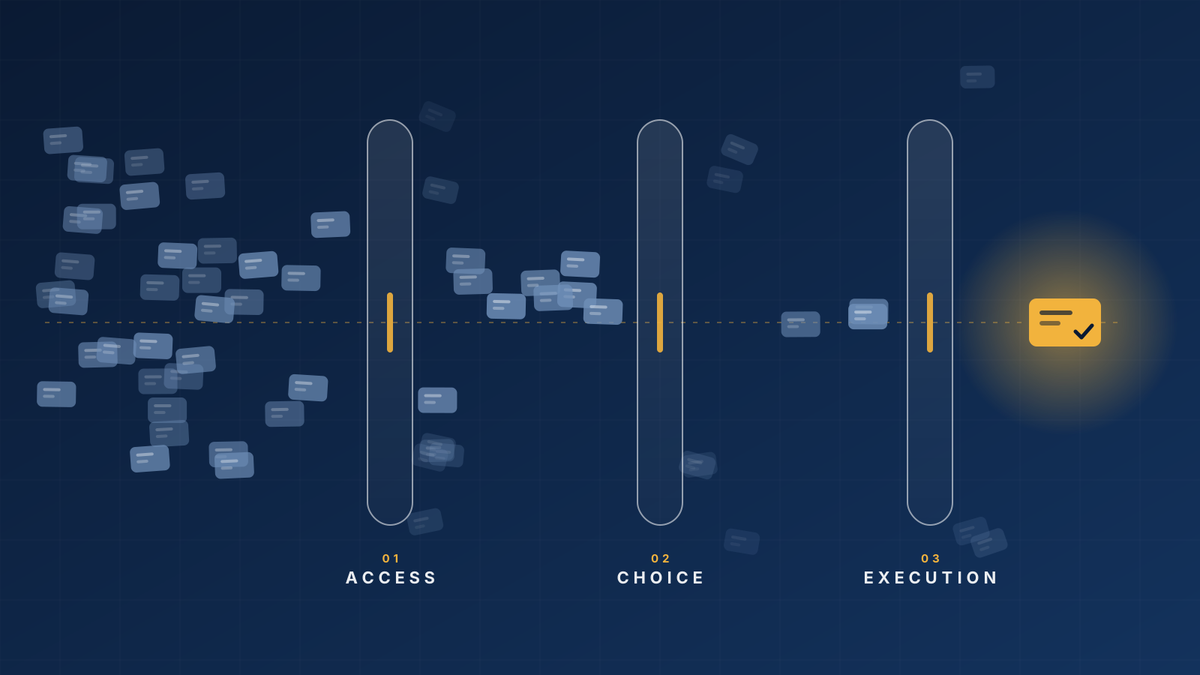
In "Chosen, Then Blocked", AIVO set out three gates every brand must pass in agentic commerce: Access, Choice and Execution. The framework was developed with consumer purchasing in view, and B2B procurement makes each gate more consequential.
Access is governed by approved-supplier lists, procurement platforms, integrations and permissions. A vendor that an agent cannot reach through the systems available to it is excluded before any comparison begins, however well known it is to human buyers.
Choice is where the agent ranks the vendors it can reach. The criteria may include structured company data, third-party evidence, procurement history, price, availability and contract terms. The supplier often has little visibility into how those signals are weighted.
Execution is where a winning recommendation can still fail. Spend controls, approval chains, security reviews, contracting requirements and technical integrations all sit between selection and purchase. A supplier can pass Access, win Choice and still lose at Execution, and the risk is higher in B2B because one transaction can cross several systems and several approvers.
Why early position can compound
The compounding effect in B2B rests on workflow persistence and institutional memory. It requires no learning capability on the agent's part.
Once a supplier has been approved, integrated and used successfully, the organisation has little reason to revisit it. Procurement records accumulate, contract terms are known and workflows have been tested. An agent operating inside those same workflows and approved-vendor data will tend to reproduce the established preference.
Access, selection, successful execution and reuse form a loop. A supplier that gets through it early can become part of the operating pattern for later purchases, which is why early position in agent-mediated buying carries commercial weight.
The adoption lag is a window
Enterprise adoption is likely to be slower than consumer adoption. Security reviews, data-protection requirements, liability for agent errors and integration with existing procurement systems all add friction to every deployment.
That delay gives suppliers time. Before agent-mediated procurement becomes routine, they can establish whether the relevant systems can reach them, understand how agents evaluate them against alternatives and find the operational barriers that stop an agent completing a transaction. Companies that measure those conditions early will be better placed than those that discover them after the buying process has changed.
What suppliers should measure now
Most current work on AI visibility addresses Access, meaning whether a brand appears in AI-generated answers at all. In B2B, that is the starting point. The commercial outcome is decided after the brand enters the decision set.
AIVO calls the discipline of managing those later conditions Agentic Brand Control. For a B2B supplier it begins with three measurable questions.
At Access, can the agents used by prospective buyers reach the supplier through the systems and permissions available to them?
At Choice, how often is the supplier selected when competitors are available, which evidence drives the outcome, and where does it drop out of consideration?
At Execution, once selected, can the agent complete the booking, order or contract without a human stepping in?
Event venues, hotel groups, agencies and professional-services firms are natural early categories because their offerings already involve complex comparison and recurring procurement.
The measurement problem is moving downstream. It is no longer enough to know whether an agent can find a supplier. Suppliers need to know whether the agent chooses them, why it chooses them, and whether the transaction can actually happen.
Comments ()