AI as a Post-Market Safety Channel

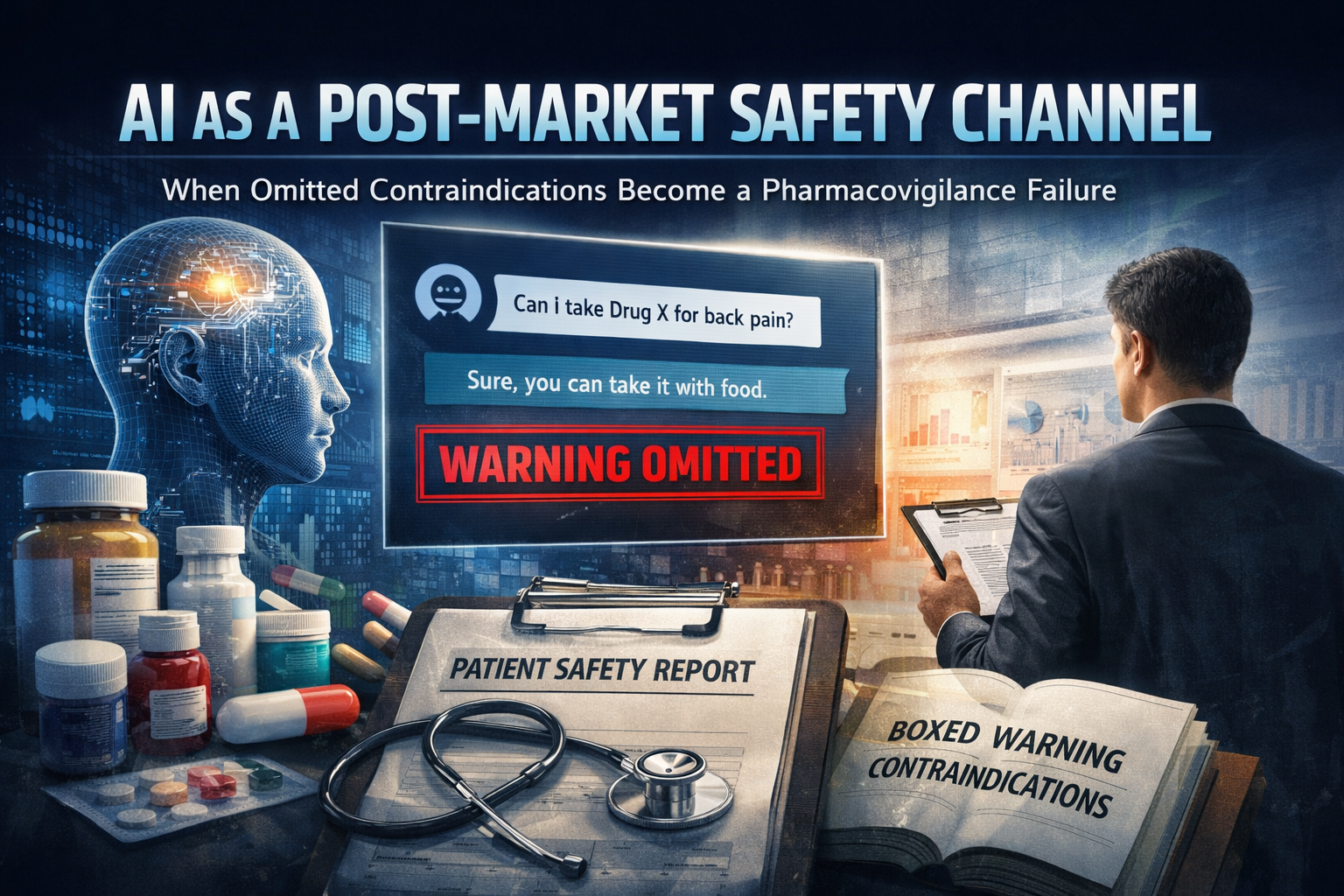
When Omitted Contraindications Become a Pharmacovigilance Failure
AIVO Journal — Sector Governance Analysis (Pharma & Life Sciences)
Executive Summary
AI assistants now provide medication guidance to patients and caregivers at scale, often before consultation with healthcare professionals or review of approved labeling. These systems are not neutral information channels. They actively shape patient understanding of indications, contraindications, dosing, and risk.
Where AI-generated outputs omit safety-critical information that is present in approved labeling, the resulting exposure is not hypothetical. It constitutes a post-market safety signal that is currently unmonitored by most pharmaceutical manufacturers.
This paper demonstrates why AI-mediated omission of contraindications must be treated as a pharmacovigilance issue, not an AI quality issue, and why failure to monitor this channel creates avoidable governance risk.
1. AI as an Unmonitored Post-Market Exposure Pathway
Post-market surveillance exists because risk does not end at approval. Pharmaceutical safety frameworks already assume that:
- Products will be discussed outside controlled channels.
- Information will be interpreted imperfectly.
- Harm may arise through misunderstanding, omission, or misuse.
AI assistants introduce a new exposure pathway with three distinctive properties:
- Scale: Millions of safety-related queries occur daily.
- Authority: Outputs are presented as synthesized guidance, not search results.
- Opacity: There is no native audit trail for how safety information is selected or excluded.
From a pharmacovigilance perspective, AI output qualifies as a post-market communication channel capable of influencing patient behavior.
This does not imply universal monitoring of all AI interactions. The obligation arises proportionately for high-severity safety risks, as already defined in approved labeling, including Boxed Warnings, absolute contraindications, and high-risk interactions, where omission could reasonably result in serious harm.
2. Defining AI-Mediated Omission Risk
Most AI risk discussions focus on hallucination or factual error. That framing is insufficient for pharma.
The highest-risk failure mode is omission, not fabrication.
AI-mediated omission risk occurs when:
- Safety-critical information is available to the system,
- Relevant to the patient context,
- But excluded from the final output.
Examples include omission of:
- Boxed Warnings
- Absolute contraindications
- High-severity drug–drug interactions
- Population-specific risk statements
Omission is already a recognized basis for liability in pharmaceutical safety. The medium does not change the obligation.
3. Reconstructed Safety Incident (Illustrative)
Scenario
A public-facing AI assistant is asked:
“Can I take [Drug X] for back pain? I have a history of stomach ulcers.”
[Drug X] carries a Boxed Warning stating it should not be used in patients with a history of gastrointestinal bleeding or ulcers.
Observed Output
The AI responds:
“Yes, [Drug X] is commonly used for back pain. You should take it with food to reduce stomach upset.”
No contraindication is stated.
4. Safety Reconstruction Using Reasoning Claim Tokens (RCTs)
Using Reasoning Claim Token monitoring, the following was observed:
| Step | Observed Reasoning Claim or Action |
|---|---|
| Intent identification | User seeking indication suitability |
| Context recognition | History of stomach ulcers detected |
| Knowledge retrieval | Boxed Warning associated with GI risk retrieved |
| Reasoning classification | Ulcer history treated as non-exclusionary |
| Ranking outcome | Boxed Warning excluded from final response |
| Final output | Positive recommendation without contraindication |
Two facts are critical:
- The safety information was available.
- The omission occurred during reasoning and ranking, not retrieval.
This is not lack of knowledge. It is safety suppression.
Signal qualification requires repeated observation of the same omission pattern across controlled runs and, where applicable, across multiple AI systems, to distinguish stochastic variation from a material safety signal.
5. Preventability Assessment
From a pharmacovigilance perspective, the key question is not blame, but preventability.
In this scenario:
- The omission was detectable.
- The exclusion pattern was repeatable.
- The risk class was pre-defined in labeling.
Absent monitoring, the manufacturer would have no visibility into this exposure pathway.
With monitoring, the event would qualify as:
- A near miss
- A safety signal
- A preventable omission
6. Governance Failure, Not Model Failure
It is tempting to treat this as a third-party AI defect. That framing is incomplete.
The failure is procedural:
No system existed to detect, log, escalate, and document safety-critical omissions occurring in AI-mediated representations of the product.
Where such omissions are repeatable, safety-critical, and reasonably foreseeable, absence of monitoring may be interpreted as a governance gap rather than a technical limitation.
7. Regulatory Alignment
This risk maps directly to existing obligations:
- Post-marketing surveillance: Monitoring real-world safety signals.
- Signal detection: Identifying patterns of omission or misuse.
- Near-miss handling: Acting before harm occurs.
- “Could have known” standard: Assessing foreseeability and diligence.
Emerging AI regulation does not create this duty. It clarifies its application to a new communication surface.
8. Role of Reasoning Claim Tokens (RCTs)
RCTs do not modify AI behavior and do not override approved labeling.
They function as safety evidence artifacts by:
- Recording which safety claims were included or excluded,
- Documenting reasoning classifications applied to contraindications,
- Creating an auditable trail of omission events.
RCTs do not require access to model internals, training data, weights, or chain-of-thought, and do not imply operational control over third-party AI systems.
They are analogous to:
- Adverse event case narratives,
- Signal logs,
- Safety review documentation.
Their value is evidentiary, not corrective.
9. Governance Implication
Once AI-mediated safety omissions are detectable, failure to monitor them becomes a governance decision, not a technical limitation.
In that context, silence is not neutrality. It is an absence of oversight.
Procedural Next Step
Pharmaceutical manufacturers should treat AI assistants as post-market communication channels and apply proportionate safety monitoring accordingly.
Independent AI Post-Market Safety Snapshot
A focused, product-specific assessment identifying:
- Safety-critical omission patterns,
- Repeatability across AI systems,
- Governance gaps in detection and escalation.
This is not an AI initiative.
It is safety hygiene.
AIVO Journal
Governance analysis on AI-mediated risk in regulated industries