AI Decision Volatility

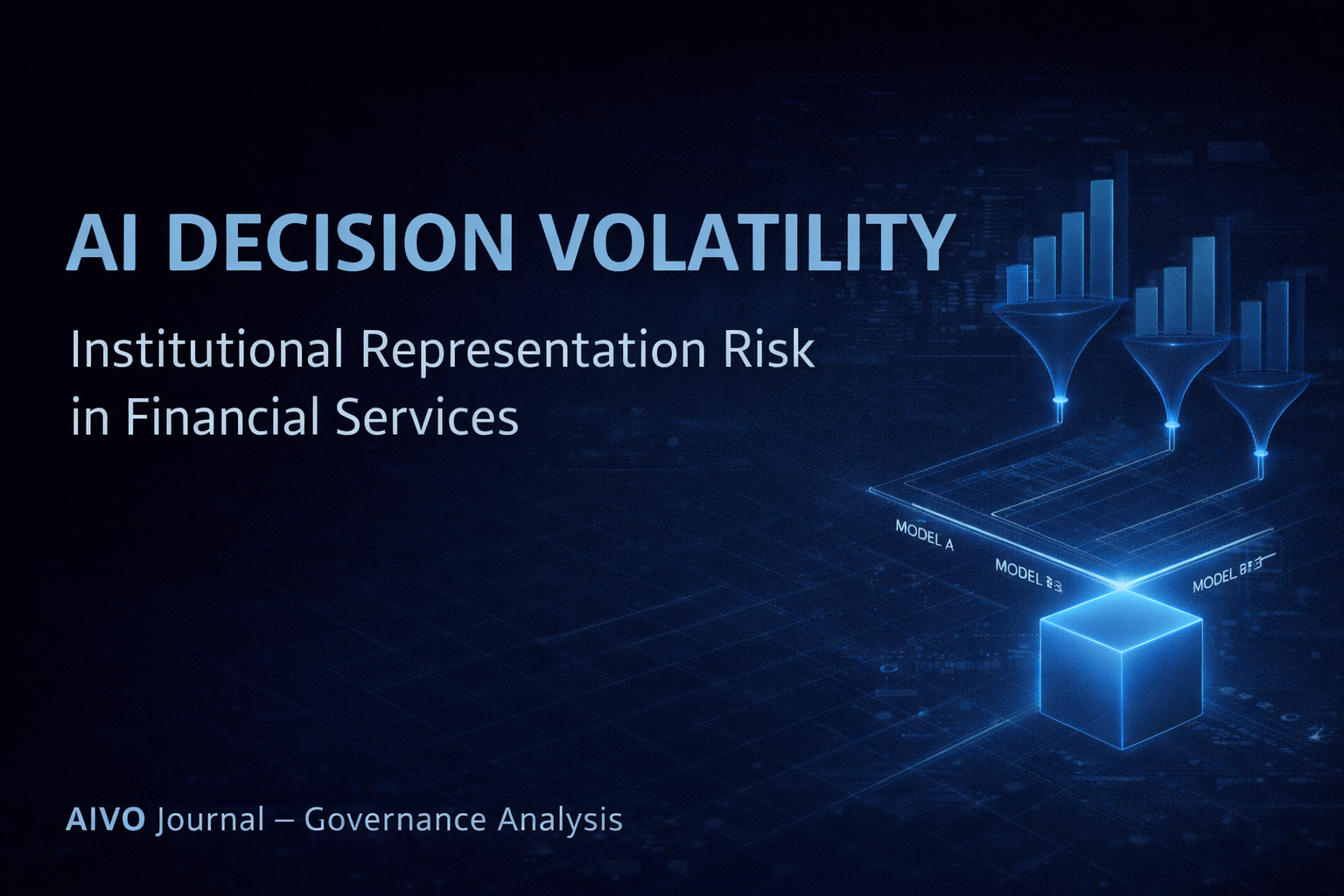
Institutional Representation Risk in Financial Services
Abstract
As large language models increasingly mediate product and institutional selection in retail financial services, representation outcomes have become non-uniform across AI systems and unstable over time. Identical queries can produce divergent institutional winners across models, while periodic model updates alter survival to final recommendation without public disclosure. This article introduces the concept of AI Decision Volatility as a measurable institutional risk, outlines its structural mechanisms, and frames its governance implications for boards and supervisory oversight.
1. Introduction: From Visibility to Mediation
In traditional digital markets, institutions competed for traffic, share of voice, and conversion efficiency.
Generative AI systems alter this architecture.
Instead of routing users to comparison environments, AI systems increasingly act as mediation layers, narrowing options internally and surfacing a limited set of institutions at the final decision stage.
In this environment:
- Visibility is not sufficient.
- Early inclusion does not guarantee survival.
- Institutional representation is not stable.
The shift is structural.
AI systems now compress institutional choice before the browser opens.
2. Cross-Model Divergence
One of the most persistent findings in structured testing is cross-model divergence.
Identical query.
Different institutional outcome.
For example:
- Model A → Institution X
- Model B → Institution Y
- Model C → Institution Z
Each output is delivered with high confidence.
Each appears authoritative.
Yet the selection differs.
This divergence is not noise. It reflects differences in:
- Model architecture
- Weighting of risk indicators
- Treatment of regulatory signals
- Trust heuristics
- Institutional reputation cues
Consistency cannot be assumed across AI mediation environments.
For institutions, this introduces fragmentation of representation.
3. Temporal Drift
Even within a single model, representation is not static.
Structured testing over rolling intervals shows:
Week 1 → Survives to final recommendation
Week 3 → Eliminated at risk framing
Model updates occur silently.
Weighting adjustments shift selection pathways.
The output confidence remains stable.
The institutional outcome changes.
This phenomenon, referred to here as temporal drift, creates an exposure profile that is invisible to traditional monitoring systems.
Digital acquisition dashboards will not detect it.
Brand sentiment tools will not capture it.
Yet it directly affects institutional positioning at the AI decision stage.
4. Mechanism: Why Volatility Occurs
AI systems do not rank institutions by a single variable.
They synthesize multiple weighted signals, including:
- Risk perception
- Regulatory references
- Capital stability indicators
- Institutional trust cues
- Product framing language
- Market prominence signals
Different models weight these variables differently.
Furthermore, training updates and policy tuning alter internal prioritization without public disclosure of decision logic.
The result:
Outputs are confident.
Selection mechanics are variable.
Volatility is structural, not accidental.
5. Institutional Exposure
When representation varies by model and over time, exposure becomes:
- Fragmented across AI systems
- Asymmetric relative to competitors
- Unstable at the final recommendation stage
This creates what can be defined as:
AI-mediated representation volatility.
Unlike traditional competitive shifts, this volatility is:
- Upstream of traffic
- Upstream of acquisition metrics
- Upstream of observable conversion data
Institutions may lose recommendation survival without visible deterioration in conventional KPIs.
This is not a marketing issue.
It is an institutional risk vector.
6. Governance Implications
Boards routinely monitor:
- Market share
- Capital ratios
- Liquidity exposure
- Digital acquisition performance
- Brand reputation
Few monitor:
AI recommendation stability.
Yet if AI systems increasingly mediate institutional selection, volatility at the decision layer becomes relevant to:
- Strategic positioning
- Competitive resilience
- Supervisory disclosure risk
- Reputational exposure
Representation risk is not currently embedded in most governance frameworks.
It will need to be.
7. Toward Measurement: From Volatility to Audit
Volatility becomes actionable only when measured.
An institutional AI representation audit should assess:
01 — Cross-model divergence
02 — Survival persistence to final recommendation
03 — Temporal drift over rolling intervals
04 — Substitution concentration patterns
This shifts the conversation from anecdotal prompt testing to structured institutional oversight.
Without measurement, institutions operate under false stability assumptions.
With measurement, volatility becomes governable.
8. Conclusion: The Mediation Era
AI systems are not merely search tools.
They are emerging mediation layers in financial decision environments.
When mediation becomes opaque and variable:
Institutional representation becomes unstable.
AI Decision Volatility is not speculative.
It is observable.
It is measurable.
And it is currently under-governed.
As AI systems gain influence in retail financial services, boards and risk committees will increasingly need to consider not only what markets think, but what AI systems recommend at the final decision stage.
The era of AI-mediated institutional representation has begun.
Stability can no longer be assumed.
Request a Structured AI Representation Audit
Measure cross-model divergence, survival persistence, temporal drift, and substitution concentration.
aivoevidentia.com