
AI Win-Rate℠
In sales, win rate is opportunities won divided by opportunities available. It is one of the few commercial measures that survives contact with a board. In AI-mediated buying, there has been no equivalent, not because the outcome is unimportant, but because there is no logged opportunity pipeline from which it can be calculated. Decisions happen inside conversations. Losses are largely invisible. And the conventional visibility metrics measure presence, not who actually wins the decision.
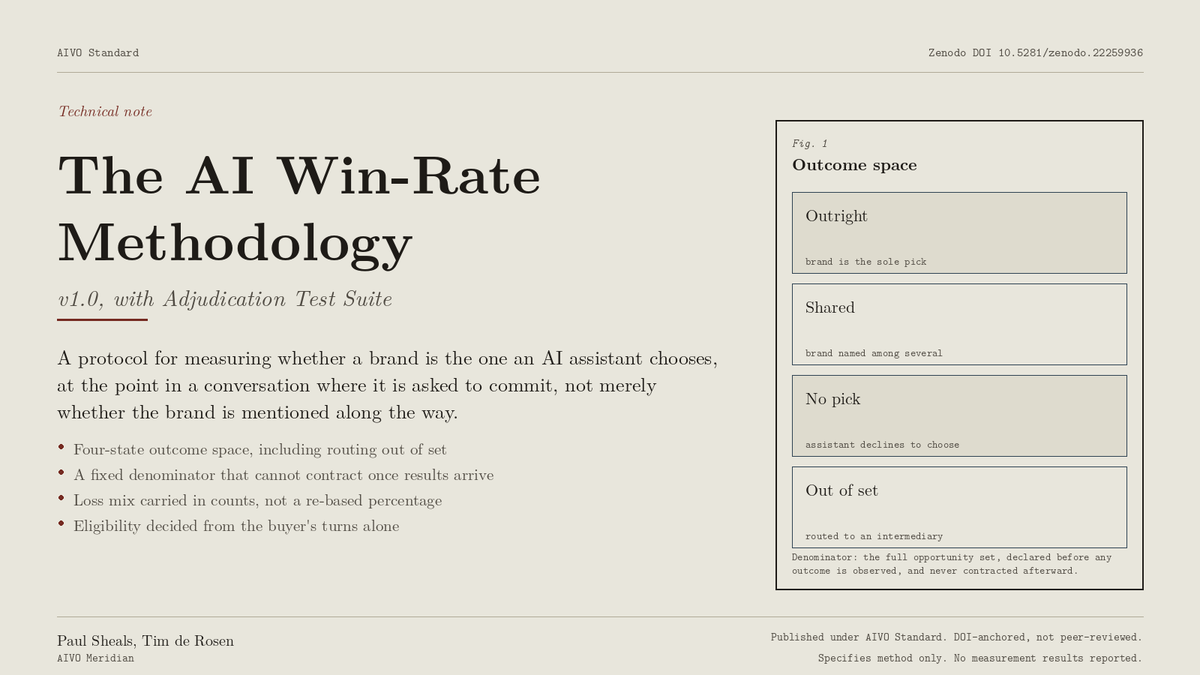
AIVO Meridian has now published a formal methodology for measuring that outcome. "AI Win-Rate: A Board Metric for AI-Mediated Buying (Methodology v1.0)," by Paul Sheals and Tim de Rosen, is out now under DOI 10.5281/zenodo.22280231.
AI Win-Rate measures the proportion of defined decision conversations in which a brand receives the assistant's decisive recommendation. Put plainly, who wins the decision when the conversation reaches a recommendation.
The difficult part is not the formula. It is defining the measurement universe correctly, and the methodology sets out five conditions a valid measurement must satisfy. Among them: the opportunity set, which must be declared before measurement begins and cannot subsequently contract. The definition of a win, which can count even when the assistant reaches a recommendation without being explicitly asked to name a provider. The outcome space, which must distinguish among five possible outcomes, including a result that conventional appearance-based metrics cannot express: the assistant decisively directing the buyer to an intermediary rather than recommending any provider. And the loss mix, which must accompany any published win rate, along with the conditions under which the methodology requires that no win-rate figure be reported at all.
The distinction matters because a brand can be highly visible to AI systems and still lose the decision. It can be cited but not chosen. It can appear in the conversation and disappear from the recommendation. AI Win-Rate measures the outcome, not the appearance.
 Sheals, Paul and de Rosen, Tim
Comments ()