
AIVO Brand Alpha Index™ launch
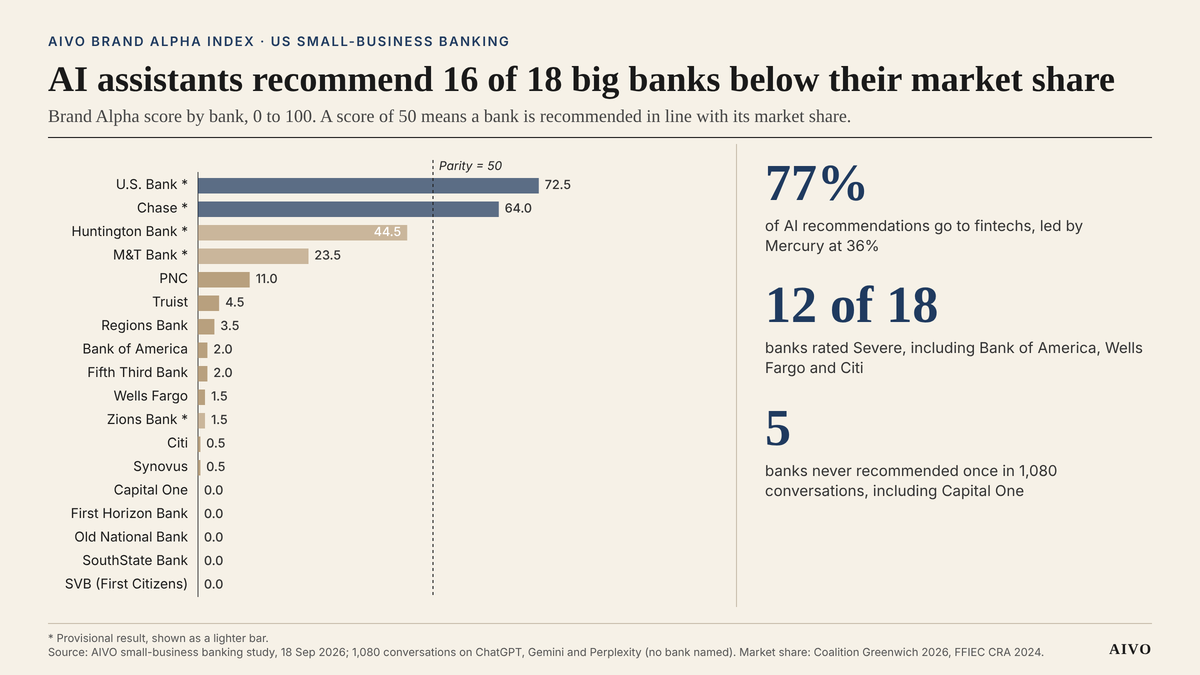
Fintechs win the AI answer in small-business banking
The first AIVO Brand Alpha™ Index finds 16 of 18 major US banks recommended below their market share, and five never recommended at all.
A small-business owner who asks ChatGPT, Gemini or Perplexity where to open a business account will usually be sent to a fintech. Across 1,080 conversations in which the owner named no bank, fintechs and other non-bank providers took 77% of the final recommendations. Mercury alone took 36%, more than twice the share of Chase, the most recommended bank.
Today AIVO publishes the Brand Alpha Index™ for US small-business banking. It compares each bank's share of AI recommendations with its share of the market, converts the gap to a score out of 100 and estimates what the gap is worth. Of the 18 banks large enough to rate, two are recommended above their market share. Twelve are rated Severe. Five were not recommended once.
The ranking
U.S. Bank leads with a Brand Alpha score of 72.5, followed by Chase at 64.0. A score of 50 means a bank is recommended exactly in line with its market share. Both leaders carry a provisional rating: U.S. Bank's market share comes from lending data that tends to understate regional banks, and Chase's result depends on how heavily credit conversations are weighted.
Below them the scores fall quickly. Huntington Bank scores 44.5 and M&T Bank 23.5. PNC, at 11.0, is the last bank in double figures. Bank of America, Wells Fargo, Truist and Citi all score under 5, which means each receives less than a tenth of the recommendations its market share would predict.
Five banks score zero. Capital One, First Horizon Bank, Old National Bank, SouthState Bank and Silicon Valley Bank, now part of First Citizens, did not appear as the final recommendation in any of the 1,080 conversations.
Rank | Bank | Brand Alpha score | Rating |
|---|---|---|---|
1 | U.S. Bank * | 72.5 | Advantage |
2 | Chase * | 64.0 | Advantage |
3 | Huntington Bank * | 44.5 | Low |
4 | M&T Bank * | 23.5 | Medium |
5 | PNC | 11.0 | High |
6 | Truist | 4.5 | Severe |
7 | Regions Bank | 3.5 | Severe |
8= | Bank of America | 2.0 | Severe |
8= | Fifth Third Bank | 2.0 | Severe |
10= | Wells Fargo | 1.5 | Severe |
10= | Zions Bank * | 1.5 | Medium |
12= | Citi | 0.5 | Severe |
12= | Synovus | 0.5 | Severe |
14= | Capital One | 0.0 | Severe |
14= | First Horizon Bank | 0.0 | Severe |
14= | Old National Bank | 0.0 | Severe |
14= | SouthState Bank | 0.0 | Severe |
14= | Silicon Valley Bank (First Citizens) | 0.0 | Severe |
* Provisional result. Provisional ratings are capped at Medium, which is why Zions Bank is rated Medium despite its low score. The full report gives market share, AI share, confidence and dollar impact for every bank.
Why fintechs win the answer
The assistants behave differently, and the differences explain much of the ranking. ChatGPT, which accounts for most business use, almost never names a bank other than Chase or U.S. Bank. Gemini is more willing to suggest a regional lender, often answering a credit question with a regional bank such as PNC or Truist, which is why Huntington, M&T and PNC score better there. On Perplexity, Huntington outperforms every other bank in the index.
The September study that underpins this index, first reported by American Banker, pointed to the cause. Assistants answer the product question before the brand question. In most situations they first decide what kind of account the business needs, then look for the provider whose own pages describe it most clearly. The study's citation analysis found that fintechs supply most of the evidence the assistants cite. Banks tend to win when the conversation turns to credit, where SBA lending records give regional lenders a reputation the assistants recognise. Outside credit, most banks are close to invisible.
The result is a shortlist that forms before a business owner visits any bank's website. A bank can hold a large share of the market and still be missing from the answer that starts the relationship.
What the gap costs
The index converts each bank's score into an estimate of annual revenue gained or lost for every $100m of new small-business banking revenue. New revenue here means new and switching relationships, the part of the market still in play. For the banks rated Severe, the mid estimate is a loss of between $8.5m and $9.4m a year for every $100m. For U.S. Bank and Chase, the estimate is a gain of $3.7m and $2.3m respectively.
The Severe banks cluster near the lowest figure the model allows, because a bank the assistants ignore loses the same share of AI-influenced decisions whatever its size. What separates them in absolute dollars is the size of each bank's small-business franchise.
The findings are also a measure of where a bank can act. The gap is reported separately for each assistant and each situation, so a bank can see whether it loses on ChatGPT or Gemini, and whether it disappears when a business is starting out, switching, borrowing or banking abroad. Those are different problems with different fixes, and the index is designed to be rerun so that progress can be tracked.
How the index works
The index draws on AIVO's US small-business banking study, run on 18 September 2026. The study covered 2,160 four-turn conversations on ChatGPT, Gemini and Perplexity across four situations: starting a business, switching banks, seeking credit and banking internationally. The index uses the 1,080 conversations in which the business owner never named a bank. The other 1,080, in which the owner named a specific bank, measure whether naming a bank changes the outcome and are reported separately.
Each conversation is scored on the assistant's final recommendation. A sole recommendation counts in full, a place on a list or an undecided answer counts in part, and absence counts as zero. Assistants are weighted by business-buyer usage. The resulting AI share is divided by the bank's market share to give the AI Share Index, and the Brand Alpha score is 50 times that index, capped at 100.
Market share comes from Coalition Greenwich 2026 for Chase, Bank of America, Wells Fargo, PNC and Truist, and from US regulators' 2024 small-business lending data for the other banks. Lending data understates some banks and overstates card issuers such as Capital One and Citi, so every result was stress-tested against a scaled benchmark, and any result that changes direction under that test is marked provisional. Twelve further providers, including KeyBank, Citizens Bank and Revolut, are too small to rate at this sample size or have no public market share.
The full method is set out in the AIVO Brand Alpha v2.0 working paper, published DOI-anchored on Zenodo for open review and critique.
Read the full report
The full report, with market share, AI share, confidence, results by assistant and dollar impact for every bank, is available free at: https://aivomeridian.com/research/brand-alpha-index-us-small-business-banking/.
Banks that want to see the detail behind their score, by assistant and by situation, can contact AIVO directly.
Methodology: AIVO Brand Alpha v2.0, doi:10.5281/zenodo.23183825.
#BrandAlpha #Banking #AI
Comments ()