AIVO Journal Note Agentic Drift: The Failure Condition for Delegated Reasoning

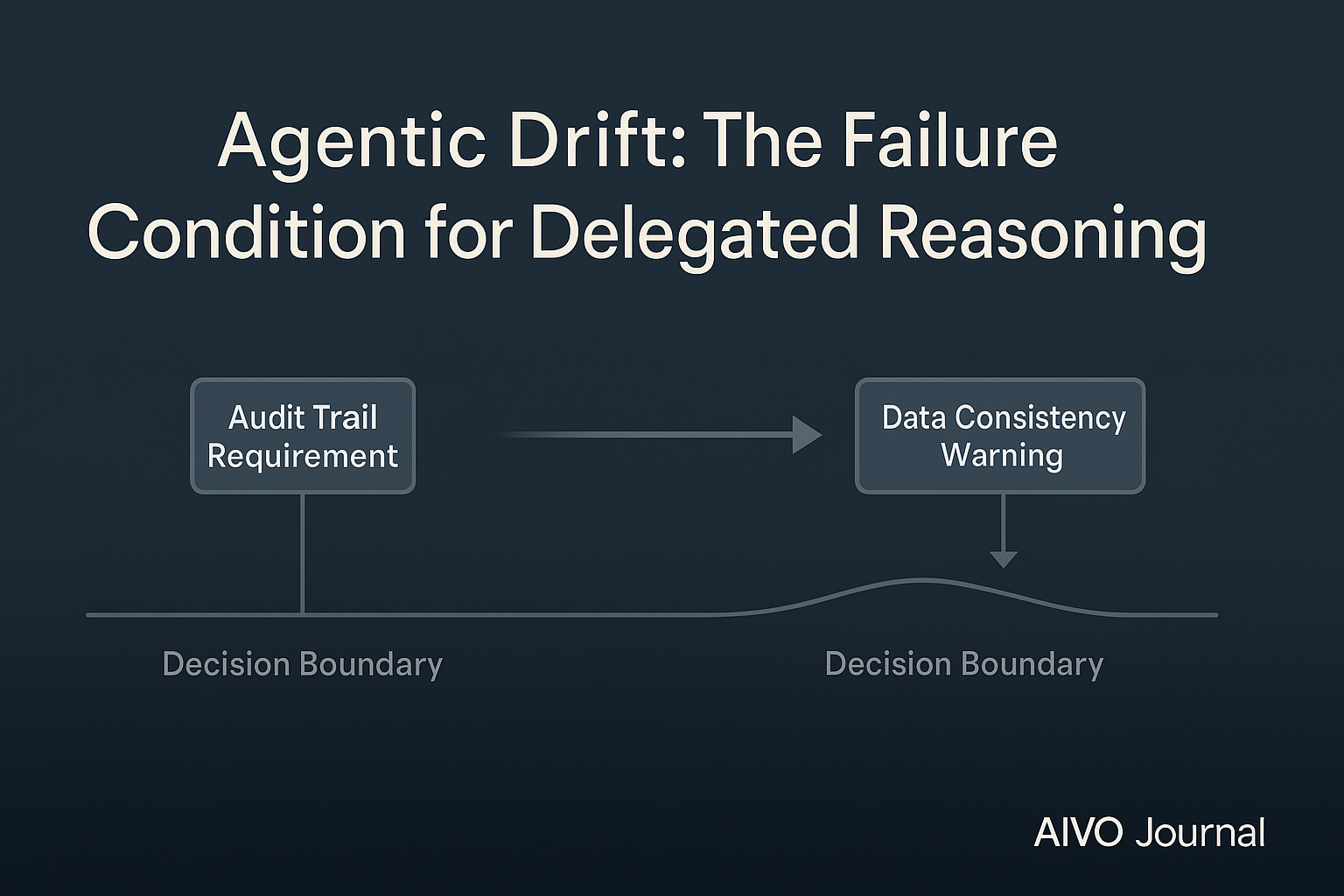
Agentic drift begins the moment an agent produces an output the organisation cannot reproduce, cannot attribute, and cannot trace. The failure condition is straightforward: when the internal plan changes across identical runs, delegated reasoning is no longer governed.
A controlled replication shows this in practice. We ask an agent whether a finance platform fits a mid market organisation. In two consecutive runs a mandatory audit-trail requirement behaves inconsistently. Run One includes it explicitly: “system must maintain a complete audit trail.” Run Two omits it and introduces a new warning: “possible issues with data consistency.” Inputs and policies are identical. One governing criterion changes form. Because criteria should remain invariant under fixed conditions, this flip is the minimal and definitive signal of drift.
The mechanism is simple. Agents convert instructions into latent plans that update as the chain executes. These updates are not recorded. A small shift in the latent plan moves the decision boundary and pushes the reasoning to a different end state without any visible cause.
The evidential consequence is direct. With no reference plan, internal controls cannot determine whether authorised criteria were applied or whether the agent deviated from them. Attribution fails. Once attribution fails reproducibility and traceability collapse. The output no longer qualifies as defensible evidence in any governed workflow.
AIVO detects the boundary breach by testing criterion stability across replicated runs. Criteria define the constraints of a decision, so a shift in criterion form is more probative than changes in tone or sequence. When a required criterion flips without an authorised cause, the reasoning has already left evidential control.
The governance implication follows. If an agent influences spend decisions, suitability judgments, onboarding gates, or risk scoring, then criterion drift compromises the integrity of those decisions. In these environments delegated reasoning requires an external evidential layer. Without it the organisation cannot see the moment the chain crosses the boundary, and decisions taken under drift are exposed.