
AIVO's Forecast: This Will Be the First Holiday Season Decided at the Recommendation Turn, Not the Search Result
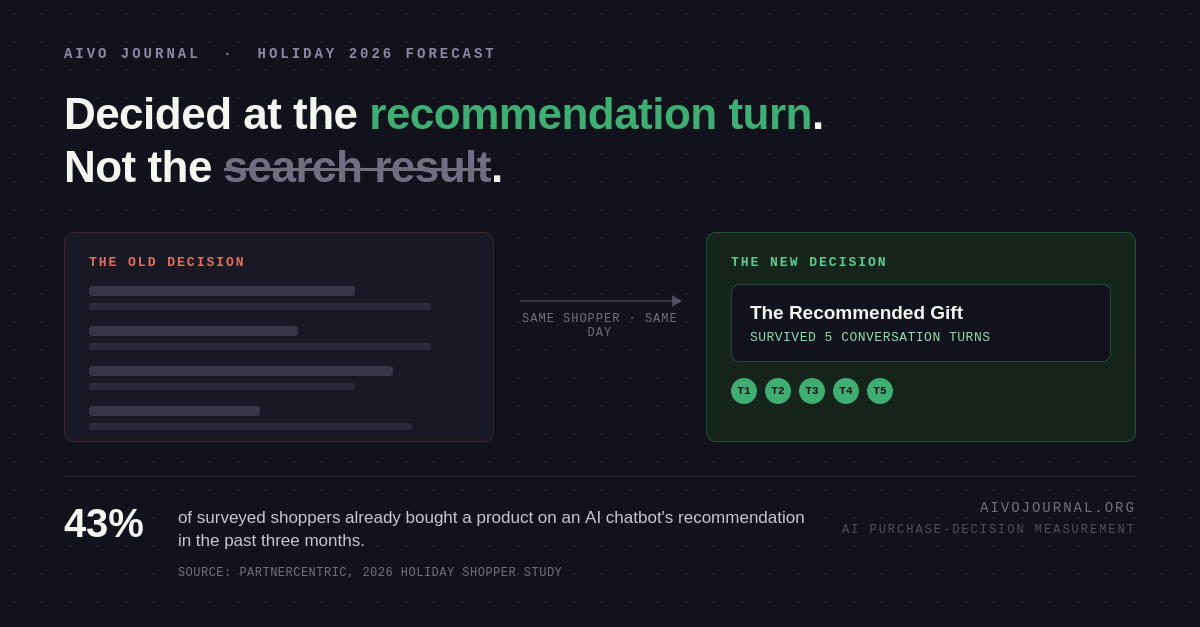
A shopper opens an AI assistant looking for a gift. They do not type a brand name. They describe a person: a sister who likes hiking, a father who is hard to buy for, a budget under fifty dollars. The assistant asks a follow-up question. Then another. By the fourth or fifth exchange, it names one option and moves the conversation toward buying it.
Nowhere in that exchange did a search results page appear. Nowhere did ten blue links compete for a click.
One recommendation survived a multi-turn conversation and became the gift. AIVO's forecast is that this becomes the dominant pattern of the 2026 holiday season, the first one meaningfully decided at the recommendation turn rather than the search result.
The shift is already measurable, not speculative
Independent research published this year gives this forecast real footing. PartnerCentric's 2026 holiday shopper survey found that 43 percent of surveyed shoppers had already bought a product on an AI chatbot's recommendation in the past three months, heading into the exact season this forecast concerns. The same research notes its shopper sample was not quota balanced and its figures are directional rather than projectable to the general population, a caveat worth carrying alongside the number rather than dropping it. Even read conservatively, a meaningful and rising share of shoppers are already completing a purchase this way, and holiday volume tends to accelerate whatever pattern is already forming.
The conversations themselves are not brief. Analyses of large-scale consumer chatbot logs, including WildChat and LMSYS Chat-1M, put general multi-turn conversation share at roughly 40 to 50 percent, with higher-consideration questions, the kind a gift search actually is, trending higher still. A holiday gift recommendation is a textbook high-consideration query: a budget, a recipient, an occasion, and usually several rounds of refinement before an answer is accepted.
Surviving the conversation is a different problem than being findable
This is where AIVO's own findings matter. Across a flagship dataset of more than 12,500 multi-turn probes spanning 68 brands, brands are displaced before the model's final recommendation 87.3 percent of the time. A brand present, named, and favorably described early in a conversation is not the same brand still standing when the model commits to an answer. The NIVEA case published earlier this year is a small, legible version of the same mechanism: cited and chosen when a shopper names the brand directly, entirely absent and replaced by a Korean competitor when the same shopper simply describes what they need.
Holiday shopping is disproportionately built from exactly this kind of unbranded, need-first question.
Nobody asks an AI assistant to compare Sonos and JBL by name for a hard-to-buy-for father. They describe the father. The brand that wins that conversation is not necessarily the one with the strongest search rankings, the most reviews, or the highest brand awareness. It is the one still standing when the model has to name one thing.
What does not change
This forecast is not that checkout moves inside the chat window. Nuvei's 2026 agentic commerce research found that 58 percent of consumers still prefer to complete an AI-assisted purchase on the retailer's own site or app, and 76 percent cite fraud or unauthorized charges as their top concern about letting AI purchase on their behalf, well above concerns about receiving the wrong item.
The recommendation moment and the transaction moment remain separable, and the forecast here concerns only the first: which brand gets named, not how the payment clears. Whether a won recommendation reliably becomes a completed sale is a genuinely open question, one AIVO is continuing to study rather than one this forecast claims to answer.
The measurement implication
If a meaningful share of holiday gift decisions this year are made inside multi-turn AI conversations that most brands have never tested themselves against, the traditional readiness questions, is our SEO strong, are we well reviewed, do we rank, answer a narrower question than the one that will actually decide the sale.
The relevant test is closer to the one this publication has argued for consistently: not whether a brand is mentioned, but whether it survives to the turn where the model actually recommends something.
By January, this forecast will be checkable. Either a large and rising share of this season's gift purchases trace back to an AI recommendation that outlasted a real conversation, or they do not.
This forecast draws on AIVO Standard's DOI-anchored working paper series (WP-2026-14) alongside third-party research from PartnerCentric, WildChat, LMSYS Chat-1M, and Nuvei, cited above. Full probe methodology and corpus data are available on Zenodo.
Comments ()