
An Open Letter to Mike Doustdar: The AI Entity-Resolution Cost of a Name Change
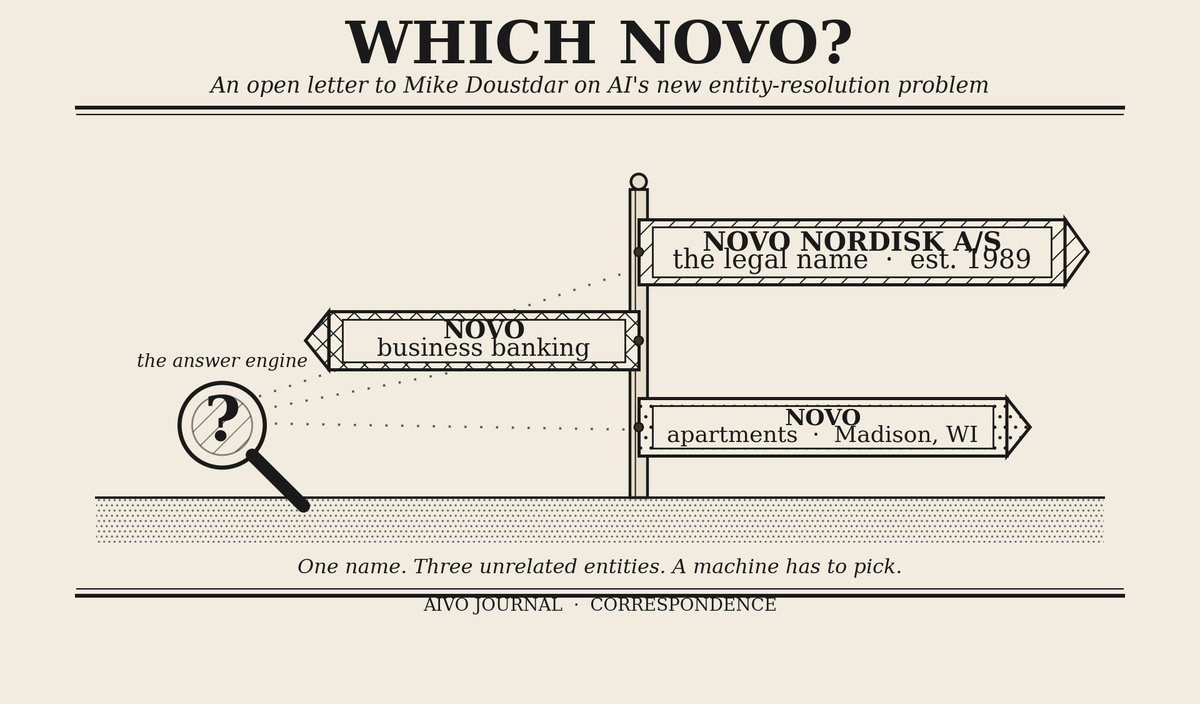
A rebrand that makes perfect sense to humans creates a new entity-resolution problem for machines.
AIVO Journal — Correspondence
By Tim de Rosen, CEO & Co-Founder, AIVO
Dear Mr. Doustdar,
Congratulations on the rebrand. "Lasting Health Starts Now" is a strong line, the refreshed bull logo is a smart piece of continuity, and the strategic logic — a leaner, more consumer-facing identity as you fight to win back ground from Eli Lilly — is sound. I have no quarrel with the brand strategy. I want to flag a measurement problem it creates, one that sits squarely in the category of thing my company exists to track: how AI systems recognize, resolve, and recommend brands.
For a human, the rebrand changes what Novo Nordisk is called. For a machine, it changes what "Novo" means. Search engines, chatbots, and AI answer engines now have to re-resolve who "Novo" is — at the exact moment those systems, not humans, are becoming the primary interface through which patients discover, compare, and choose healthcare products. And you've asked them to do it into a name that was not empty ground.
The entity you're moving into is already occupied
"Novo" is the day-to-day name of a business banking platform with a large existing web footprint. It is also the name of a Wisconsin apartment complex, a restaurant, and assorted smaller brands scattered across local business listings. None of that matters much for a human searcher, who has context, intent, and a results page with ten blue links to sort through. It matters a great deal for a large language model asked a single-shot question like "is Novo safe for diabetes patients" or "what does Novo cost," which has to resolve a bare, ambiguous string to one entity before it can answer at all — and which, unlike a search engine, gives the user one answer, not ten options to sift.
Early monitoring is already showing the kind of contamination this creates. Automated content aggregators — the kind of low-quality pages that increasingly seed AI training and retrieval corpora — are blending your patient-safety messaging ("if it's not made by Novo Nordisk, it's not FDA-approved Wegovy or Ozempic") into the same block of text as banking-app sign-up copy and apartment listings. That is exactly the low-authority, high-volume content layer that retrieval-augmented systems lean on most heavily when the higher-authority signal is thin or new — and it is worth AIVO, and frankly Novo, tracking closely as the transition matures.
Why this differs from a normal rebrand risk
A traditional brand transition is managed through the channels you already control: paid media, PR, retail packaging, sales collateral. AI answer engines are a fourth channel, and they don't work the same way. They don't wait for a press cycle to update; they infer identity from whatever text already exists about a string, weighted by authority and recency, and they can misattribute confidently rather than hedge. The problem is not that "Novo" starts from nothing — decades of citation weight behind "Novo Nordisk" still exist and will eventually anchor the new name too. The problem is that you are trying to transfer a very large, well-established entity onto a short, already-occupied lexical identifier, and asking every machine that has indexed the old one to make that transfer correctly, consistently, and fast.
The commercial stakes are not abstract. Patients are increasingly asking chatbots, not search boxes, "what's the difference between Ozempic and Wegovy" or "is Novo trustworthy." The risk isn't a single dramatic failure — it's the chain from entity confusion, to incorrect attribution, to a subtly wrong or hedged answer, to a small but real loss of confidence at exactly the moment someone is trying to make a healthcare decision. That chain is worth taking seriously even without a single headline-grabbing incident.
What I'd suggest
Treat AI-entity resolution as its own workstream inside the rebrand, not a downstream consequence of the PR rollout. That means deliberately reinforcing the "Novo" ↔ "Novo Nordisk A/S" linkage in every machine-readable surface you control — structured data, Wikipedia and Wikidata entries, your own site's schema markup — and monitoring, not assuming, how the major AI platforms are currently answering basic questions about the new name. The question isn't whether AI systems will eventually learn the new identity — they will. It's how quickly, how consistently, and with how little residual ambiguity they do so. That is a variable you can engineer and measure, not just wait out.
I'd be glad to share what we're finding as we track this.
Respectfully,
Tim de Rosen
CEO & Co-Founder, AIVO
Comments ()