
An Uncomfortable Truth
The Distance Between Them Is the Work
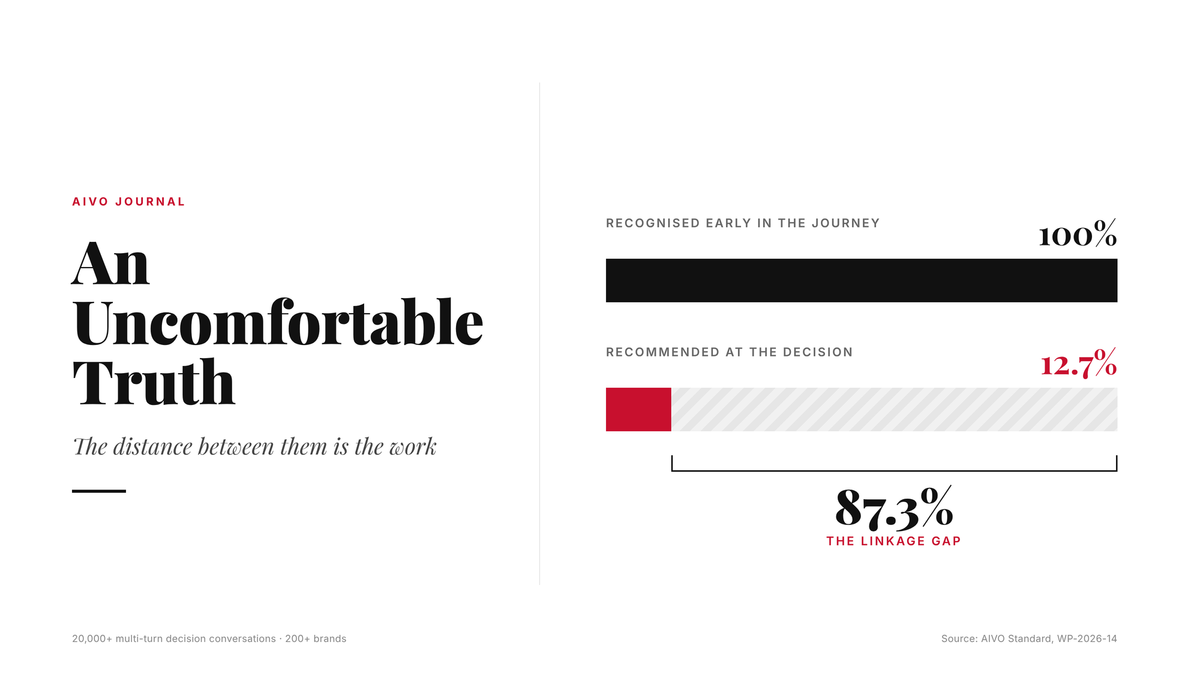
Across more than 25,000 multi-turn decision conversations and 200 brands, AI assistants recognised a brand early in the journey but ultimately recommended it in only 12.7% of those journeys, producing an 87.3% Linkage Gap. Findings like that are hard to hear, harder to pass upward, and frequently at odds with what a company's surveys, trackers and brand valuations say. This article argues that the divergence is a measurement result rather than a contradiction: human and machine instruments read different moments, and the distance between them is a diagnostic signal about the record AI systems choose from.
The messenger problem
When a brand is shown how AI assistants treat it at the moment of decision, curiosity is not always the first reaction. More often, the conversation slows. A meeting is postponed, a reply promises to revert, a sponsor asks for time to think. The pattern is familiar enough to deserve an explanation of its own.
The explanation is structural. The person who commissions a measurement is seldom the person who can act on it, so a difficult result has to be carried upward through people who did not ask for it. Each handover is a point at which silence looks safer than escalation. A finding that a brand loses at the decision can read as a verdict on whoever owns its reputation, its content or its search programme, and the instinct of anyone whose work is implicated is to protect it.
There is also no obvious place to put the news. A falling share price has a board paper, a failed product launch has a post-mortem. A finding that machines describe the company accurately and still choose a competitor has no owner, no budget line and no established remedy. Results without a home get parked, and parked results are the most expensive kind, because the behaviour they describe continues while the paper waits.
Why the results feel wrong
There is a natural intuition that being well known and being chosen travel together. In AI-mediated decisions they frequently part company. An assistant can name a brand unprompted in the opening turn of a conversation, describe it accurately, praise its integrity, and then recommend someone else when asked to decide. Visibility is measured at the start of the conversation and the outcome is decided at the end, and a great deal happens in between.
The first thing that happens is category fit. Assistants answer the question as it is framed. When the framing closely matches what a brand sells, category fit can give it an early advantage. When the same brand is assessed against a question that describes a competitor's product, it may instead be reclassified as a specialist that belongs on the list rather than at its head. A company can therefore be dominant with one audience and marginal with another while its reputation for quality is identical across both.
The second is the objection. Over several turns, the assistant's initial answer is exposed to new criteria and objections. A single recurring objection, a perceived conflict of interest or a narrow product range, can be enough to change the recommendation. Those arguments may be difficult to surface in a company's own research, particularly when research is structured around awareness, consideration or stated preference. Yet they may be prominent in the text the models have read.
The third is timing. Information introduced late in a conversation does not necessarily have the same influence as information already incorporated into the assistant's working context. A company can therefore publish the right evidence and still find that it has little effect on a decision already taking shape. The persistence of what models hold is striking: a car rental service that ceased trading in 2024 can still be recommended above live competitors, because the information available to the models has not caught up with the market.
Why AI findings and analog findings disagree
Traditional brand measurement was built to read human memory. Awareness studies ask what comes to mind, consideration studies ask what would be shortlisted, reputation surveys ask how a company is regarded, and brand valuations convert those signals and financial performance into a number. All of them measure the residue that advertising, experience and word of mouth leave in people. They are good at it, and decades of evidence connect those readings to sales.
An AI assistant operates on a different information base. It draws on what is available in its context and, where applicable, retrieved information, compares options against the question it has been given, and produces a recommendation. The inputs that move human memory, such as media weight, distinctive assets and emotional association, have no direct route into that reasoning. The signals available to the machine, such as how third parties describe a company, which credentials are attached to its name and which objections circulate about it, are largely invisible to a survey.
The two methods therefore measure different moments with different instruments. A brand can score strongly on human trust and weakly on machine recommendation for the same audience, and both readings can be correct. Where the readings diverge, the gap becomes a question about the record available to AI systems: how the brand is described, which credentials are associated with it, which objections recur and how those signals interact with the decision context. Whether established empirical regularities of brand behaviour hold in machine recommendation is an open research question, and one AIVO Standard is now testing directly.
It follows that a company should expect its AI results to contradict its trackers in places. A brand that has invested heavily in awareness may find that investment has little purchase on the decision turn. A smaller competitor with clearer category language and better-documented credentials may be recommended above it. None of this means the tracker was wrong. It means the tracker was never designed to see this channel.
Divergence as a diagnostic signal
The argument so far has three parts. Human measurement establishes what people believe about a brand. Machine measurement establishes what happens when an AI system has to choose. Read together, the divergence between them becomes a diagnostic signal, because it tells you to look for where the record available to the machine departs from the reputation the brand holds with people. Multi-turn diagnostic work is how those places are then found.
The most useful findings sit where the two methods disagree. If people trust a company and machines do too, there may be little to act on in the divergence itself. If people trust it and machines still choose a competitor, the divergence creates a tractable diagnostic question: what does the machine-readable record say about the brand when it has to choose? The answers are often concrete, such as a missing credential, a dated description or a category label that places the brand in the wrong comparison set.
One recent AIVO baseline illustrates the point without needing names. A research firm with an excellent human reputation was named unprompted by assistants in most conversations, and its integrity was never questioned. It still lost the recommendation to larger competitors with institutional and regulatory audiences. The diagnostic question had a visible answer in the sources: its regulated businesses, the assets most relevant to those audiences, were almost absent from what the assistants read, while competitors' equivalent businesses were cited routinely. A survey would have recorded strong trust and missed the loss entirely.
For this reason AIVO correlates every engagement against a traditional measurement counterpart where one exists. The analog reading establishes what people believe. The machine reading establishes what the record says when an assistant has to choose. That distance is the work.
Treating the finding as evidence
If the divergence is evidence, the task is to keep it from being read as blame long enough for the diagnostic question to be answered. The first discipline is to separate the finding from the fault. A brand that loses at the decision turn has usually done nothing wrong by the standards it was managed against. The record the machines read was never anyone's job, so a weak result describes an unowned channel and should be presented that way to the people who will be asked to respond.
The second is to pair every problem with the specific thing that would change it. A gap that names the missing credential, the misleading description or the unanswered objection gives a sponsor something to take upward that sounds like progress. A sponsor who can say the company has found a gap it can close has something concrete to escalate; a sponsor who can only report that the company is behind has much less to take upward.
The third is to hear the result before reading it. Difficult findings land better in a conversation, where the recipient can ask questions and form a view, than in a document that arrives with no one to explain it. A short summary the sponsor can forward in their own name does more for adoption than the full report.
The last is to look for the person inside the organisation who gains from the news. In most companies someone is already arguing for the change the data supports, and an undersold business unit is rarely sorry to learn it has been undersold. Bad news finds a home fastest when it is handed to the person who has been waiting for it.
Conclusion
For decisions that enter an AI conversation, the assistant becomes a reader of the brand before the buyer makes the choice, and it reads a brand differently from the people its measurement was built to understand. That difference will produce results that are counter-intuitive, that contradict long-trusted trackers and that are uncomfortable to deliver. Those qualities are not evidence that the measurement is wrong. They may be evidence that it is seeing something the established instruments were not designed to capture.
The companies that benefit will be the ones that treat an awkward result as a map. The companies that leave the finding unresolved leave the underlying record unchanged, while AI systems continue making decisions from it.
AIVO Journal articles are editorial. Supporting methodology is published as DOI-anchored working papers under AIVO Standard on Zenodo; these are not peer-reviewed.
Comments ()