
Being Mentioned Is Not the Same as Making the Sale

The missing measurement between AI visibility and a suitable, profitable purchase
A brand can appear in an AI answer, provide the source the answer cites, and still lose the sale.
That should be an uncomfortable starting point for any business buying generative engine optimization, or GEO. A rising share of mentions in a test set may show that a brand is becoming easier to find. It does not show that a customer is becoming more likely to choose it.
Before commissioning another visibility program, brands should ask two questions. How much of that visibility would their existing communications have produced anyway? And what happens when the conversation moves from naming options to deciding which one to buy?
The communications brands already pay for
AI systems draw on an information environment brands have spent years shaping: journalism, independent reviews, research, product pages and other published material.
A 2025 preprint by Chen and colleagues compared source patterns across ChatGPT, Perplexity, Gemini and Claude, classifying cited sources as brand-owned, earned or social. It found greater reliance on earned sources, though results varied by engine and query.[1] That concerns which sources answers draw on, not what drives purchases. But it does suggest that good PR and independent coverage already feed the material AI uses. What it cannot tell a brand is how much of its own visibility comes from that work, or what a separate GEO program adds.
Google is clearer on the technical question. It says appearing in AI Overviews and AI Mode requires no additional technical requirements or special optimizations beyond the established foundations of Search.[2] That applies to Google rather than every assistant, but it challenges the idea that every brand needs a separate technical program simply because answers are now generated.
GEO is a label covering very different work: technical accessibility, PR, content publication, product-feed fixes and answer monitoring. Each should be judged against its own task. Monitoring identifies a problem; it does not fix it. A product-feed correction is useful whatever an agency calls it. Some work sold as GEO is good publishing, PR or SEO under a new name. That doesn't make it worthless, but it does make the extra fees, and the claims of extra value, worth examining.
Define what the metric establishes
Visibility asks whether the brand appears. Commercial effectiveness asks whether its appearance changes the buying outcome. The two are related, not interchangeable.
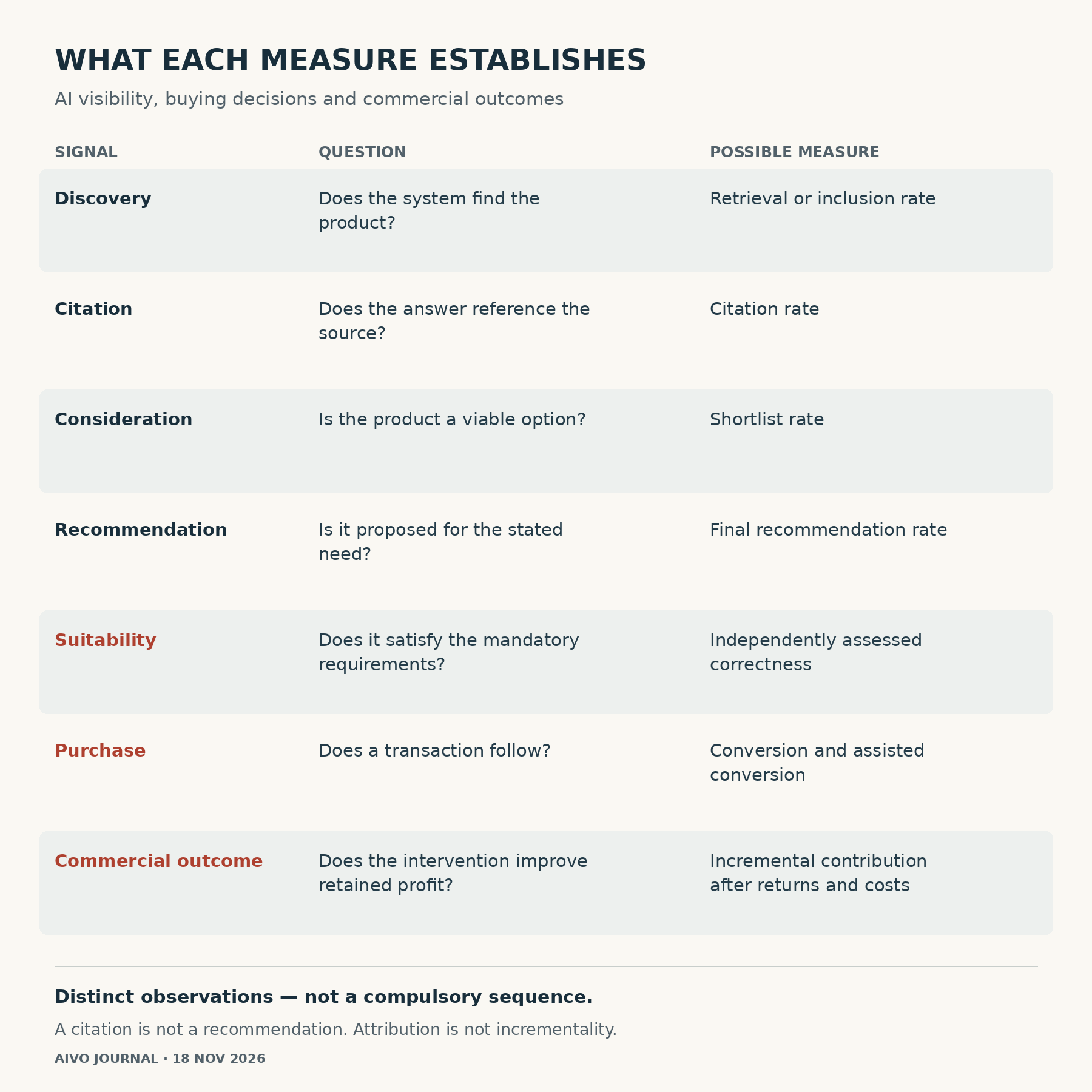
Seven distinct observations, not a compulsory sequence. Visibility does not establish recommendation, suitability or incremental profit.
These are distinct observations, not a compulsory sequence. A product can be recommended without a citation. A citation may credit a brand's research while the answer recommends a competitor. A mention may place a company among ten alternatives. A recommendation may vanish the moment the customer adds a requirement the product can't meet.
Discovery still matters: a brand that never enters consideration never gets to compete. But success at that stage cannot stand in for success through the decision. OpenAI's own shopping documentation describes product selection as weighing the user's intent and context, product information and third-party content, with the weighting shifting as requirements change.[3] A familiar brand still has to pass a specific test: is this the right choice for this buyer?
In one AIVO US small-business banking test, Chase appeared in 262 of 270 buying conversations but received no final recommendations. Under those tested conditions, near-universal presence did not translate into being chosen. This was a scripted study, not observed customer purchasing; it does not establish that Chase is generally unsuitable. It illustrates what a visibility report alone cannot establish.
Where the sale becomes uncertain
Consider a shopper looking for a leather work bag. The first question produces a shortlist of well-known brands. Reviews, editorial coverage and a clear product page all help a bag get there.
Then the shopper adds: "It needs to hold my 14-inch laptop inside its protective sleeve."
Now the decision needs different evidence. "Fits a 14-inch laptop" does not establish that it fits that laptop in that sleeve. The relevant facts are the sleeve's external dimensions, the bag's usable interior and the width of its opening.
More mentions do not resolve a missing measurement. More authority does not establish compatibility. The useful response may be a follow-up question, and if the measurement isn't available, the honest answer is that fit can't yet be confirmed.
These moments of uncertainty are where brands should look. They reveal the difference between being easy to discover and being possible to recommend with confidence.
When visibility spending becomes dangerous
The strongest criticism of visibility-led GEO is about management decisions. If mentions are accepted as evidence of commercial progress, a business can keep spending while the real obstacle to purchase stays untouched. Reports improve. Buyers still can't establish whether the product meets their needs.
There is also an attribution problem. A visibility gain after a GEO engagement might reflect new press coverage, better reviews, routine website improvements or a change in the AI system itself. A before-and-after chart cannot separate those explanations.
And optimization can distort what gets published. Producing more generic pages to cover more prompts can consume resources better spent documenting the facts that distinguish the product and determine its suitability.
The danger is false confidence: mistaking an improving intermediate metric for an improving business.
GEO still has to earn its return
Deliberate content changes can influence AI visibility. The original GEO paper, accepted at KDD 2024, reported visibility gains of up to 40% in its experimental setting, varying by domain.[4] That deserves recognition. It does not establish an equivalent increase in recommendations, purchases or profit.
A useful program diagnoses before it prescribes. Is the brand absent from consideration? Is information inaccurate? Is a deciding fact missing? Does the product fail a requirement? Is there a purchase obstacle? Each calls for a different response, and publishing more content cannot repair all of them.
What a better evaluation looks like
A realistic brief is not necessarily a common one. Build the test set from evidence of actual buying needs, using customer enquiries, search data, sales conversations and other relevant sources. Report how scenarios were selected and, where credible frequency estimates exist, weight them accordingly. Keep uncommon but consequential suitability failures visible separately. Otherwise, an aggregate score can reflect the researcher's choice of questions more than the business's exposure.
Define correctness before the test runs. A correct recommendation meets the buyer's stated mandatory requirements using verifiable facts. If several options qualify, allow more than one right answer. A merchant's preference to sell a product is not a suitability criterion.
When a deciding detail is missing, a targeted follow-up question is the right intermediate response. An unsupported "yes" is a failure. When nothing qualifies, a justified refusal is correct. Record these separately, so no system can improve its score simply by declining everything.
Build the reference assessment from current specifications and policies, using qualified reviewers or explicit rules, with independent review of disputed cases and assessors blind to the test condition where practical. Date and version source records, assign ownership for updates, and withdraw claims when their evidence expires.
Compare the intervention against a contemporaneous baseline: same briefs, comparable agent access, repeated runs, aligned models and conditions. Report sample sizes, exclusions and uncertainty. Where practical, include an improved-product-page condition to test whether assistance adds value beyond ordinary information repair.
Size the test to expected traffic and a commercially meaningful effect rather than a fixed number of days, then allow for the return or cancellation window. Track suitability errors alongside purchases.
Finally, separate connection from causation. A reference linking an assisted session to an order shows a connection. Incrementality needs a comparison, through randomized availability or another defensible controlled design. And profit must net out discounts, returns, refunds, fulfillment, support and the cost of the intervention.
How AIVO approaches the gap
AIVO builds products intended to improve AI buying decisions, so we have a commercial interest in this argument. The standard above applies to our products as much as to GEO.
Meridian identifies the decision-critical questions in tested buying conversations. Assist answers visiting agents from approved facts, supplies sources, asks for missing details and can decline an unsuitable request.[5]
In 335 controlled sessions on realistic test websites, the right business was chosen in 157 of 168 sessions with Assist, against 79 of 167 without: roughly 93% versus 47%. AIVO built and ran the test agents, so these are company-reported selection results in a controlled setting. They are not merchant conversion results, and not a comparison against a GEO program. A separate attribution test credited all 14 sessions that consulted the expert and then booked, with zero false credits. That demonstrates correct attribution in those tested sessions; it does not show incremental bookings.[5] Merchant-customer outcomes are pending.
The evidence justifies further testing of decision assistance. The next question is whether the improvement holds with merchants' own customers and produces more suitable, profitable purchases against a proper baseline.
Ask what changes the choice
Brands should keep investing in reputation, credible coverage and useful information, and in understanding how AI systems discover and interpret it. But a separate GEO budget needs a clear account of what it adds and why that matters commercially.
Before renewing a visibility-led program, identify the questions that decide the purchase. Check whether your product information answers them. Test whether recommendations are correct, including when the right answer is a question or a refusal. Then compare suitable purchases and profit against a credible baseline.
Visibility can have value before a sale, in awareness and future consideration. But visibility alone cannot demonstrate its contribution to sales, or show that a particular intervention deserves the credit.
The commercial question is not how often AI mentions your brand. It is what happens when a customer asks whether they should buy it.
Want to see how your brand performs on that question? We’ll test one category and show where your brand enters consideration, where it loses the recommendation, and which evidence gaps warrant investigation.
Sources
- Chen et al., Generative Engine Optimization: How to Dominate AI Search (2025), research preprint. https://arxiv.org/abs/2509.08919
- Google Search Central, AI features and your website. https://developers.google.com/search/docs/appearance/ai-features
- OpenAI, Shopping with ChatGPT Search. https://help.openai.com/en/articles/11128490-shopping-with-chatgpt-search
- Aggarwal et al., GEO: Generative Engine Optimization, KDD 2024. https://arxiv.org/abs/2311.09735
- AIVO, AIVO Assist: product description and deployment information. https://aivocorp.com/assist
Sources accessed 18 November 2026.
Comments ()