
Beyond The First-Prompt
A brand can appear in the first response of an AI reasoning chain and still lose the sale. This is the finding that keeps surprising the marketing and communications teams we talk to. It is worth explaining clearly, because it redefines what "AI visibility" must mean for any brand operating in a world where consumers rely on AI systems to make decisions.
Most tools built for this category measure whether a brand is cited. A model is asked a question, the brand's name appears somewhere in the answer, and that appearance gets logged as a win. This is a reasonable place to start. It is not where the story ends.
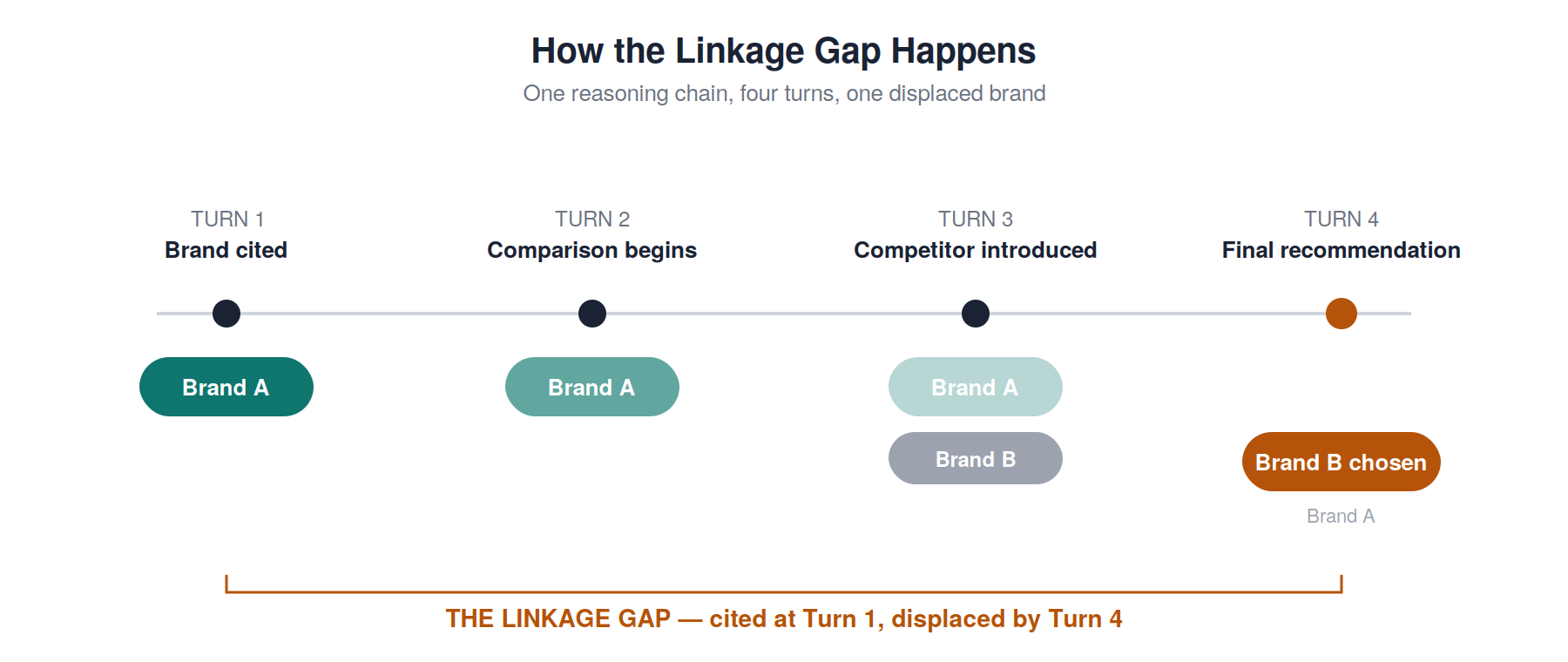
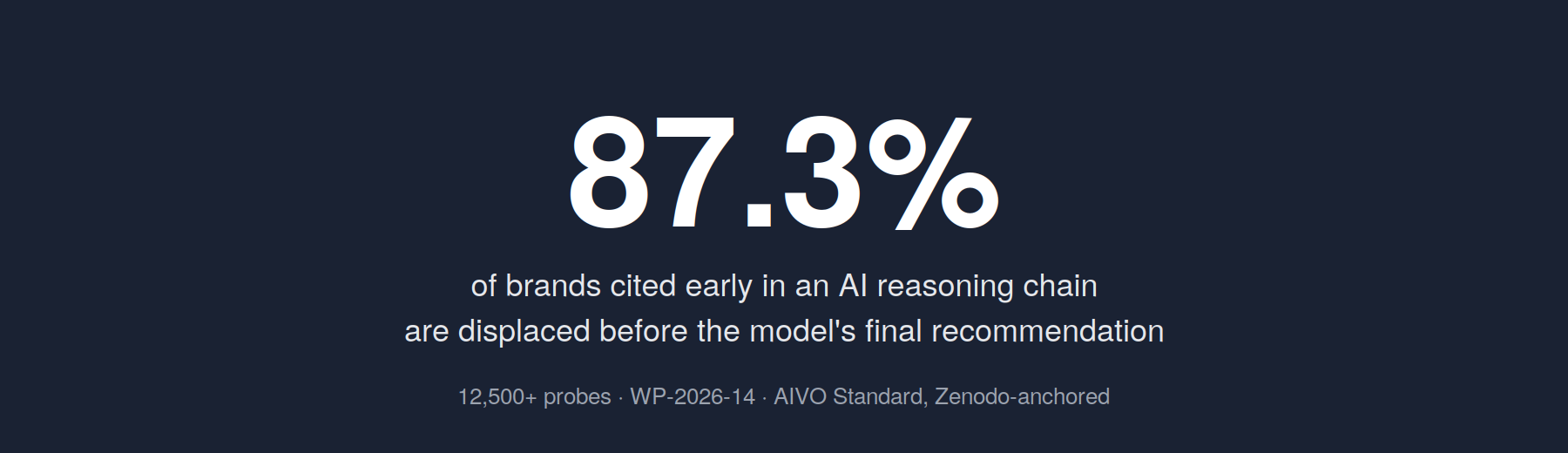
Across more than 12,500 probes documented in WP-2026-14, AIVO found that 87.3% of brands that were cited early in a reasoning chain were displaced by a competitor before the model reached its final recommendation. The brand was mentioned. It was not chosen. We call this the Linkage Gap, and it is the single most important thing a brand can know about its position in AI-mediated decisions.
The reason this happens is structural, not incidental. Large language models do not answer questions in one step when the question involves a real decision. A user asking about a product, a policy position, a company's handling of a controversy, or a new launch is rarely satisfied by a single response. The conversation continues. The model revises its position as it reasons through tradeoffs, incorporates new information the user supplies, and narrows toward a final answer.
Reputation, in particular, is almost never resolved in a single turn. A model's view of how a company handled a product recall, a leadership change, or a policy controversy tends to shift and sharpen over the course of a conversation, the same way a journalist's understanding of a story develops through follow-up questions rather than a single quote.
This is why multi-turn measurement is not an enhancement to first-prompt visibility. It is a different object of study. A tool that stops measuring after the first response is describing the opening move of a conversation that, in the cases that matter most to a brand's revenue and reputation, has not yet been decided. Measuring only the first turn is a bit like judging a negotiation by the opening offer.
This distinction matters when a brand is already working with a tool that reports on citation and sentiment. Those signals tell a brand whether it entered the room and how it was described the moment it walked in. They do not tell a brand whether it closed the deal.
A brand can have strong sentiment at first mention and still be the one dropped by the third or fourth turn, once the model has reasoned through alternatives. Citation and sentiment describe the opening move. The Linkage Gap describes whether the brand survived to the turn where the model actually commits, and that is what determines whether it gets chosen.
The Linkage Gap is not an inevitable tax on AI visibility. It is a specific, findable pattern in specific reasoning chains, and it can be remediated. AIVO's Meridian architecture identifies the Displacement Initiation Turn, the exact point in a reasoning chain where a brand begins losing ground to a competitor. Once that turn is identified, a brand's messaging, evidence, and public content can be evaluated against what the model was actually weighing at that moment, and adjusted to close the gap.
This is the beginning of what we consider closing the loop: moving from diagnosis of where a brand loses to attribution of why, and from attribution to a defined remediation path.
Knowing a brand was mentioned is a diagnostic baseline. Knowing where it was lost and how to fix it is what determines outcomes.
Comments ()