Brand Safety Has Moved Upstream of Media

Why AI explanations now shape trust before ads, articles, or owned channels appear
The brand safety model most teams still operate under
For the past two decades, brand safety meant controlling adjacency.
Was our ad placed next to inappropriate content?
Did our brand appear alongside misinformation?
Were we associated with publishers or creators that created reputational risk?
This model assumed three things:
- Media intermediaries existed
- Placement could be audited
- Exposure left a durable trace
Those assumptions are no longer reliable.
AI assistants now mediate how people understand brands before any media surface is reached.
The upstream shift most brand frameworks miss
When a consumer, investor, job candidate, or partner asks an AI assistant:
“What does this company actually do?”
“Is this brand trustworthy?”
“Why is this firm in the news?”
The response they receive often precedes:
- Visiting a website
- Seeing an ad
- Reading coverage
- Engaging with owned channels
This is not a media placement problem.
It is an explanatory layer problem.
Brand perception is being shaped upstream of media, in a space where:
- There is no placement
- There is no publisher
- There is no persistent artifact
Why this breaks traditional brand safety logic
Classic brand safety controls work by managing context. AI explanations collapse context.
They compress:
- Corporate history
- Ongoing controversies
- Strategic intent
- Reputation signals
Into a short, authoritative narrative.
That narrative reflects choices about emphasis, omission, and framing. Those choices vary by model, prompt, and time. Even when they are reasonable, they are not stable.
The result is a brand surface that influences perception early, feels authoritative, and cannot be audited after the fact.
A simple but revealing comparison
| Scenario | Traditional misleading article | AI explanation drift or misrepresentation |
|---|---|---|
| Retrievability | Source identifiable and quoteable | Phrasing ephemeral and irreproducible |
| Remediation | Correction request with evidence | Inference-only response |
| Impact bounding | Reach and sentiment measurable | Pre-exposure, hard to quantify |
The absence of a record changes the governance posture entirely.
Why sentiment and SEO are insufficient proxies
Organizations often reach for familiar instruments:
- Sentiment tracking
- Search visibility
- Share of voice
These tools measure downstream effects. They do not capture upstream explanation.
An AI assistant can shape understanding without generating clicks, posts, mentions, or measurable sentiment signals. By the time a signal appears, the explanatory moment has already passed.
This is why brand teams increasingly feel blindsided. The shift is not one of intensity, but of sequence.
The real risk is narrative drift, not narrative attack
Much discussion frames AI risk in adversarial terms: hallucinations, misinformation, or attacks.
In practice, the more common failure mode is drift.
Over time, AI explanations can:
- Overweight outdated issues
- Undervalue recent corrective action
- Flatten nuance into generalization
This does not require malice or error. It is a natural consequence of probabilistic synthesis without memory or accountability.
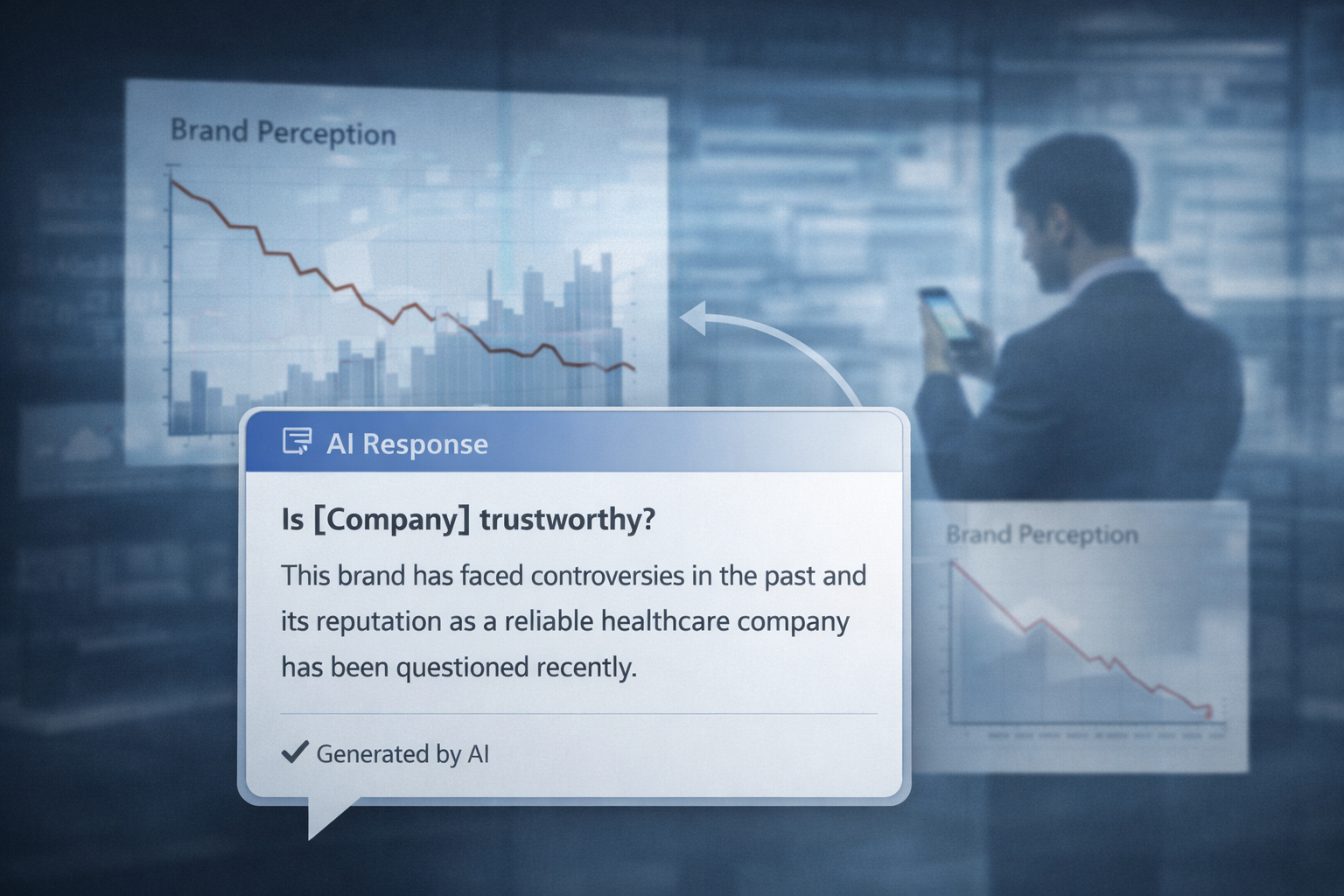
Documented patterns in 2025 showed brands experiencing subtle perception shifts in LLMs after transient news cycles. In one health category case, AI descriptions drifted from “reliable” to “controversial” during a short misinformation wave, followed by a material drop in AI-driven recommendations, despite no change in underlying facts.
Similar persistence has been observed for large consumer brands where resolved controversies continue to surface in AI summaries months later. Coverage of Southwest Airlines in 2025–2026 highlighted how generative systems recirculated earlier disruption narratives well after operational recovery, reshaping first impressions without new reporting.
Variability enables adaptive, contextually relevant explanations in many queries. Unchecked drift, however, compounds outdated or flattened narratives over time.
Where AIVO fits in the brand safety stack
AIVO does not sit where brand safety tools traditionally live.
It does not:
- Block placement
- Suppress narratives
- Optimize messaging
- Influence AI outputs
Instead, it introduces a missing layer: explanatory observability.
By preserving time-stamped, reproducible records of how AI systems describe a company in response to defined questions, AIVO allows teams to see:
- How explanations change over time
- When emphasis shifts
- Where omissions emerge
This transforms brand safety from reactive interpretation to procedural awareness.
What changes when explanation becomes observable
Once AI explanations are observable:
- Brand teams can distinguish normal variation from meaningful drift
- Corporate Affairs can brief leadership with evidence rather than inference
- Decisions about engagement, correction, or escalation regain grounding
This does not require intervening in how AI systems operate. It restores visibility, not control.
The implication for brand and Corporate Affairs leaders
Brand safety no longer begins at the point of media exposure.
It begins at the point of explanation.
Organizations that continue to treat AI assistants as peripheral channels will struggle to understand how their brands are framed in the moments that shape trust most.
This is not about chasing every answer an AI produces.
It is about recognizing that explanation itself has become a brand surface.
Brand surfaces that cannot be observed cannot be governed.
If AI systems are shaping how your organization is explained, the first governance question is not what should be said next, but what was already said.
AIVO exists to make AI-generated representations observable, time-stamped, and reconstructible when scrutiny arises.
Learn how explanatory observability changes corporate communications, crisis readiness, and brand governance.