
Case Study: The Best-Read Site in Its Category Was Chosen 4 Times in 15
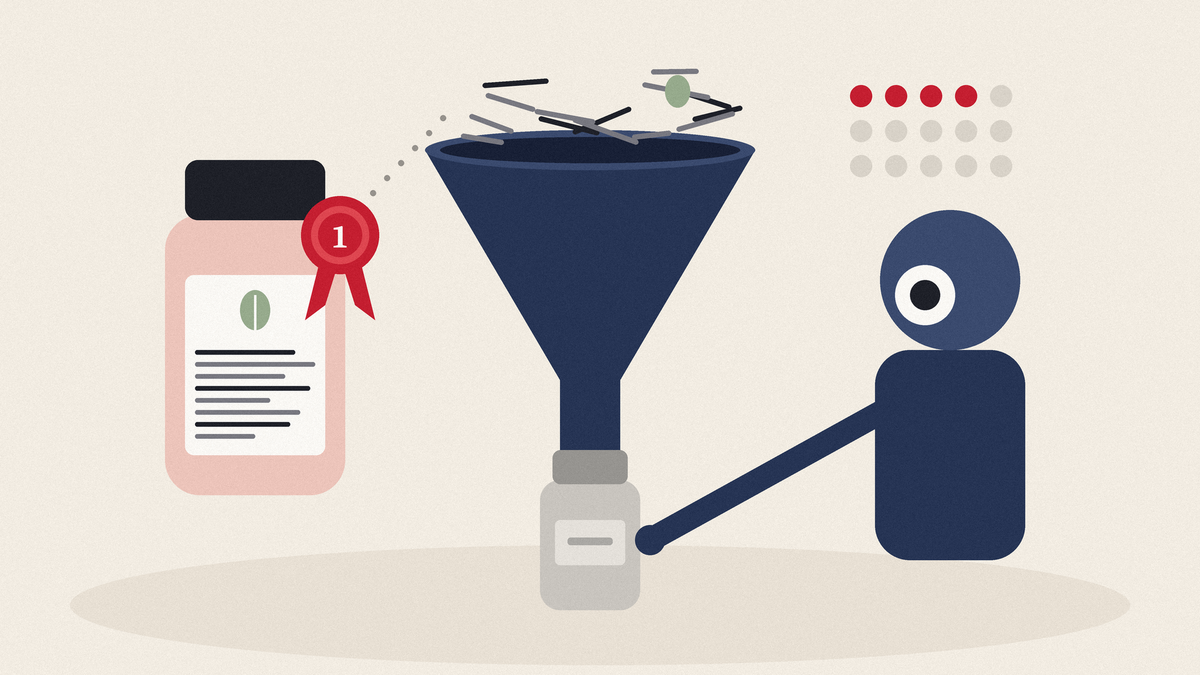
We compared four natural skincare brands on how well AI agents like Muse and Dots read their websites. One, a UK brand known for products suited to sensitive skin, clearly led. An AI agent found and correctly stated 80% of its key buying facts, against 57%, 50% and 40% for its three competitors. Yet when ChatGPT, Gemini and Perplexity were asked to recommend a brand to a typical buyer, they chose it in only 4 of 15 conversations.
The lesson is uncomfortable. Being easy for AI to read and being easy for AI to choose are different things, and they need to be measured separately. We call the first AI readability: how much of what decides a purchase an agent can find and state correctly. We call the second AI choice: how often an agent acting for a buyer actually picks the brand. A website can score highly on the first and still lose on the second.
For twenty years, brands have optimized their websites for people. The next decade belongs to agents that read on people's behalf and then make the decision. This case study shows what that difference looks like in practice, and why even an excellent website is no longer enough.
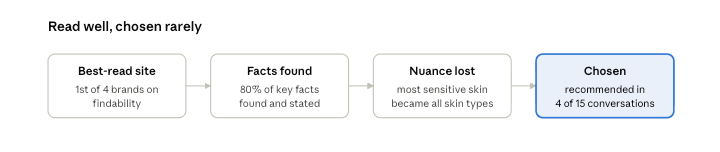
The site led on readability, the agent kept most of its facts, the differentiator was smoothed away, and the brand was chosen in a minority of conversations.
What we tested and how
On 2 November 2026 we ran AIVO Agent Analyzer on the brand's main website and on the sites of three competing natural skincare brands. The analyzer reads each site the way different AI agents read it: as a crawler that fetches the raw page, as a browsing agent, as a reader-view copy, as an agent that takes only the first section, as one that sees only the first screen, and as a search result.
From each site we took up to 30 facts that matter to a buying decision, such as prices, product suitability, terms and evidence, keeping only facts stated word for word on the page. Each fact became a question a shopping agent would ask, and an AI agent answered it using only the pages it landed on. We then compared its answers with what the site says. Separately, ChatGPT, Gemini and Perplexity were each given the same buyer request five times, researching the live web as they do for real users, and we recorded whether they recommended the brand.
Finding 1: the best-read site in its category
The brand's site led all three competitors on findability, the share of key facts an agent found and stated correctly on the pages where it landed.
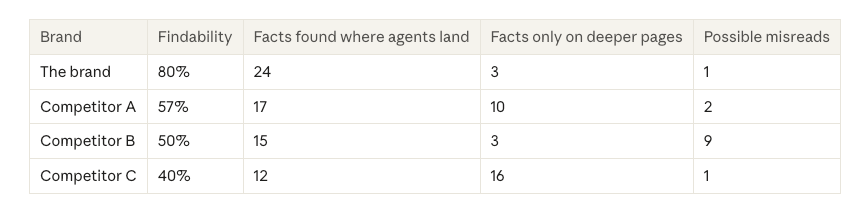
The gap comes largely from where facts sit. The brand puts most of what a buyer needs on the pages agents reach first, including clear answers to common questions. Competitor C has more than half its key facts on deeper pages that an agent landing elsewhere never reads, and Competitor B's pages produced nine answers that differed from what its site says.
Finding 2: the sensitive-skin message, lost in one reading
Only one of the brand's facts was misread, and it was the one that matters most. Asked what kind of exfoliating product the brand features and which skin type it suits, the agent concluded it was designed for all skin types. The site says it is gentle enough to brighten and smooth even the most sensitive skin.
Strictly, the agent was not wrong: a product for the most sensitive skin is suitable for most skin. That is precisely the problem. AI agents rarely invent facts. Far more often they compress them. The specific becomes the general, and the differentiator becomes a description of the whole category.
Compression is commercially dangerous because brands compete on exactly those details. A buyer with reactive skin, or an agent briefed on that buyer's behalf, needs the specific promise. The general version reads like every other exfoliator on the market and removes the reason to choose this one. A website can be read accurately in every sense a checker would recognise and still lose the one fact that would have won the sale.
Finding 3: prices some agents cannot see
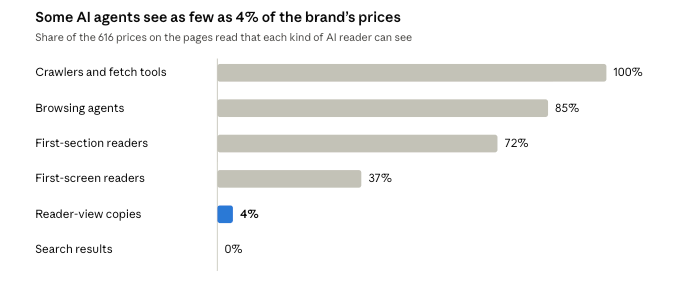
Crawlers and browsing agents see nearly all of the brand's prices. Reader-view copies, which keep the main text and drop boxes, menus and forms, see almost none, because the prices sit in page elements those readers discard. Search results carry no prices at all, since page titles and descriptions do not mention them.
Two further gaps matter for comparison shopping. The brand's product sizes are not stated in a form an agent could use, so no price per 100 ml could be worked out, while competitors with stated sizes could be compared on value. And because the site serves several regional versions, on two pages our browser was shown another region's currency, which an agent may also be shown on its user's behalf.
Finding 4: claims without proof, and a modest recommendation rate
The site makes 38 evidence or performance claims. Only five link to their proof where the claim is made. An agent that checks a claim before repeating it, as careful agents increasingly do, may leave the rest out of its answer.
When ChatGPT, Gemini and Perplexity were each given the same buyer request five times, they recommended the brand in 4 of the 15 conversations: once on ChatGPT, three times on Gemini and never on Perplexity. In the others they named other natural skincare brands. This test used a single buyer request and is indicative only, but it makes a useful point. The best-read site in its category was still chosen less than a third of the time. Being easy to read gets a brand onto the shortlist. Being chosen also depends on whether the agent can confirm the fact that decides the purchase, and trust it.
Why even excellent websites fall short
The brand did most things right. Its shortfall has little to do with effort and a great deal to do with how agents behave. Five patterns explain it.
Agents read slices. A person browses; an agent lands on a page, takes the part its reader keeps and moves on. Depending on how it reads, it may see the whole page, the first section, the first screen or a stripped-down copy. Facts in the wrong place, or in elements a reader discards, simply do not exist for that agent.
Agents compress. Asked to summarise, an agent keeps the gist and drops the qualifier, and the qualifier is often the differentiator, as the exfoliator shows.
Agents check before they repeat. Careful agents prefer claims they can verify. A claim without its proof in the same place is easier to leave out than to defend, so unsupported claims quietly fall away from the answer.
Agents compare by calculation. An agent weighing value works out price per millilitre, total cost with delivery, or whether a product meets every condition in its brief. If a size, a delivered price or a condition is missing, the brand cannot be scored on it, and a brand that cannot be scored loses to one that can.
Agents bring briefs a page cannot anticipate. A real buyer asks whether a product suits reactive skin, contains no fragrance, arrives by Friday and costs less than forty pounds. No page can answer every combination in advance, and agents rarely come back to ask.
Beneath all five sits a sixth problem: the brand cannot see any of it happening. Standard web analytics are designed to ignore automated browsers, and in AIVO's controlled tests they recorded none of 314 agent visits. A brand can lose a sale to an agent without ever knowing the agent came.
What other brands can learn
Put the deciding fact where agents land, in plain words. The specific promise that sets a product apart, such as suitability for very sensitive skin, should sit on the pages agents reach first and be stated so precisely that it cannot be generalised away.
Make prices readable by every kind of agent. Prices held in widgets, boxes or scripts disappear for some readers. Stating the price in the main text, and in page titles and descriptions where appropriate, closes most of that gap.
State sizes so value can be compared. An agent comparing products works out price per millilitre or per gram. Without a stated size, a brand cannot win on value, however good that value is.
Link claims to their proof where they are made. A study, certification or test result that sits on another page may as well not exist for an agent that checks before it repeats.
Give agents a way to ask. Even an excellent site cannot anticipate every combination a buyer brings. One emerging approach is an expert on the brand's own website that visiting agents can consult, answering only from facts the brand has approved, each with its source, and recording which answers lead to sales. AIVO Assist is our version of it. On our own website, the analyzer found that adding it raised findability from 61% to 96%.
What this case shows
This case study illustrates a wider change. In the search era, success meant being indexed. In the agent era, success means carrying the deciding fact all the way into the recommendation. Readability puts a brand on the shortlist; choice depends on whether the agent can confirm the fact that makes the brand the right answer, trust it and keep it intact.
The brands that understand the difference earliest will gain a structural advantage, while their competitors are still polishing pages that agents never fully read.
Method, limits and disclosure
The brand and its competitors are not AIVO clients, did not commission this study and are not named. All four sites were read on 2 November 2026 by AIVO's crawler, which identifies itself honestly, respects robots.txt and never poses as another agent. Facts were kept only when stated word for word on the page. Differences between an agent's answer and the site are flagged as possible misreads, and some may be fair readings. The recommendation test used one buyer request and five conversations per assistant, so it is indicative rather than a measure of market share. Results describe the sites as read on that date and will change as the sites and the agents change.
AIVO, Inc. built AIVO Agent Analyzer and offers AIVO Assist commercially. The 61% to 96% figure comes from the analyzer's report on AIVO's own website. This case study has not been peer reviewed.
AIVO Agent Analyzer produces this read for any brand, against the competitors it chooses. Brands that want the same view of their own site can request a report through aivocorp.com/assist.
Comments ()