
Chosen, Then Blocked: The Three Gates of Agentic Commerce
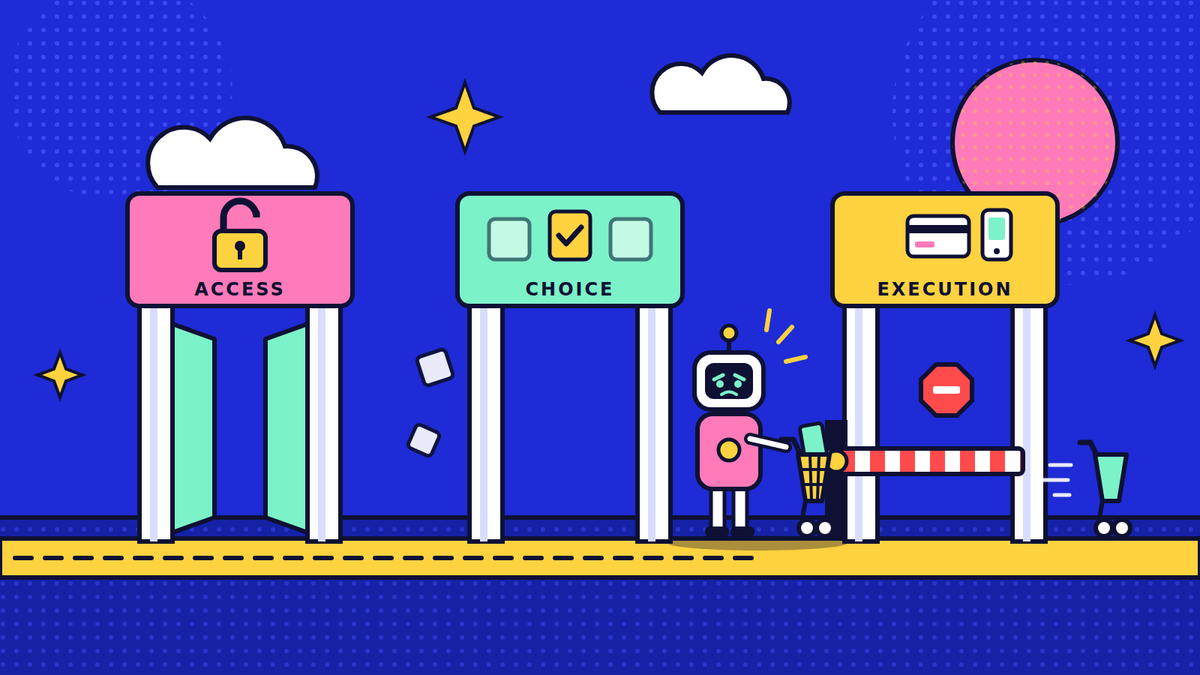
Consumer AI agents have moved from recommending to acting. A brand can now be lost before it is considered, while it is being chosen, or after it has been chosen.
On the night of 20 September, Amazon began blocking Meta's new Muse agent from shopping on Amazon.com. Earlier the same month, Resy locked a diner's account after his personal agent, Instinct, repeatedly queried the platform, reportedly hundreds of times an hour. In both cases, an agent acting for a real customer reached a commercial channel and could not complete the job.
The response across the market has been anything but uniform. Within days of the Amazon block, Shopify, PayPal, Expedia and Instacart announced connectors that let Muse check out, pay, book hotels and order groceries directly. One channel shut the door while others built a new one. The transaction layer is being reorganised around agents, in real time, and brands are discovering that being known to AI is only the first of several conditions for winning the sale.
From answers to actions
Meta launched Muse on 8 September. It can browse websites, complete forms, connect to a user's apps and make purchases, and within days it reached the top of Apple's US App Store chart. Instinct, built by San Francisco's Spear Street Technology, is reached by text or phone call and works through its own computer and phone line. It announced a $1 billion Series C at a $10 billion valuation on 28 September. Fo, from Wajo, calls, emails and coordinates with businesses to complete everyday errands, bringing in human assistants when a task needs judgement.
The same shift is under way in business settings. Agently positions itself as an AI chief of staff that chases invoices and moves deals. Wajo is building agents for vendor onboarding and claims handling.
What these products share is that the customer no longer receives a list of options to act on. The agent reads, decides and completes the task. That changes what a brand has to get right, and it divides the journey into three gates.
Gate one: access
Before an agent can choose a brand, it has to reach it. The controls many brands use to govern automated access were designed around crawlers rather than agents acting interactively for individual users. Meta's documentation states that its fetcher for user-requested tasks may bypass robots.txt, on the reasoning that a person asked for the page. Agents that operate through a browser, meanwhile, can be stopped by bot protection the brand's own team may not know is running.
Channels are now writing their own rules. Amazon's Conditions of Use include terms requiring any agent to identify itself in every request and to answer truthfully when asked whether it is a computer. Amazon's complaint against Muse included the allegation that the agent did not identify itself while browsing. Access is becoming a negotiated condition, set channel by channel, and a brand's reach to agents can depend on terms it may never have considered.
Gate two: choice
Fo's own interface shows the decisive moment. Asked to find a barber open on Sunday, it searches, reports three nearby options, and then calls one of them. Every business in the area was a candidate. Three made the shortlist, and one received the call.
This is the decision point AIVO's Win Rate is designed to measure: how often a brand that enters an AI-mediated consideration set is the one the system ultimately recommends. A brand can be well represented in a model's knowledge and still lose at this point, because a competitor better matches the specific requirement the customer stated. Visibility tells you who appeared. Choice tells you who survived.
Gate three: execution
A recommendation still has to survive contact with the channel. An agent may choose a brand, meet a blocked checkout, switch to a competitor and complete the purchase there. The Amazon episode shows how quickly an access decision can stop an agent from completing a purchase, while the Shopify and Expedia connectors show the opposite route, where a channel makes execution easier for agents it admits.
Execution reaches beyond online checkout. Both Instinct and Fo place phone calls to businesses to book and arrange things. In the EU, new AI Act transparency rules applying from 2 August require certain interactive AI systems to disclose when users are interacting with AI rather than a human. That creates an operational question for any business that takes bookings by phone: whether its staff and systems are ready to handle an AI caller, and what happens to the customer when they are not.
Why the gates compound
A brand has to pass all three gates to win, and failure at any one of them cancels success at the others. A brand chosen by the agent but unreachable through the channel it sells on has gained nothing. A brand that is fully transactable but never reaches the shortlist is in the same position.
Most AI visibility measurement to date has concentrated on whether brands are mentioned in chatbot answers. That was a reasonable starting point when AI only answered questions. It captures only part of what happens once an agent is making the choice and carrying out the task.
What brands and agencies should establish
The first question is how each major family of agents actually experiences the brand's digital estate, including browser-based access and bot protection, and how that compares with the policy the brand believes it has. The second is which of the channels the brand sells or books through currently admit agents, on what terms, and through which connectors. The third is how often the models behind these agents choose the brand when a customer's requirements are specific, measured with enough repeated runs to separate genuine change from noise. For local and service businesses there is a fourth: whether the booking path, including the phone, works when the caller is an agent.
Every step between being known and being bought can now be tested by software acting on the customer's behalf. Brands that measure only whether they appear will discover the other two gates through failed journeys they never saw.
Sources:
- Amazon blocks Meta's Muse agent, Agent Terms detail (Mixed)
- Amazon blocks Meta's Muse AI assistant (GeekWire)
- Muse tie-ups with Shopify, PayPal, Instacart and Expedia (OfficeChai)
- Expedia partners with Muse on hotel booking (Travel Noire)
- AI agents promise to do everything for you (CNN)
- Meta debuts its Muse AI agent (TechCrunch)
- Viral AI agent Instinct raises $1B Series C (TechCrunch)
- What Is Instinct AI? (Carly)
- Wajo – Fo
- Agently
- Meta Web Crawlers (Meta for Developers)
Comments ()