
Consumers Already Trust AI's Top Pick. Most Brands Aren't Fighting For It.
Marketers keep asking the wrong question about AI search. The question isn't "are we cited?" It's "do people actually do what the AI tells them?"
New research out of Kevin Indig's Growth Memo gives us the clearest answer yet, and it should change how every brand marketer thinks about their AI strategy — not because it's a new measurement framework, but because it's a study of consumer behavior.
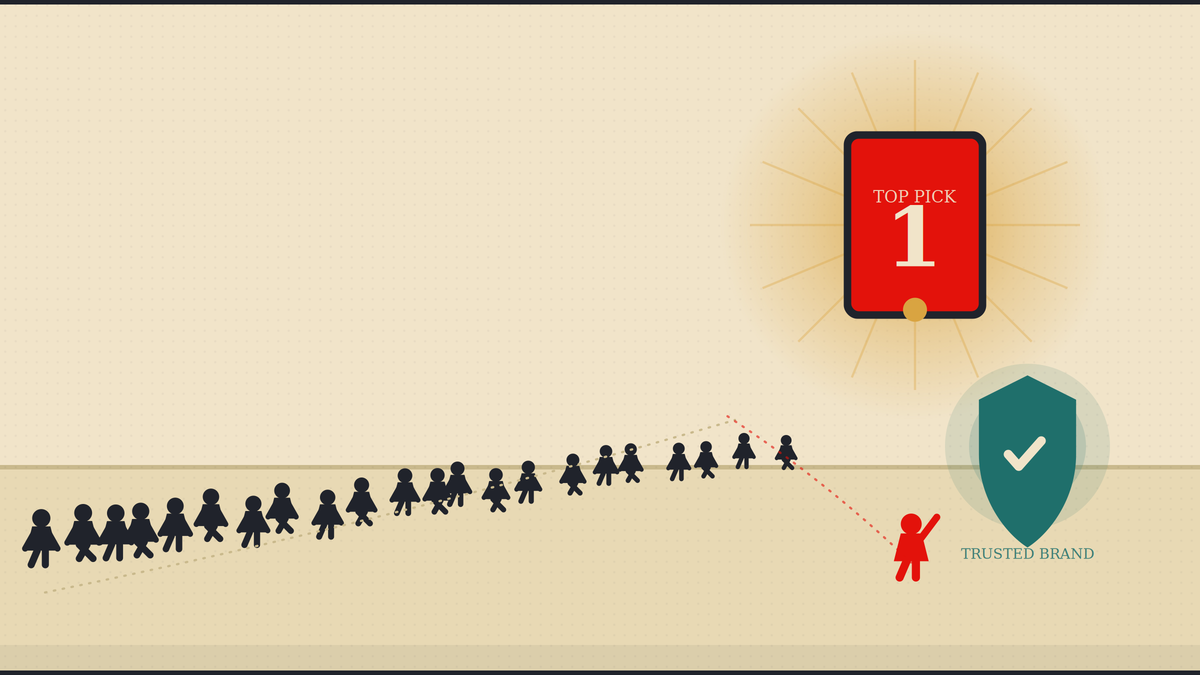
People don't shop the AI shortlist. They take the first name off it.
Indig's H1 2026 research found that roughly three out of four consumers pick the number-one result an AI recommends. Three-quarters. Not "consider," not "click through to compare" — pick. That's not how people use a Google results page, and it's not how they use a shelf of options in a store. It's closer to how people take advice from a friend they trust: efficiently, and without much second-guessing.
There's one exception worth sitting with: if a brand the consumer already trusts appears anywhere on that shortlist — not necessarily first — they'll choose it over the AI's top pick. Trust, in other words, is the only thing that currently beats position.
That single finding rewrites the brief for every brand marketing team still optimizing for search-era metrics. Position matters enormously, right up until existing trust in your brand overrides it. Which means the marketing job hasn't gotten smaller in the AI era. It's gotten more foundational: you're not fighting for a ranking, you're fighting for the kind of trust that survives being second.
The acceptance rate is the real headline
The number that should stop marketers mid-scroll: in AI Mode specifically, users accepted the AI's top product recommendation as the best option 88% of the time. Compare that to how people behave in AI Overviews, where Indig's research shows people still click, evaluate, and compare — classic search behavior carried over into a new interface.
That's a meaningful split. It tells us AI-native shopping experiences are training a different consumer habit than AI-augmented search results. In one, people still do their own diligence. In the other, they're handing the decision over.
Marketers have spent two years treating "AI visibility" as one undifferentiated problem. It isn't. Whether a consumer scrutinizes your brand or simply accepts what the AI tells them depends on which surface they're standing in — and brands need to know which behavior they're up against before they can do anything about it.
One caveat worth naming rather than glossing over: an 88% acceptance rate almost certainly doesn't hold evenly across every category. Someone asking an AI for a phone charger and someone asking it to recommend a wealth manager are not making the same kind of decision, and there's no public data yet breaking this figure out by purchase stakes. The honest read is that delegation is real and already large at the low-consideration end — and an open question, not a settled one, for high-consideration categories like enterprise software, financial services, or healthcare. Brands in those categories shouldn't assume the 88% applies to them; they should go find out.
Why fragmentation makes this harder, not easier
If trust and acceptance were the whole story, the fix would be straightforward: build trust, get named first, done. But Indig's research also surfaced a structural problem underneath all of this — citation overlap between the major AI platforms is minimal. The vast majority of citations show up in only one engine, not across all of them.
That means there is no single "AI visibility" score to chase. A brand can be the trusted, accepted answer in one AI surface and functionally invisible in the next conversation a consumer has, on a different platform, five minutes later. Consumer trust doesn't transfer between engines automatically, even when it's earned.
What this means for marketers, not measurement teams
None of this is a call to instrument more dashboards. It's a call to recognize that AI has changed the psychology of the purchase decision before most brand teams have changed anything about how they show up.
It's also not a call to abandon technical work in favor of brand-building, as if the two compete for the same budget line. They don't. Trust is what wins a consumer once your brand is in front of them — but you still have to be on the shortlist for trust to get the chance to matter. A brand with deep equity and no AI presence isn't in this conversation at all. The finding here isn't "stop optimizing, start branding." It's that optimization gets you eligibility, and trust gets you chosen — and most brands have only been working the first half of that equation.
Consumers have already decided to trust AI's advice, in specific and measurable ways. The open question for 2026 isn't whether AI recommendations shape demand — that's settled. It's whether your brand is one of the trusted names that survives being recommended second, on the surfaces where people are still willing to look past the first answer.
That's a brand question before it's a technical one. It belongs in the CMO's office, not just the analytics team's.
Sources: Kevin Indig, "AI Halftime Report: H1 2026," Growth Memo, July 27, 2026.
Comments ()