Enterprise Liability and AI-Mediated Representation

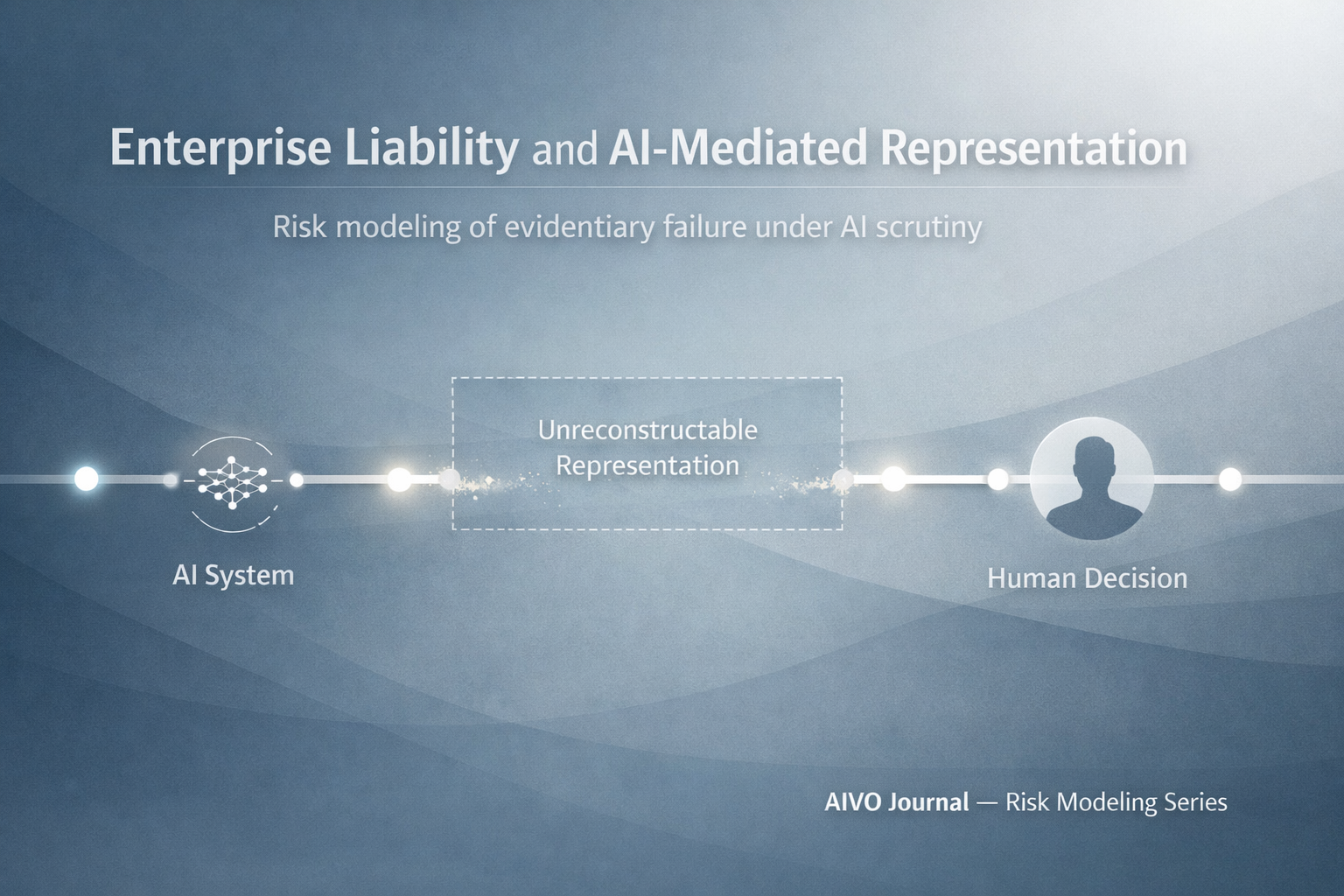
A risk-modeling analysis of governance failure under evidentiary scrutiny
Abstract
This article does not argue that courts have resolved enterprise liability for third-party AI outputs. They have not. Instead, it models a set of emerging risk conditions under which enterprises face increased legal, regulatory, and reputational exposure when AI-mediated representations cannot be reconstructed, evidenced, or bounded at the moment of reliance.
The analysis treats current litigation theories, regulatory enforcement actions, and state-level statutes as pressure vectors, not settled law. The central claim is operational rather than doctrinal: when enterprises intentionally influence how AI systems represent them, the absence of evidentiary controls becomes the dominant failure mode, regardless of whether liability ultimately attaches.
Scope and methodology
This is a risk-modeling exercise, not a statement of legal outcomes. It draws on:
- active litigation theories, including negligent misrepresentation and inducement claims, whether or not they have prevailed
- regulatory enforcement postures that shape discovery and settlement dynamics
- procedural obligations introduced by recent state statutes
- structural properties of large language models, including variability and replication at scale
The article deliberately avoids predicting how courts will rule. It examines what happens to enterprises when scrutiny occurs and evidence is missing.
Risk condition 1: Intentional influence without reconstructability
Condition
An enterprise takes affirmative steps to influence how AI systems present its brand, products, or services. This may include optimization strategies, structured content programs, or paid visibility arrangements.
Risk mechanism
If challenged, the enterprise cannot reconstruct what representations were generated, when, under what prompts, or with what variability controls.
Why this matters
In this condition, legal inquiry shifts away from authorship and toward governance. Even if no liability attaches, the enterprise faces elevated exposure during discovery, regulatory inquiry, or internal review because it cannot evidence restraint, monitoring, or contemporaneous oversight.
Key point
This is not a claim that influence creates liability. It is a claim that influence without evidence weakens defensibility.
Risk condition 2: Procedural obligations as evidentiary leverage
Recent state-level AI statutes introduce documentation, disclosure, and risk-assessment requirements that are procedural in nature.
Examples often cited include Utah’s attribution rules for enforcement actions and Colorado’s reasonable care standard supported by documented impact assessments. These statutes do not create automatic civil liability, and in many cases do not create private rights of action at all.
Risk mechanism
Procedural non-compliance can be used to lower evidentiary thresholds, accelerate discovery, or support negligence narratives in adjacent claims.
Why this matters
Even where statutes do not control the outcome, they change the cost and posture of dispute. Enterprises may find themselves unable to demonstrate that AI-mediated representations were governed in a manner consistent with their own disclosures.
Risk condition 3: Established tort doctrines applied to AI failure modes
Most AI-related consumer claims rely on existing doctrines, not AI-specific law. These include negligent misrepresentation, products liability theories tied to advice, and consumer protection claims alleging exaggerated AI capabilities.
Risk mechanism
Courts do not need to resolve questions about model internals, training data, or probabilistic behavior to entertain these claims. Analysis proceeds on familiar elements such as duty, reliance, and foreseeability.
Why this matters
Enterprises often assume technical opacity protects them. In practice, opacity is irrelevant if the question is whether the enterprise can show what information entered a governed process at all.
Risk condition 4: Regulatory enforcement as a dispute accelerator
Regulatory action does not determine civil liability. It does, however, influence:
- what documents are requested
- what representations are treated as material
- how quickly matters escalate
In the European context, phased implementation of the EU Artificial Intelligence Act and updates to product liability rules similarly affect evidentiary posture without predetermining outcomes.
Risk mechanism
Regulatory scrutiny often precedes or parallels private disputes, shaping narratives of duty and standard of care even where no violation is ultimately found.
Risk condition 5: Scale and replication effects
AI systems operate at scale. A single governance gap can produce many similar representations across users, time, and model versions.
Risk mechanism
Plaintiffs and regulators may argue that shared failure modes indicate systemic issues. Courts remain cautious, especially around reliance and damages, but scale alters exposure economics even when claims fail.
Important constraint
At present, class certification based solely on AI output similarity remains speculative. This condition should be treated as risk modeling, not trend reporting.
Defense realities and constraints
A balanced analysis must acknowledge that defenses remain strong in many jurisdictions:
- Output variability complicates causation
- Non-determinism undermines reliance at scale
- Third-party content doctrines continue to succeed in some contexts
- Many claims fail before reaching substantive adjudication
Nothing in this article suggests those defenses have collapsed. The risk identified here is not inevitable liability. It is loss of leverage when evidence cannot be produced.
What this analysis does and does not claim
This article claims
- Enterprises face increased exposure when they intentionally influence AI representations without evidentiary controls.
- Procedural obligations and enforcement actions can amplify that exposure.
- The dominant failure mode is absence of evidence, not model error.
This article does not claim
- That courts have converged on a liability framework
- That these theories have broadly prevailed
- That enterprises are strictly liable for third-party AI behavior
Conclusion: defensibility erosion, not liability certainty
The current environment is best understood as one of defensibility erosion. Enterprises are not losing because law has settled. They lose time, leverage, and credibility because they cannot reconstruct AI-mediated representations when scrutiny arises.
This is an operational risk. It exists regardless of whether any particular claim succeeds. Treating it as such allows enterprises to respond proportionately, without assuming outcomes the law has not yet delivered.
Source note
This analysis is adapted from an internal memorandum examining enterprise exposure to third-party AI outputs, reframed here as conditional risk modeling rather than legal prediction .