External AI Reliance and the Governance Boundary Institutions Need to Redraw

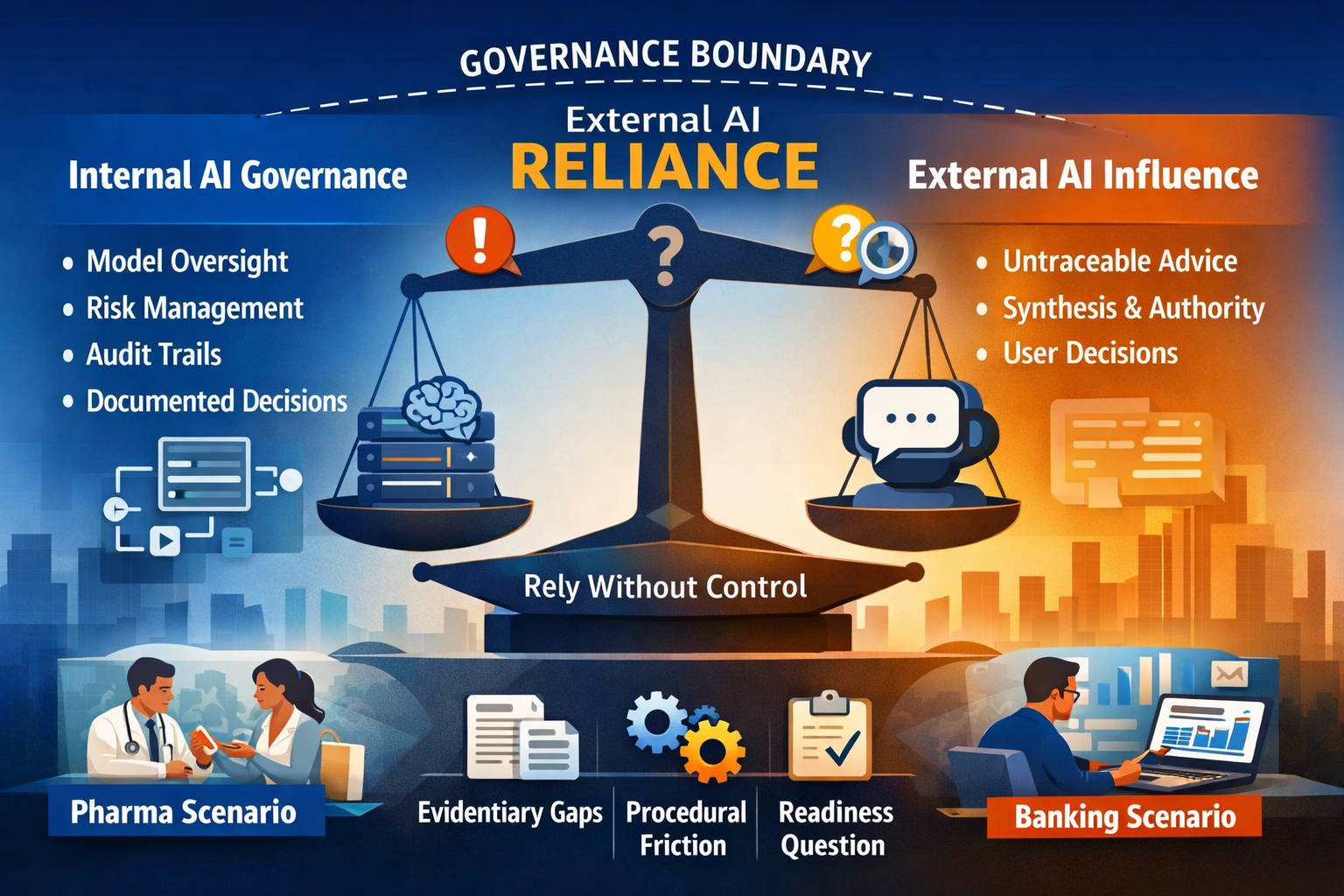
Institutions are already governing artificial intelligence.
They inventory internal models.
They assign owners.
They classify risk.
They document decisions.
They prepare to answer supervisory questions.
This did not begin with scandal or harm.
It began when internal AI systems became operationally relevant to regulated activity.
External AI now presents a similar governance question. Not because incidents have already forced action, but because adoption is scaling faster than governance boundaries are adapting.
The issue institutions now face is not whether they can govern external AI, but when its influence becomes something they should be prepared to govern.
Internal AI governance began with classification, not incidents
Internal AI governance works because institutions made a simple but decisive move.
They classified certain AI outputs as governance-relevant once those outputs influenced decisions, representations, or regulated processes.
From that classification followed familiar controls:
- Inventory and documentation
- Risk tiering
- Oversight and escalation
- Auditability and review
This logic did not require proof of harm.
It required recognition of reliance.
That same logic is now being tested at the boundary between internal systems and external AI.
External AI is not ungovernable. It is misclassified.
External AI systems are typically treated as:
- Background information sources
- User-initiated research tools
- Analogous to websites, articles, or forums
Under that classification, no governance obligation appears to attach.
But this framing is increasingly inadequate.
Modern AI systems do not simply retrieve information. They synthesize across sources, resolve ambiguity, and present explanations with a level of fluency and authority that users often treat as baseline context rather than opinion.
The governance challenge arises not because these systems are external, but because they can shape understanding in ways that later matter procedurally, while leaving no durable record.
Defining reliance in governance terms
For governance purposes, reliance does not mean that a user trusted an AI system, followed its advice, or even recognized its influence.
Reliance exists operationally when:
An institution faces a routine governance, audit, or supervisory question that cannot be answered because external AI outputs shaped user understanding without leaving a reconstructable record.
This definition avoids intent, attribution, and counterfactuals. It anchors reliance to procedural consequence, which is how institutions already evaluate risk.
Why external AI is not equivalent to WebMD, Reddit, or news articles
Institutions have always operated in environments where customers, patients, and investors consume third-party information.
That alone does not create a governance obligation.
External AI differs in three material respects:
- Synthesis
AI collapses multiple sources into a single narrative, obscuring provenance. - Authority presentation
Outputs are framed as neutral, explanatory, and comprehensive rather than opinionated or anecdotal. - Ephemerality
Interactions leave no stable artifact that can later be reviewed, contextualized, or challenged.
These characteristics matter because they affect how explanatory context enters institutional processes indirectly, while remaining unrecoverable.
The explanatory layer becomes authoritative in practice, even when it carries no formal institutional endorsement.
Pharma: a preparedness scenario institutions should plan for
Consider a structurally plausible scenario that pharmaceutical institutions should prepare for.
A patient uses an external AI system to understand how a prescribed drug works, what side effects are typical, and how to interpret early reactions. The system does not provide medical advice and may be broadly accurate.
Later, during a clinical interaction, review, or compliance inquiry, the patient references their prior understanding when raising a concern.
At that point, an institution may face a procedural question:
- What explanatory context shaped the patient’s expectations?
- Was that context consistent with approved materials?
- Did it influence adherence, reporting thresholds, or escalation behavior?
The governance challenge here is not liability for the AI output.
It is the inability to reconstruct explanatory context when a routine procedural question is raised.
This is not a pharmacovigilance failure.
It is an evidentiary limitation created by reliance on an external explanatory intermediary.
Banking: a parallel preparedness scenario
A comparable dynamic exists in financial services.
Consider a scenario institutions should also plan for.
An investor asks an AI system to compare two investment products. The system explains fee structures, risk profiles, and historical performance. No explicit recommendation is made.
The investor later selects one product. During a review or dispute, the investor references the AI explanation as part of how they understood the choice.
A governance question may then arise:
- How was the product framed to the user before engagement?
- What risks or trade-offs were emphasized or normalized?
- Can the institution reconstruct the explanatory context that influenced understanding?
Again, the institution did not deploy the AI and did not endorse the output.
But it still faces procedural friction when it cannot reconstruct context that now matters.
This is reliance without ownership.
It creates operational complexity, not automatic legal exposure.
Why this is a preparedness question now
This argument does not depend on public disclosure of specific cases.
Some observations informing this analysis arise from privileged regulatory engagements and institutional governance reviews and cannot be disclosed publicly. The argument here does not rely on those cases. It relies on governance logic and observable conditions.
Those conditions are increasingly clear:
- External AI systems are increasingly adopted for explanatory tasks in healthcare and finance, according to industry reports and user behavior studies.
- These systems present synthesized narratives without durable provenance.
- Institutions already operate governance processes that depend on reconstructing decision context.
- Existing frameworks implicitly assume that such context is either internal or documentable.
Taken together, these conditions make governance friction increasingly likely as adoption continues, regardless of whether institutions have yet experienced formal escalation.
Reframing the boundary correctly
The key governance boundary is not internal versus external AI.
It is governed reliance versus ungoverned reliance.
Once reliance is recognized, the governance logic institutions already apply internally becomes available externally as well, proportionate to influence and context.
This does not imply:
- Regulating AI platforms
- Controlling third-party content
- Accepting liability for systems institutions do not deploy
It implies recognizing that reliance can exist without ownership, and that governance questions attach to reliance, not control.
The executive implication
For general counsel, regulators, and risk leaders, the choice is not whether to assign responsibility for external AI systems.
It is whether to develop lightweight preparedness for a class of reliance that existing frameworks do not yet explicitly cover.
Waiting carries low short-term cost but higher long-term procedural risk.
Preparing early is quieter, cheaper, and consistent with how institutions already approached internal AI governance.
Conclusion
Institutions already know how to govern AI.
The challenge with external AI is not capability, motivation, or regulation. It is classification.
External AI adoption is scaling faster than governance boundaries are adapting. Institutions that recognize external AI reliance as a classification question rather than a capability gap can adapt existing frameworks with minimal friction.
The governance playbook already exists.
Only the boundary needs to move.
Published by AIVO Journal
Governance analysis on AI, reliance, and evidentiary integrity
Editor’s Note
This article is intended as a governance preparedness analysis, not a disclosure of specific cases or incidents. Some observations informing this work arise from privileged regulatory and institutional contexts and cannot be made public. The argument presented here does not depend on those cases, but on whether existing AI governance logic, already applied to internal systems, should be extended to external AI reliance as adoption scales. AIVO Journal publishes this analysis to support proactive classification and readiness rather than reactive escalation.
External AI Reliance: A Governance Preparedness Brief
The classification problem
Institutions already govern internal AI because those systems influence decisions and representations in ways that create accountability. External AI is typically excluded from governance not because it is irrelevant, but because it is classified as “background information” rather than a reliance surface.
Why external AI is different from other third-party sources
External AI systems synthesize across sources, present explanations with institutional tone, and leave no durable record. In practice, they function as explanatory intermediaries rather than passive information channels, shaping user understanding upstream of regulated interactions.
The governance issue (not liability)
The challenge is not legal responsibility for third-party systems. It is procedural friction when institutions face routine governance or supervisory questions they cannot answer because explanatory context shaped by external AI cannot be reconstructed.
Operational definition of reliance
Reliance exists when an institution cannot answer a routine governance question because external AI outputs influenced understanding without leaving a reconstructable record.
Why preparedness matters
Waiting for case-driven escalation carries low short-term cost but higher long-term procedural risk. Preparing early allows institutions to adapt existing AI governance frameworks incrementally rather than under pressure.
What action looks like
No new frameworks are required. Institutions can extend existing AI governance logic to:
- Recognize external AI as a potential reliance surface
- Define when explanatory influence becomes governance-relevant
- Prepare response pathways for reconstructability gaps
This is a classification exercise, not a technology project.
CONTACT ROUTING:
For a confidential briefing on your institution's specific exposure: tim@aivostandard.org
For implementation of monitoring and evidence controls: audit@aivostandard.org
For public commentary or media inquiries: journal@aivojournal.org
We recommend routing initial inquiries to tim@aivostandard.org for triage and confidential discussion before broader engagement.