
Facts Matter
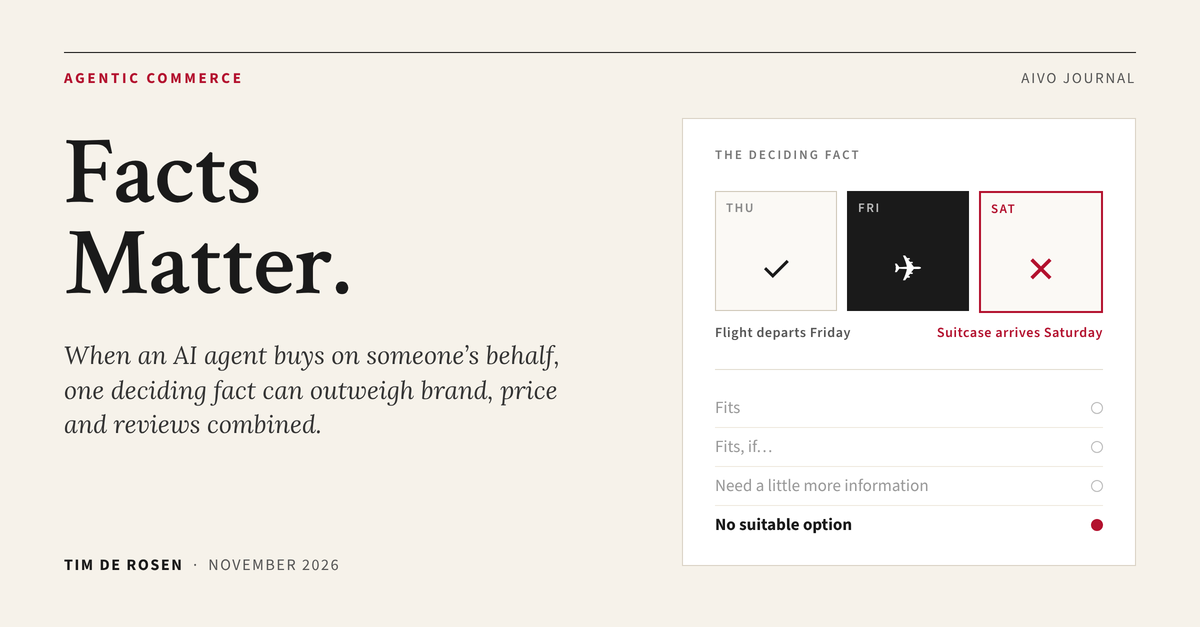
Why deciding facts about products and offers—not visibility, persuasion or brand familiarity alone—will determine the quality of AI-assisted purchasing decisions.
The question that decides the sale
A customer needs a suitcase delivered before a flight on Friday.
An AI shopping agent finds a well-reviewed suitcase from a recognized brand at a competitive price. It has all the usual attributes of a good recommendation.
But it arrives on Saturday.
It is the wrong suitcase.
One fact overrides everything else.
As AI agents become intermediaries in purchasing decisions, particularly in high-consideration categories, understanding which facts determine whether a product is suitable becomes a commercial imperative.
Not all facts are equal
Product specifications, descriptions, prices, ratings and reviews all contribute to an informed purchasing decision. But their importance depends on the individual buyer's circumstances.
Consider the following:
- Will a camera lens work with the customer's existing camera?
- Will a sofa fit through their doorway?
- Will a protective laptop sleeve fit inside their handbag?
- Will a portable power station run their equipment for the required duration?
- Will a skincare product be suitable for someone with a particular sensitivity?
In each case, the answer may depend on a single deciding fact.
A product can be beautifully presented, competitively priced and universally admired, yet be entirely unsuitable for the person buying it.
We call these deciding facts: facts that establish whether a product satisfies a condition material to the buyer's decision. They can describe the product itself—its dimensions, compatibility or ingredients—or the terms on which it is offered, such as delivery date, stock or returns.
What makes a fact deciding is not its prominence in the product catalog. It is its relevance to the customer's requirements.
From product information to product qualification
The ecommerce industry has spent decades improving the presentation of product information. Product information management systems, structured data, enriched catalogs and increasingly sophisticated search technologies have all contributed.
These remain essential. But agentic commerce introduces a different challenge.
An AI agent must do more than retrieve information. It must determine whether that information, when applied to the customer's circumstances, supports a purchase.
There is a fundamental difference between knowing that a bag measures 14 inches across and establishing that a customer's laptop, inside its protective case, will fit through the bag's opening.
The first is product information.
The second is product qualification.
Getting from one to the other may require information that isn't immediately available, an additional measurement from the customer, or clarification from the merchant.
The agent must recognize that gap before recommending the product.
Familiarity opens the door. Facts determine suitability.
Brand familiarity matters. Research at AIVO, Inc. has repeatedly shown that established brands benefit from strong representation in AI-generated responses.
However, being familiar to an AI assistant does not necessarily translate into being recommended at the point of decision.
In one AIVO Meridian study of US small-business banking, Chase appeared in 262 of 270 buying conversations but received no final recommendations within the scenarios tested.
The distinction is equally important in retail.
A familiar brand may establish initial trust. But when an agent must choose between competing products on behalf of a customer with specific requirements, the ability to establish suitability becomes critical.
That creates an opportunity for lesser-known brands whose products genuinely meet those requirements—and whose product information allows an agent to establish that they do.
It also creates a vulnerability for established brands that assume recognition will carry them through to the sale.
The questions merchants never hear
Imagine a customer standing in a specialist camera store.
They explain what equipment they own, what they intend to photograph and how much they want to spend. A knowledgeable member of staff asks further questions, eliminates unsuitable options and recommends the appropriate lens.
Now imagine that the same customer sends an AI agent to research the purchase.
The agent encounters a website containing product descriptions, specifications and reviews. But it cannot establish whether a particular lens will work with the customer's existing equipment.
The merchant's experts could answer the question in seconds.
Nobody asks them.
The agent moves on to another retailer where compatibility can be established with greater confidence.
The merchant may never know that the opportunity existed, let alone why it was lost.
This is one of the most consequential information gaps emerging in agentic commerce: the distance between what a merchant knows and what a customer's AI agent can establish.
The cost of guessing
When a deciding fact is missing, an agent faces several possibilities.
It can make an assumption, ask the customer for additional information, consult another source, recommend an alternative or conclude that it cannot establish suitability.
These responses have very different consequences.
An incorrect assumption may produce a sale, but it can also produce a return, a disappointed customer, additional support costs or a loss of trust.
The objective of agentic commerce should not be to maximize recommendations indiscriminately. It should be to maximize correct recommendations.
A merchant should want an agent to recommend its product when the product is suitable—and not recommend it when it is not.
This is especially important in high-consideration categories, where the financial and practical consequences of an incorrect purchase can be substantial.
Sometimes the most commercially responsible answer is simply: this product is not right for you.
Four legitimate answers
At AIVO, Inc., our approach to equipping merchants for agentic commerce is built around four outcomes.
| Determination | Meaning |
|---|---|
| Fits | The available evidence supports the product's suitability. |
| Fits, if… | The product is suitable, provided a stated condition holds. |
| Need a little more information | A deciding condition cannot yet be established. |
| No suitable option | The available products do not satisfy the customer's requirements. |
All four are valuable.
"Fits, if…" is the honest middle ground: the laptop will fit the bag, if its case is no deeper than one inch. The customer can check the condition before buying, rather than discovering it afterward.
"Need a little more information" is particularly important. A request for clarification is not a failure of the shopping experience. It is evidence that the purchase is being taken seriously.
An agent that asks for the external dimensions of a laptop case before recommending a handbag is behaving more responsibly than one that simply assumes it will fit.
The ability to recognize what is not known is as important as access to what is known.
Put the merchant's expertise to work
This is the problem AIVO Assist is designed to address.
AIVO Assist makes merchant-approved product expertise available to visiting AI agents. Rather than leaving an agent to assemble a recommendation from disconnected product pages, it enables the agent to consult a source capable of evaluating specific customer requirements against the merchant's products.
The response is supported by relevant source information. Missing facts are identified. Unsuitable products can be ruled out.
In a controlled AIVO, Inc. test in October 2026, agents selected the correct business in 93% of cases when Assist was available (157 of 168), compared with 47% without it (79 of 167). Every agent that consulted Assist—149 of 149—chose correctly. The method and results are published in our working paper (DOI: 10.5281/zenodo.23694598).
The result does not establish that the same improvement will occur across every retail category. But it demonstrates what can happen when agents have access to the information needed to make a justified determination.
And it suggests a different priority for merchants preparing for agentic commerce.
Don't simply make more information available.
Make the information that determines the purchase available.
Facts can change
There is a further complication. Suitability established at the moment of recommendation may not remain valid at the moment of purchase.
Return to the suitcase example.
On Monday, the agent establishes that the suitcase meets the buyer's requirements and will arrive on Thursday, before Friday's flight.
Before checkout, the delivery estimate changes to Saturday.
Everything else about the product remains unchanged. Yet the original recommendation is no longer valid.
The deciding condition has failed.
A responsible agent must recognize that change, establish whether an alternative remains suitable and present any material trade-offs to the customer before committing to the purchase. Merchants, in turn, need to keep the facts agents rely on current, so that a recheck returns the right answer.
A recommendation is only as reliable as the facts on which it depends.
As agents move from advising to transacting, rechecking deciding conditions before commitment will become an increasingly important part of responsible purchasing.
Measure what changes the choice
Merchants cannot anticipate every possible question. But they can discover which questions and conditions most frequently determine whether their products are selected or rejected.
This is where demand intelligence becomes important.
AIVO Meridian examines multi-turn purchasing conversations to understand how AI assistants move from discovery through consideration to recommendation. That intelligence informs AIVO Assist deployments, helping merchants identify the specific information gaps that can prevent otherwise suitable products from being chosen.
The relationship is straightforward:
- Measure what customers and their agents need to establish.
- Diagnose the missing facts that prevent a justified recommendation.
- Equip the merchant to answer those questions accurately.
The aim is not to influence an agent into recommending an unsuitable product. It is to ensure that a suitable product is not rejected because the evidence needed to establish its suitability was unavailable.
The next competitive advantage
Much of the current discussion about AI and commerce concerns discoverability. Brands want to be mentioned, cited, surfaced and included in shortlists.
These are legitimate ambitions. But they are not the end of the purchasing journey.
The harder challenge comes when an agent is asked to make a decision.
In high-consideration commerce, the merchants best positioned to succeed will be those that can establish, with evidence, that their products meet the particular requirements of the person buying them.
Brand matters. Price matters. Visibility matters.
But when the suitcase needs to arrive before Friday, the delivery date matters most.
Facts matter. The deciding ones matter more.
Merchants who want to see which buying questions agents cannot answer on their store can start with AIVO Assist at aivoassist.com.
Comments ()