From Audit to Advantage: Why PSOS™ Defines the New Standard for AI Search

Abstract:
AI assistants compress discovery from pages of links into a handful of brand answers. This change makes visibility inside assistants not a marketing vanity metric but a strategic risk factor. In this article, we outline the Prompt-Space Occupancy Standard (PSOS™) under the AIVO Standard™ and show why it is the first audit-grade benchmark capable of linking visibility to financial performance through Visibility IRR.
The Compression of Discovery
In traditional search, ten blue links defined the battlefield. In AI assistants, the battlefield has collapsed to a single answer.
When a consumer asks “What’s the best digital wallet?”, ChatGPT does not present a list. It names one or two brands. When they ask “Which EV is most sustainable?”, Perplexity does not deliver ten ranked options. It delivers one.
This is not a small shift — it is a collapse of choice architecture. As McKinsey reports, 65% of organizations already deploy generative AI, with marketing and sales among the most affected functions. That means brand exposure is no longer filtered through SEO rankings but through AI assistant recall.
Why Snapshots Fail
Dashboards from Profound, Evertune, and others attempt to measure AI visibility. They rely on screenshots or “share-of-voice” snapshots. They are non-reproducible, unauditable, and decay the moment algorithms update.
CMOs may like the graphs. Boards cannot use them.
Gartner has warned that poor retrieval infrastructure is the single biggest barrier to assistant reliability. If retrieval is flawed, then snapshots are meaningless. Brands need measurement that is timestamped, reproducible, and auditable. This is the purpose of PSOS.
The Prompt Funnel: Where Decisions Happen
Visibility must be measured across the prompt funnel:
- Level 1 (Surface Awareness): “Best EV in 2025”
- Level 2 (Evaluation): “Which EV has the longest warranty in North America?”
- Level 3 (Conversion): “Which EV qualifies for EU subsidies under €40,000?”
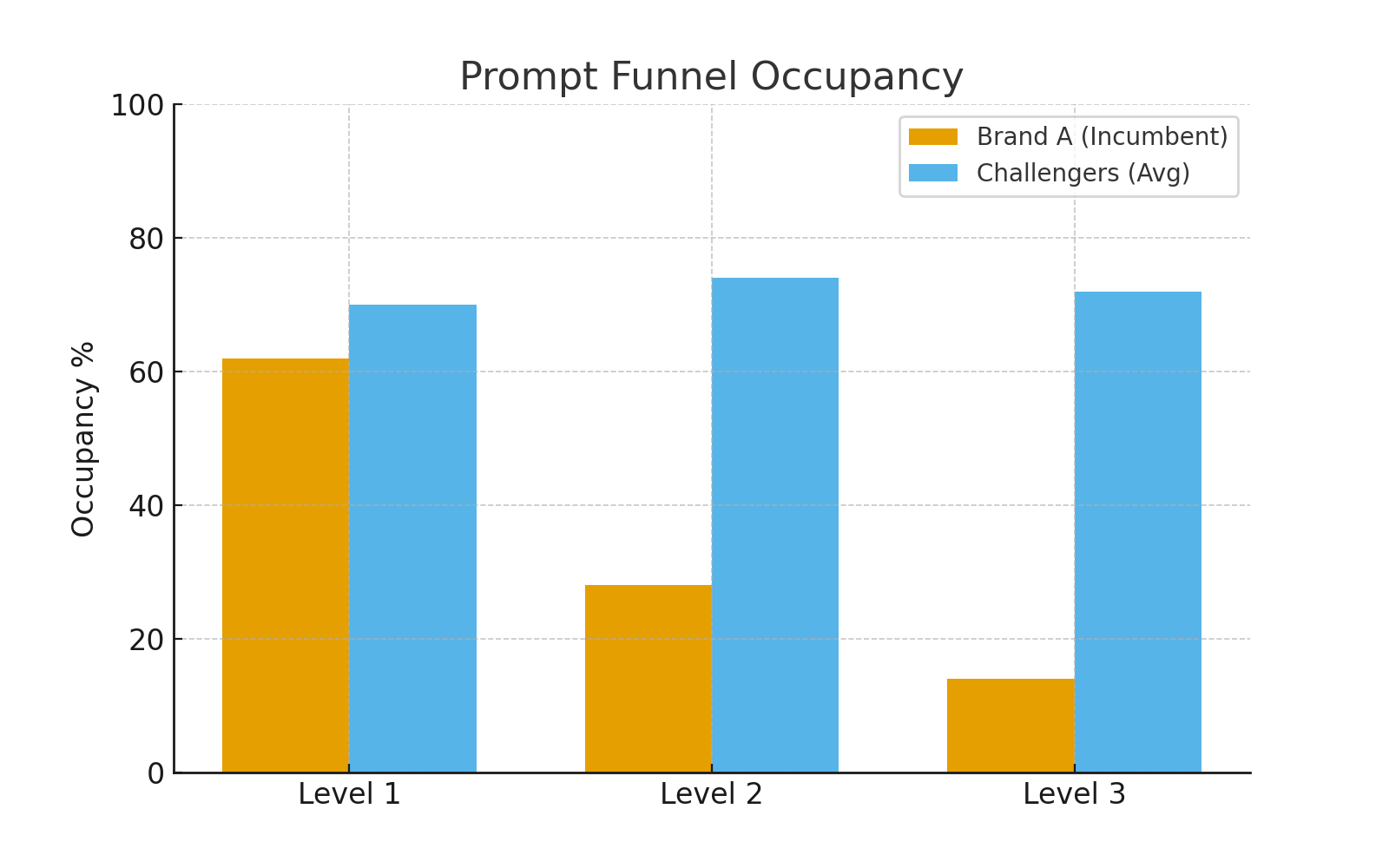
In an anonymized PSOS audit of a global payments brand:
- Level 1 visibility: 62%
- Level 2 visibility: 28%
- Level 3 visibility: 14%
- Challenger visibility (Revolut, Wise, Cash App): ~70% across all levels
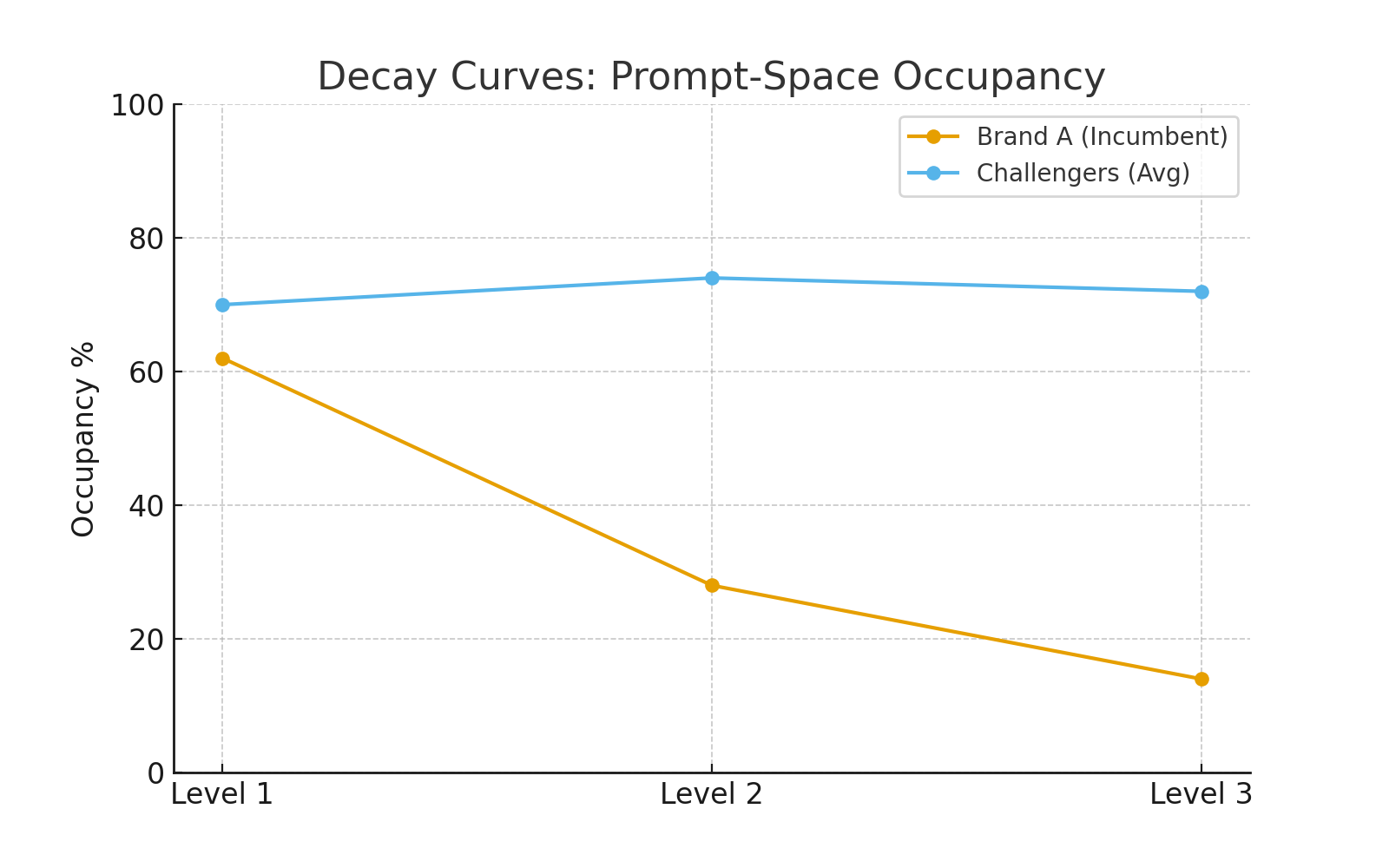
The implications are stark. Awareness is not enough. Brands that vanish at Level 2 or 3 are losing customers invisibly — precisely at the moment of switching intent.
Visibility IRR: From Vanity to Capital Discipline
The AIVO Standard introduces Visibility IRR — the internal rate of return on AI search spend.
In the payments audit, Brand A redirected just 5% of its marketing budget from generic campaigns into retriever-friendly PR citations. Within one quarter, second-level prompt occupancy rose by 23%.
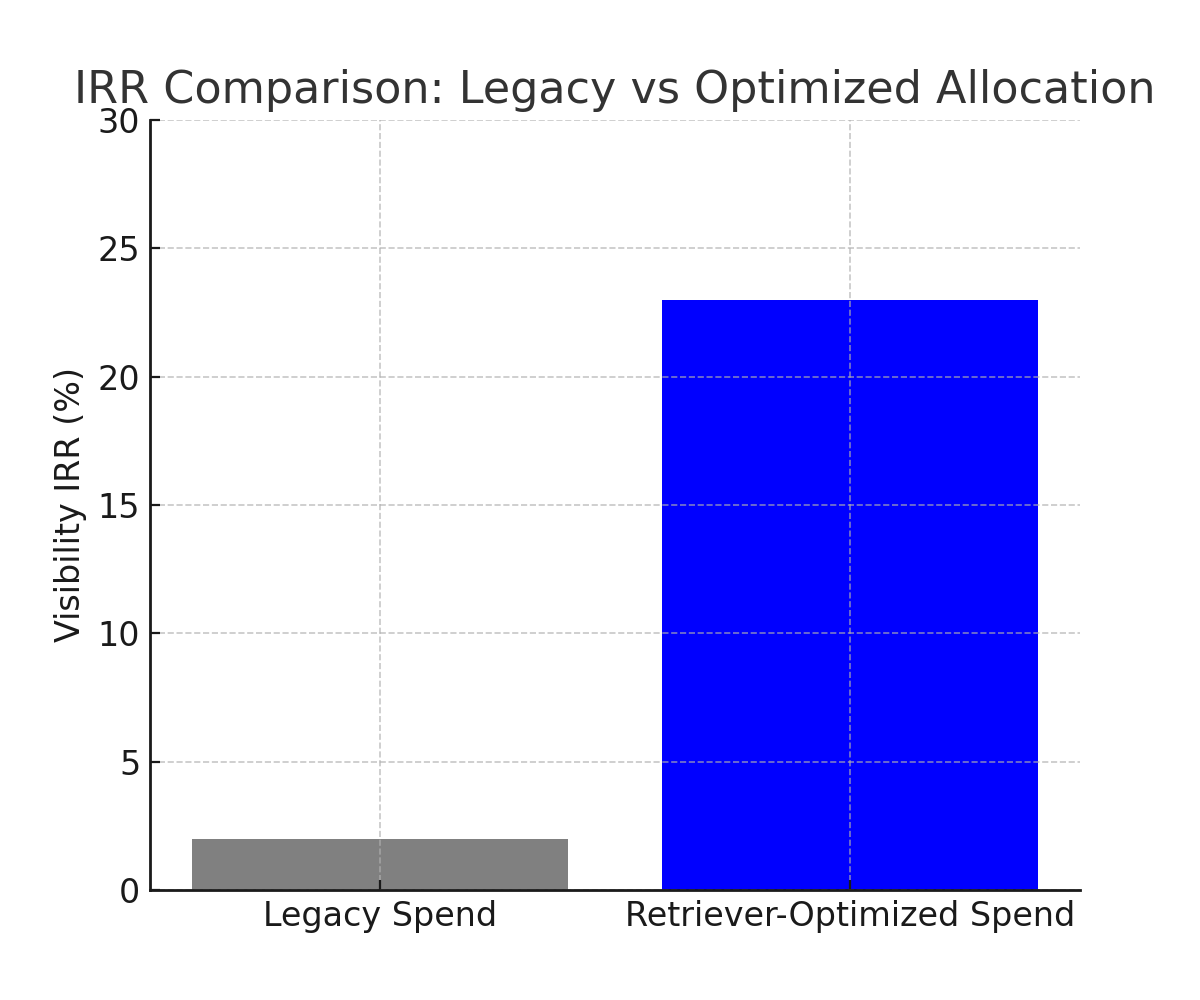
McKinsey research shows some organizations already attribute more than 10% of EBIT to generative AI. Visibility IRR extends this logic: reallocating spend into retriever-ready content can deliver financial returns greater than almost any other marketing channel.
The message for CMOs is clear: visibility is not a “brand metric.” It is a capital efficiency benchmark.
The Playbook: Stop, Shift, Seed
Every PSOS audit concludes with a three-part playbook:
- Stop: Identify marketing spend that delivers no persistent visibility.
- Shift: Reallocate to channels consistently cited by assistants (structured data, high-authority PR).
- Seed: Create retriever-friendly assets (tables, benchmarks, white papers) that persist in LLM memory.
Klarna has already saved $10 million annually in marketing costs by deploying generative AI. The lesson is clear: challengers who optimize fast compound their advantage. Incumbents who wait cede share invisibly.
Governance + Growth: The Dual Mandate
PSOS operates on two levels:
- Governance mandate: Reproducible, timestamped, auditable records for boards and regulators.
- Growth mandate: IRR optimization that converts visibility into ROI.
KPMG’s 2025 CEO Outlook found that more than 40% of CEOs expect to increase AI budgets to gain competitive advantage. Those budgets will either fuel auditable growth or become part of the 40% of agentic AI projects Gartner expects to be scrapped by 2027.
PSOS is the line between the two.
Ingest: The Strategic Battleground
The most urgent truth is also the most overlooked: visibility is impossible without ingestion.
If your brand’s content is not ingested into LLMs, it cannot be recalled. No prompt, no campaign, no budget will fix this.
The Ingestion Playbook:
- Structure: Use Schema.org, JSON-LD, and retriever-friendly formats.
- Authorize: Secure citations in high-authority outlets (press, analysts, repositories).
- Persist: Validate ingestion through quarterly PSOS audits.
This is not a hygiene checklist. It is the strategic control point of the AI economy. Whoever controls ingestion controls recall. Whoever controls recall controls consumer choice.
Execution Priorities: Audit. Optimize. Ingest.
AI assistants are the new consumer interface. Visibility is no longer about impressions or rankings. It is about occupying the answer space.
The Prompt-Space Occupancy Standard (PSOS™) under the AIVO Standard™ is the only framework that:
- Audits visibility with governance-grade rigor.
- Optimizes Visibility IRR for financial performance.
- Tracks persistence across the prompt funnel.
- Links audits to the decisive act of LLM ingestion.
Audit. Optimize. Ingest.
The AIVO Standard exists to ensure that visibility in AI assistants is treated with the same rigor as financial audits. CMOs, boards, and agencies should begin with a PSOS audit, benchmark Visibility IRR, and publish retriever-ready content that assistants cannot ignore.
We invite CMOs, analysts, and agencies to adopt PSOS as the common benchmark - to ensure visibility becomes auditable, comparable, and persistent. Those who act now will shape the standards of AI search. Those who wait will inherit the answers assistants have already learned.
- What to do: Run a PSOS audit, benchmark IRR, structure retriever-ready content.
- Who it’s for: CMOs, boards, agencies.
- Why now: Irreversibility of LLM learning.
- Framing: Not sales, but an invitation to adopt a standard.
References
- McKinsey, The State of AI in 2024: Gen AI Adoption Spikes
- McKinsey, A Generative AI Reset
- Gartner, Rethink Enterprise Search to Power AI Assistants
- KPMG, CEO Outlook Survey 2025
- Reuters, Gartner: 40% of Agentic AI Projects to Be Scrapped by 2027
- Reuters, Klarna Cuts $10m in Marketing Costs Using GenAI
Editorial Note
AIVO Journal serves as the canonical record for AI Visibility Optimization™. Each edition is designed to establish not just opinion but standard.