From Observed Distortion to a Missing Governance Layer

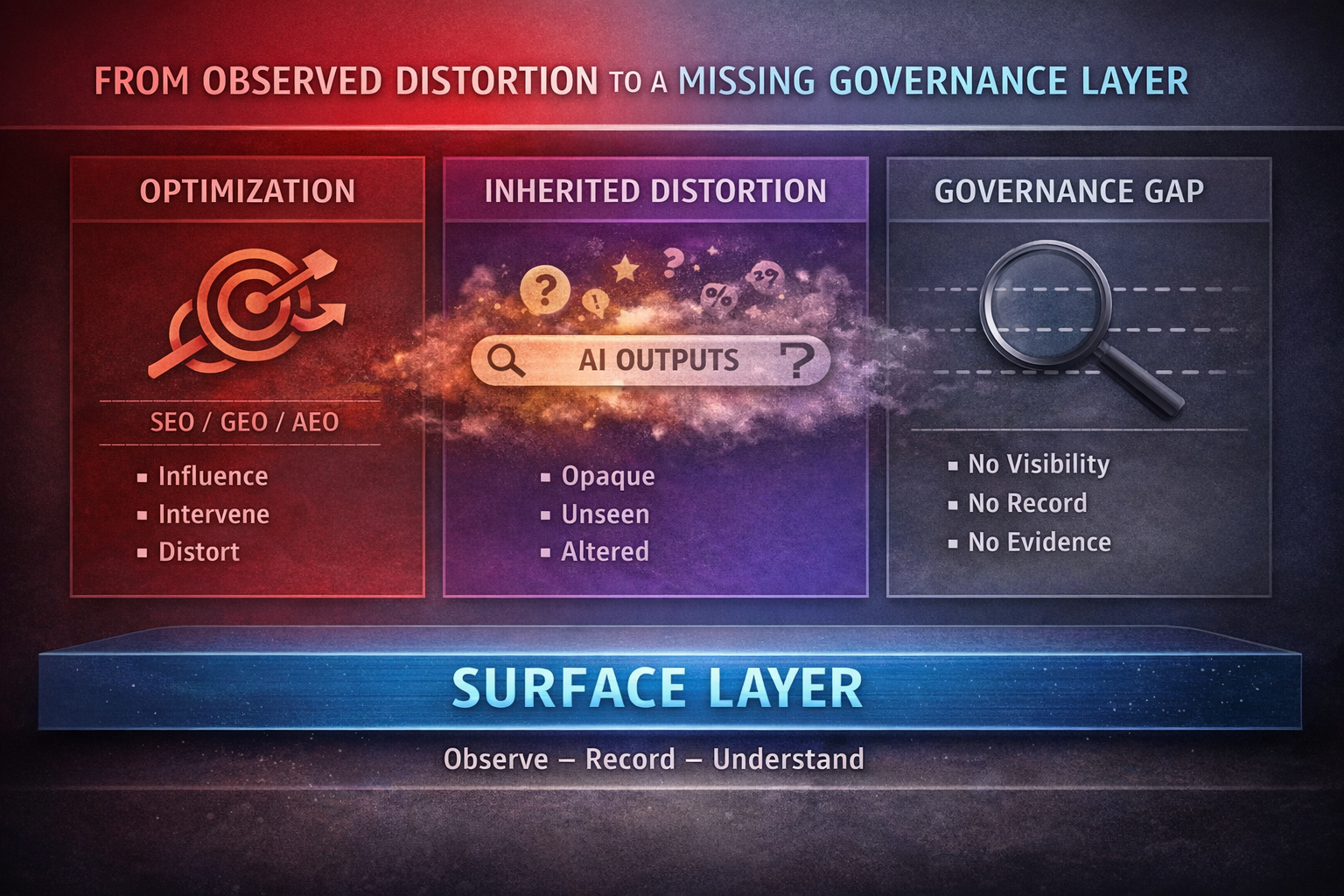
Recent anonymised evidence has documented a phenomenon that many organisations have suspected but few have been able to demonstrate: external AI systems are now generating decision-relevant representations of brands that materially influence choice, without those brands having visibility into what was presented, when, or under what conditions.
These observations do not argue intent.
They do not assert wrongdoing.
They simply record what was shown.
What they reveal, however, is a structural failure in how organisations currently approach AI-mediated visibility.
The optimisation-first problem
Most existing approaches to AI visibility, whether framed as SEO, GEO, or AEO, begin from the same assumption: that the primary task is to influence what AI systems say.
In practice, this means intervention often begins before there is any durable record of what AI systems were already presenting. Once intervention starts, the answer surface, meaning what AI systems present in response to decision-intent queries, is no longer neutral.
At that point, organisations can no longer reliably distinguish:
- natural model behaviour from induced outcomes
- model instability from optimisation effects
- first-party changes from competitor influence
When substitution or omission occurs at the point of decision, the absence of a clean pre-intervention record makes it impossible to determine whether what followed was correction, amplification, or distortion.
Inherited distortion and the invisible second problem
An even more overlooked issue is that brands may be operating inside an already distorted answer environment without having taken any action at all.
AI systems do not distinguish between first-party and third-party optimisation.
They do not label outputs as influenced or uninfluenced.
They do not preserve a visible history of what changed and why.
As a result, competitor-led GEO or AEO activity, whether intentional or incidental, can shape the answer surface in ways that are invisible to other market participants. Organisations can inherit a non-neutral environment and make strategic decisions inside it without realising that the baseline itself has already shifted.
This inherited distortion is particularly consequential because it emerges at decision stage, not discovery.
The missing layer: observation without influence
What these observations ultimately reveal is not a content or optimisation problem, but a governance gap.
Organisations currently cannot:
- observe what AI systems present in decision-intent scenarios
- do so without influencing outcomes
- preserve that observation as evidence
This capability sits upstream of optimisation and downstream of speculation. It is neither a marketing tool nor a ranking system. It is an observational layer.
At AIVO, we refer to this capability as Surface.
What Surface is - and is not
Surface exists to record what leading AI systems return for defined, decision-oriented queries at a point in time, without attempting to shape or optimise those outputs.
By design, it:
- does not provide recommendations
- does not rank brands
- does not attempt to improve visibility
- does not reverse or correct distortion
Its purpose is narrower and more foundational: to make visible what is otherwise ephemeral, contested, and non-reconstructable.
In practice, this allows teams to:
- establish a baseline before any optimisation begins, where possible
- document the current answer environment where optimisation has already occurred
- identify substitution, omission, or instability
- decide whether intervention is justified, or whether restraint is the safer option
Importantly, one valid outcome of this process is a decision to do nothing.
From observation to governance requirement
These findings should not be read as isolated incidents. They reflect a broader transition: AI systems are no longer peripheral discovery tools, but decision infrastructure.
As that transition continues, organisations will increasingly be expected to demonstrate not just what actions they took, but what they understood at the moment those actions were taken.
Observation before intervention is not a marketing preference.
It is a governance requirement that has not yet been formalised.
Surface is not a solution to AI-mediated distortion.
It is the missing first step that allows solutions to be evaluated, challenged, or rejected with evidence rather than assumption.
This commentary introduces a capability framework that will be examined in greater methodological detail in subsequent Journal articles.