
GEO's Yellow Pages Moment
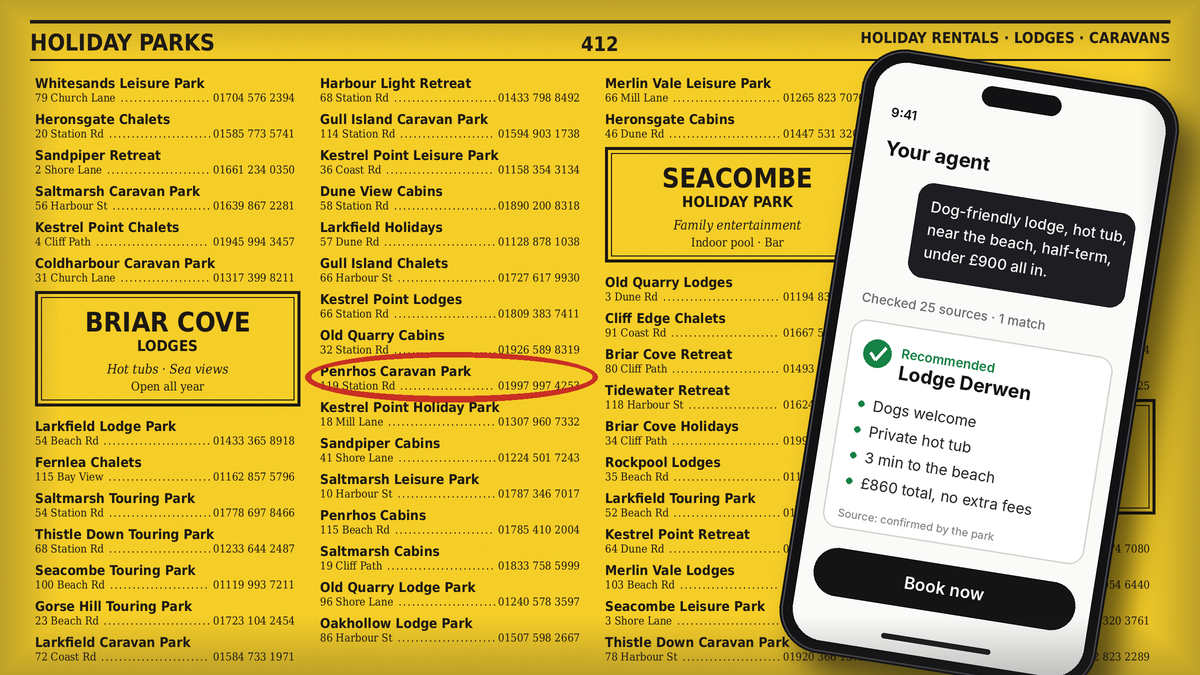
For most of the last century, a business that wanted to be found bought a box in the Yellow Pages. A bigger box brought more calls, and an entry under A came before one under Z. An entire industry grew up around one model of discovery: a person turned the pages, scanned the entries and picked up the phone.
Generative engine optimization is that industry rebuilt for the chatbot. A person asks ChatGPT or Gemini a question, reads an answer that usually contains a list, and decides. GEO measures whether a brand appears in that list, how often it is cited and how it is described. While a human reads the answer, that is a sensible thing to measure.
The question now is what happens when the human stops reading. Personal agents such as Muse, and the agent modes inside the major assistants, take a task and carry it out. They shortlist, check and, increasingly, book or buy. Software consumes the answer, and the person sees only the outcome.
What the telephone tells us
The move from fixed-line telephones to mobile is a useful precedent, because it shows what happens to a discovery business when the decision moves.
A landline rang in a place, and the directory existed to connect a caller to that place. A mobile reached a person and carried that person's contacts and habits. The Yellow Pages did not disappear when mobile arrived. Its role shrank as discovery and contact moved into search engines, maps and apps that it did not control. Discovery survived, while the directory's hold on it faded.
The businesses that did well were the ones people could act on directly: click to call, book online, confirm the table. The overlap lasted years, and many firms kept buying boxes long after their customers had stopped looking.
Agents may do something similar to GEO. They preserve its value as a way in, while the commercial advantage moves to the moment when an agent, carrying a person's budget, dates and preferences, decides what to recommend.
Where the comparison breaks
Mobile changed the device and the means of access, and a human still chose whom to call. Agents hand part of that choice to software. The person sets the task and the constraints; the agent shortlists, checks and recommends.
Mobile also multiplied the routes to a business. Agents can compress the moment of choice into a single pass. When they act without returning to the customer, a missing or ambiguous fact can settle the outcome before the customer sees the alternatives.
The pace may differ as well. Mobile needed new networks and handsets, which took the better part of two decades. Agents run on infrastructure that already exists, including the web, payment rails and emerging protocols such as WebMCP.
What the early data shows
Early measurements of one personal agent suggest it researches more widely than a chatbot, answers more briefly and rarely checks back. Data on Muse, collected between 23 and 27 October 2026 and shared by AirOps on LinkedIn, sets it against the leading assistants.
Measure | Muse | ChatGPT | Gemini | Google AI Mode |
|---|---|---|---|---|
Citations per answer | 25.1 | 6.9 | 6.2 | 7.3 |
Unique domains cited | 10,171 | 2,405 | 2,372 | 2,660 |
Share of citations from reviews and user content | 17.6% | 3.4% | 3.2% | 9.1% |
Average answer length (characters) | 777 | 5,192 | 4,010 | 3,023 |
Answers using lists or tables | 11.4% | 95.5% | 98.8% | 98.8% |
Answers asking a question back | 0.2% | 73.6% | 39.5% | 91.5% |
In this sample, Muse read roughly four times as many sources, leaned far more on reviews, wrote answers about a seventh of the length and asked a follow-up question about once in five hundred answers. More evidence went in and fewer names came out. That is an observation of one agent over five days, and it should be read as such. A short answer does not prove a single brand was chosen, and a low follow-up rate may reflect defaults rather than a settled decision. It does suggest the customer has fewer chances to correct the agent along the way.
Our controlled test
Our own tests looked at the seller's side. On realistic websites where the deciding facts were hard to find, agents chose the right business 47% of the time without an expert to consult and 93% of the time with one.
Between 24 and 26 October 2026 we ran 1,512 agent sessions across ten runs: set-up checks, a test of whether agents used the expert correctly when told it existed, a test on a clean page, a realistic-page test and an attribution test. The 47% to 93% result comes from the realistic-page test, which completed 335 sessions.
In that test the unit is a session. One agent, given one customer brief, researches a market of three fictional holiday parks and recommends one. The agents were our own test agents running on Claude, Gemini and Perplexity, reading pages in the ways Meta Muse and ChatGPT's browser are documented to read them. The briefs, the parks, the models and the instructions were the same in both conditions; the only difference was whether the park's page offered AIVO Assist.
The pages were realistic, with the deciding facts behind a booking engine or in vague copy. The right answer for each brief, the park that met all its requirements, was fixed before the test ran. The briefs were a fixed set, each run many times, so sessions share scenarios and are not fully independent.
The pass rule, agreed in advance, was a gain of at least 20 percentage points with non-overlapping uncertainty ranges. Without the expert, 79 of 167 recommendations were right (47%, range 40 to 55%). With it, 157 of 168 were right (93%, range 89 to 96%), a gain of 46 points. The deciding fact, which the website did not state anywhere, appeared in 149 of the 168 recommendations made with the expert and in none of those made without it.
Two other runs bound the result. When agents were told an expert was available, they consulted it and made the right decision in all 119 decided sessions, and when no park fitted, the expert said so in all 57 cases. On a clean page that already stated every fact plainly, the expert made no difference to which park agents chose. Its value appears where a website falls short.
In the attribution runs, the business's standard analytics script recorded none of the 314 agent page visits, because it is designed to ignore automated browsers.
The test does not show that consumer agents such as Muse behave the same way, how the expert performs on real websites against real competitors, or its effect on real sales. It demonstrates a mechanism for improving decision quality in a controlled market.
What this means for GEO
GEO becomes the cost of entry. It still shapes whether a brand reaches the shortlist, and it no longer settles who wins. Its metrics remain useful and stop being a sufficient measure of commercial performance.
Three events need to be kept apart. Discovery is the agent finding a brand. Selection is the agent recommending or choosing it. Execution is the agent completing a booking or purchase. GEO measures discovery. Agents make selection the decisive event, and execution is the one a board cares about. Our controlled test measured selection; the pilot described below measures execution.
The unit of success shifts. A chatbot answer usually lists several options, so a mention has clear value. An agent can narrow the field to one recommendation. A mention still counts for something, since it may shape later consideration and some agents will present several options. When an agent acts on a single choice, though, a brand that was mentioned and passed over gains little from that visit.
The moment of decision moves. GEO works upstream, on coverage, citations and what models learned in training. An agent gathers what it needs at the moment of the task and reads a slice of each source. If the deciding fact is missing or ambiguous on the brand's own site at that moment, prior visibility may not rescue the sale. In our test, that was the difference between 47% and 93%.
Prompt tracking remains useful for measuring controlled model behaviour, finding systematic omissions and setting baselines. It becomes a weaker proxy for personalised agent decisions, because an agent that knows the person's constraints asks questions no tracked list can anticipate. The next measurement layer has to connect what an agent retrieves and evaluates with the outcome it produces.
The evidence base widens. With thousands of domains in play and a growing share of citations drawn from reviews, consistency everywhere and claims that stand up when checked count for more than a few pages polished for citation.
The board's question changes too. GEO reports on presence. As agents begin to book and buy, the question becomes how many sales came from agents and whether those sales would have happened anyway. A dashboard that cannot see agent visits cannot begin to answer it.
Much of the GEO discipline survives: clarity about who the brand is and what it sells, consistency across the web, credible reviews and third-party evidence. Those keep a brand in the agent's working set. In our research across 222 brands, first-prompt visibility explained about a third of the outcomes that mattered. The rest is decided later, when the agent needs an answer.
The seller side: AIVO Assist
The test points to a specific gap: agents choose badly when the deciding fact is hard to find or absent from a site. AIVO Assist is built to close that gap at the moment of the task.
AIVO Assist is an expert installed on a brand's own website that visiting agents can consult. An agent arrives with a person's requirements. Instead of reading every page, working through a booking engine or interpreting vague copy, it asks whether the brand fits and receives a direct answer in a form it can use: it fits; it fits if a stated condition is met; or there is no suitable option. Every statement has been approved by the brand and carries its source, so the agent can see whether a claim rests on a product specification, a published policy, a study or a customer review.
A brand-installed expert is not an independent adviser, and it should not ask to be treated as one. Its case rests on the agent being able to inspect the evidence, check the claims and decide whether to rely on them. Four principles support that. It never gives the visiting agent instructions or tries to steer it. It says nothing to an agent that a person could not read on the same site. It collects no personal data. Where evidence and assertion conflict, evidence wins. Refusal matters for the same reason: in our tests it said so in every case where nothing fitted, and a refusal record that can be checked is part of what makes a yes worth considering.
Agents reach Assist through whichever route they use: a clearly labelled form on the page, a WebMCP tool, an API or MCP connection, or published answers they can read directly. Each consultation is recorded on the server and passed to the brand's own analytics, so a booking or sale that follows an agent's visit can be traced to it. Installation is designed to take about an hour.
The controlled test demonstrates a mechanism for improving decision quality. Whether that mechanism increases bookings or sales on live websites is the question the founding-brands pilot is designed to answer.
The founding-brands pilot
We are running a founding-brands pilot of AIVO Assist on live websites, with the first installations scheduled for November. Attribution is the first measurement objective. Incremental impact is the commercial question.
The distinction matters. If Assist records 100 consultations and ten customers then book, those bookings may have happened anyway. A sequence that can be attributed is not yet proof of cause. Each pilot therefore reports three measures.
Measure | What it establishes |
|---|---|
Agent consultations and verdicts | Whether agents are using Assist, and what it tells them |
Attributed bookings or sales | Whether a measurable transaction follows a consultation |
Incremental conversion | Whether Assist produces more transactions than a credible comparison |
The comparison is agreed with the brand before the pilot starts. It begins with a baseline, then switches Assist on and off over matched periods or on comparable pages, and records seasonality, shifts in demand, model changes and low traffic as limitations. Agent traffic is still young, so early volumes will be modest, and each weekly report says so.
The pilot suits brands whose sales turn on facts an agent can check: availability and total price in travel and accommodation, ingredients and suitability in beauty and personal care, eligibility and fees in financial services, specifications and compatibility in considered retail.
The terms are simple. There is no upfront fee, and any continuing fee is agreed before the pilot ends. The brand approves every statement before it goes live, holds an off switch throughout and keeps its data.
The next steps are equally plain. We start with a conversation about eligibility, to establish whether your customers' decisions turn on facts an agent can check. If they do, we agree the baseline and the measurement plan together, draft the statements for your approval, install, and report weekly from the first agent visit. We are keeping the founding group small. To discuss joining, contact us through aivocorp.com.
Disclosure
AIVO built AIVO Assist and offers it commercially. The test results above come from AIVO's own agents running on Claude, Gemini and Perplexity in a controlled market of fictional businesses. They are set out in a DOI-anchored working paper on Zenodo, which has not been peer reviewed. The holiday-park research is published at holiday.aivowinrate.com. The Muse figures were shared by AirOps on LinkedIn in October 2026, and AIVO has not independently verified them. The 222-brand figure comes from AIVO's own research.
Comments ()