
How AIVO Works: From Being Seen to Being Chosen

Being seen is not the same as being chosen
AI visibility matters. The next promise is that platforms can improve it, too. Buyers should ask what that improvement means: more mentions, more recommendations, or more business?
As the next round of platform announcements arrives, here are the standards we believe every provider, including AIVO, should meet.
Can you show whether AI started choosing the brand? Can you explain what changed? Can you connect an interaction to a click, basket, booking or sale, and distinguish that connection from proof that you caused it?
AIVO connects decision measurement, diagnosis, remediation and direct answers to buying agents. Each service can stand on its own. Together, they form a loop that ends with remeasurement.
Why visibility measurement stops short
A mention shows that a brand appeared in an AI answer. It does not establish that AI recommended it when the buyer was ready to choose. A brand can be visible and still lose because of:
- Access: the agent cannot reach or interpret decisive information, such as specifications, pricing, suitability or availability.
- Displacement: the brand appears early in a conversation, but a competitor takes the final recommendation.
- Unused facts: relevant evidence is available but does not influence the recommendation.
- Reputation drift: AI presents an outdated, incomplete or inconsistent account of the company to customers, investors, employees or regulators.
These are different problems. They require different investigations and different fixes. A visibility score alone cannot tell you which one to address.
One loop, four stages
AIVO connects four stages:
- Measure. AIVO Meridian measures whether AI chooses the brand across repeated buying conversations, including how recommendations develop over multiple turns.
- Diagnose. AIVO Prism tests explanations against documented evidence, distinguishing supported findings from plausible hypotheses.
- Remediate. AIVO, the client's agency or its own team addresses the evidence, access and content problems identified by the diagnosis.
- Answer. AIVO Assist provides sourced product answers to buyers and their agents, recording questions and unmet needs that can inform the next cycle.
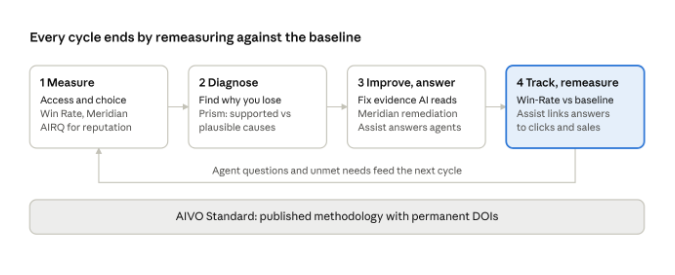
The cycle returns to measurement: did the tested recommendations change, and what remains unresolved?
AIVO Standard provides the methodological foundation through published methods with permanent DOIs. Clients can begin at any stage and use AIVO alongside their existing technology and agency relationships.
Separate recommendations, outcomes and causation
AIVO's headline decision measure is AI Win-Rate: how often AI selects a brand in the final recommendation across the tested buying conversations.
An increase means the tested recommendations changed. It does not, by itself, establish that sales increased or that a particular fix caused the change.
We distinguish three kinds of evidence:
- Tested recommendations. Remeasurement uses a comparable test design, with material changes in models, timing and test conditions disclosed. Repeated runs help assess variability.
- Observed outcomes. Where integrations and identifiers allow it, AIVO Assist can link an interaction to a recorded click, basket, booking or sale. A matched event establishes a connection; it does not automatically establish incremental impact.
- Unresolved attribution. A reference code alone does not prove that an answer caused a purchase. Unmatched outcomes remain unattributed, and modeled revenue exposure is reported separately from observed sales.
A before-and-after result can show improvement. Stronger claims about why it happened require stronger evidence, such as suitable controls or comparisons. The report should make that distinction clear.
Publishing for agents is only part of the job
Accurate, accessible content is essential. Buying agents may also need clarification during the decision itself: does this product suit the intended use, satisfy the customer's constraints or require a different option?
AIVO Assist is the brand's product expert. It answers questions from AI systems gathering information and from buying agents acting for customers. It uses sourced brand evidence, asks for missing details when needed and gives one of three verdicts:
- Fits: the product meets the stated need.
- Fits if: it meets the need under a stated condition.
- No suitable option: the available range does not meet the need.
The purpose is to help the buyer reach a supported decision. Sometimes that means declining to recommend a product.
Each answer carries a tracking reference. Where that reference or another permitted identifier connects to a downstream event, the interaction can be linked to an observed outcome.
The conversation also provides evidence about demand: the constraints buyers express, the information they cannot find and the needs the brand cannot meet. Those findings can inform content improvements, product decisions and future measurement.
Agent-readable content helps make the brand's evidence accessible. A product expert adds the ability to clarify that evidence in the context of a particular buying decision.
Every improvement claim should be independently checkable
When one provider measures, diagnoses and fixes, clients should be able to examine how it reached its conclusions. That applies to AIVO as much as to a platform vendor.
AIVO supports that scrutiny in three ways:
- Published methodology. AIVO Standard documents the methods behind the measures, with permanent DOIs, so clients and reviewers can inspect their basis and limitations.
- Documented diagnosis. AIVO Prism distinguishes findings supported by evidence from hypotheses that need further testing. A plausible explanation should not become a remediation commitment simply because it sounds convincing.
- Separate purchasing options. Clients can use AIVO to measure and retest fixes performed by their agency, CMS provider or internal team. Where AIVO also performs remediation, that role is disclosed.
Published methods support scrutiny. They do not make a provider independent of work it performed itself. Buyers should be able to distinguish external measurement of another provider's work from a vendor's assessment of its own results.
Six questions to ask any AI visibility platform this week
- Do you measure whether AI chooses us in a buying conversation, or only whether it mentions us?
- Do you test multi-turn journeys, and can you show where a competitor displaces us?
- How do you distinguish an explanation supported by evidence from a plausible hypothesis before we spend money on a fix?
- Who measures the result, what role did they have in the remediation, and is the methodology published?
- Can a buying agent ask our brand a question and receive a sourced answer, including “no suitable option”?
- How do you report unattributed outcomes, distinguish matched events from causal impact, and keep modeled revenue separate from observed sales?
These questions apply whether the proposed solution is a dashboard, a content platform, an agency service or a brand-side agent. They apply to AIVO, too.
Start where you are
You do not need to replace your stack to begin:
- New to AI measurement: start with a Win-Rate check to establish a baseline.
- Already using a visibility tool: add decision measurement to test whether being mentioned leads to being chosen.
- An agency handles your fixes: use AIVO's measurement and diagnosis to direct the work, then retest.
- AI misrepresents your company: begin with an AI reputation study.
- Need a focused engagement: a 30-day Sprint establishes a baseline, addresses three priority findings and measures again.
This week's announcements will describe what platforms can do. Buyers should ask what changed in the recommendation, what happened afterward and how much of that result the evidence supports.
Read How AIVO Works. To discuss a Win-Rate check for your category, contact tim@aivocorp.com.
Comments ()