
How Search Ends
Why AI Agents Will Replace Search as the Primary Commercial Interface
There is a question almost nobody in digital marketing is asking.
What happens when customers stop searching?
For thirty years commerce began with a Google search.
A customer wants something.
They type words into a search engine.
They browse websites.
They compare products.
Eventually they make a decision.
Everything we built—from SEO and search advertising to attribution, analytics and AI Search optimisation—rests on that single assumption.
That customers search.
But they won't.
Not because Google fails.
Not because large language models replace search.
Because customers increasingly won't do the searching at all.
They will delegate it.
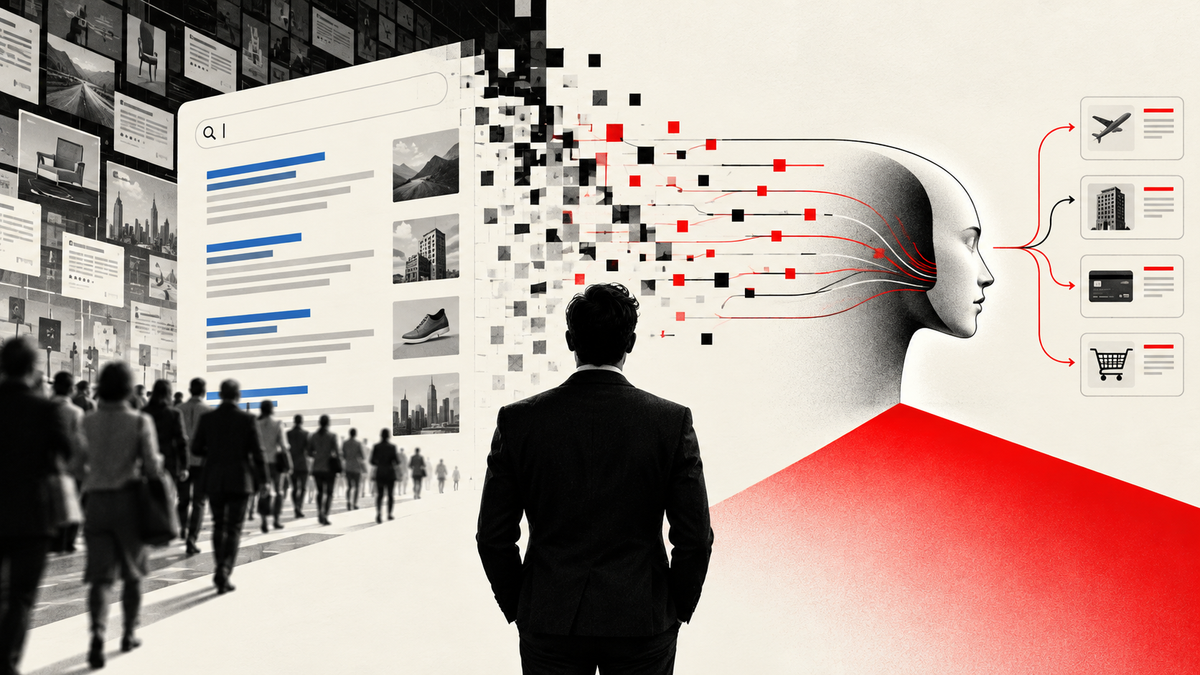
The commercial interface shifts from human → search engine to human → AI agent.
That changes everything.
Search was an accident of history
Search feels permanent because an entire generation grew up with it.
It isn't.
Search solved one problem.
Humans knew what they wanted but didn't know where to find it.
The web became too large.
Search organised it.
That was never the objective.
The objective was making a decision.
Search was simply the shortest path available.
AI changes the path.
The age of delegation
Imagine booking a family holiday.
Today you search.
Tomorrow you simply say:
Find us somewhere warm in February.
The agent already knows your children.
Your budget.
Your loyalty programmes.
Your passport status.
The schools.
The weather you prefer.
The flights you've previously rejected.
It doesn't search.
It reasons.
It eliminates.
It negotiates.
It books.
You never see the search.
Because there wasn't one.
There was a decision.
The end of optimization
This is where almost the entire industry is looking in the wrong direction.
Everyone is asking:
How do we optimize for AI Search?
That question assumes search remains the interface.
It doesn't.
If an AI agent chooses directly between products, optimisation no longer happens on Google.
It happens inside the enterprise.
The optimization loop becomes:
Knowledge → Decision → Outcome → Learning
The enterprise continuously improves the knowledge presented to AI agents.
Not its ranking.
Not its keywords.
Its decisions.
The public web becomes a reference library.
The enterprise knowledge layer becomes the commercial interface.
Visibility becomes table stakes
For years marketers have chased visibility.
Then citations.
Then AI mentions.
But visibility has never been the objective.
Recommendation has.
An AI can mention your company.
Quote your website.
Link to your product.
And still recommend your competitor.
Visibility creates possibility.
Recommendation creates revenue.
Those are not the same thing.
Search gives way to consultation
The future commercial interaction is unlikely to begin with an AI crawling millions of web pages.
It begins with the agent consulting trusted sources.
Some public.
Some private.
Some owned directly by the enterprise.
The question changes completely.
Instead of asking:
Can the AI find us?
Businesses ask:
Can the AI trust us enough to make a decision?
That is a different problem.
And it requires different infrastructure.
The rise of decision infrastructure
The next generation of enterprise software will not optimise search.
It will optimise decisions.
It will answer questions such as:
Why was this product recommended?
Which evidence mattered?
Which facts were missing?
Which products consistently fail qualification?
Which changes increase recommendation rates?
Which recommendations generate measurable commercial outcomes?
Those answers cannot be found in search analytics.
They emerge only when the enterprise governs the knowledge presented to AI agents and measures what happens afterwards.
Why attribution becomes the new search
Search created traffic.
Traffic created attribution.
Agentic commerce reverses the process.
The customer may never visit your website.
The AI agent may never click a link.
Yet a recommendation is made.
A transaction occurs.
Revenue is generated.
The enterprise that cannot connect those events has become blind to its own commercial performance.
The future belongs to businesses that can measure the complete chain:
Need → AI consultation → Recommendation → Decision → Transaction
Everything else becomes a proxy.
How search ends
Search does not disappear.
It becomes infrastructure.
Invisible.
Like DNS.
Like HTTP.
Like the routing protocols that move data around the internet today.
Nobody optimises for them.
Nobody thinks about them.
They simply exist.
Search will become one source among many that AI agents consult while making decisions.
The commercial interface has moved elsewhere.
For thirty years businesses competed to be found.
Over the next thirty they will compete to be chosen.
That is how search ends.
Not with fewer searches.
But because search ceases to be the place where commerce happens.
Tim de Rosen
CEO & Co-Founder, AIVO, Inc.
AIVOCORP - Infrastructure for the Agentic Economy
Comments ()