
Is the Zero Click Era Over?
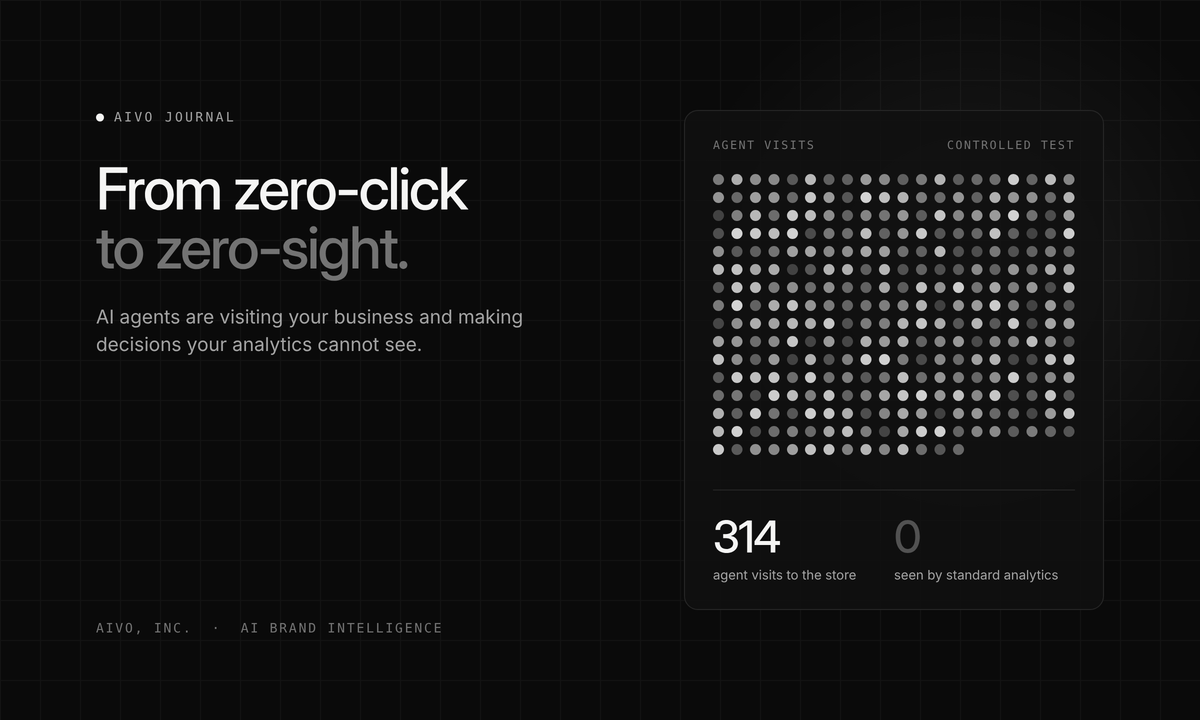
The zero-click era is giving way to the zero-sight era. AI agents are visiting your business, making decisions your analytics cannot see.
The famine everyone measured
For two years, the story of AI and search has been one of subtraction. SparkToro's latest analysis of Similarweb clickstream data found that 68.01% of US Google searches ended without a click in the first four months of 2026, up from 60.45% in 2024. Only around a third of searches now produce any click at all, and a shrinking share of those reach the open web. Ahrefs found that when an AI Overview is present, the click-through rate for the top-ranking page falls by roughly 58%.
Publishers called it an extinction event. Brands called it the AI famine: the answers were still being given, but the visits that used to follow them had dried up.
Then the visitors came back
Holiday 2026 is shaping up as the first season in which the shopping agent actually pays. In the past few weeks alone, OpenAI launched ChatGPT wallet to push agent purchases through retailer checkouts, Google began rolling out UCP-powered checkout in Canada through AI Mode and Gemini, Walmart started letting customers cap an agent's spending at $50, $100 or $200, and Amazon blocked Meta's Muse agent from its retail site. Bain estimates that roughly one in four online shoppers plan to start their holiday shopping on an AI platform.
The traffic numbers have turned too. Adobe reports that AI-referred traffic to US retail sites grew 71% year over year in September 2026, and 1,772% since October 2024. Those visitors converted 90% better than non-AI traffic and generated 83% more revenue per visit. A year earlier, in August 2025, AI traffic converted 9% worse.
So is the zero-click era over? It is tempting to say yes. It would also be wrong.
The click came back. The customer didn't.
Look carefully at what Adobe is counting: humans clicking a link after an AI assistant has already done the research. That click arrives at the very end of the journey. The shortlist has been drawn up, the comparison made, the deciding facts checked. That is why AI-referred visitors convert so well. They arrive further along the decision-making journey, often with a shortlist already established.
Behind that small, valuable human click sits a much larger flow of machine visits. Agents now read product pages, interrogate specifications, compare stores and check claims on the shopper's behalf. This is Shopping Augmentation: the agent takes over the slog of product research while the shopper still makes the final pick, or increasingly hands that over too.
Most of this activity is invisible. In AIVO, Inc.'s controlled testing, standard web analytics recorded zero of 314 agent visits. The agent came, read, judged and left, and the brand never knew it had been considered, let alone rejected.
The zero-click era isn't ending. It is changing shape. We are moving from zero-click to zero-sight: a famine of human visits alongside a feast of machine visits that your dashboards cannot see, making decisions you never get the chance to influence.
It is worth keeping a sense of proportion. eMarketer puts US end-to-end agentic commerce sales at $1.44 billion this year, and Okta finds only 31% of consumers are likely to let an agent complete a purchase without reviewing it. Agentic checkout is still small. Agentic research is not, and research is where the choice is made.
The new question: will the agent choose you?
For twenty years, digital marketing asked: did they see us, and did they click? In agentic commerce, the question becomes: when an agent goes looking on a customer's behalf, does it choose us?
Agents don't browse. They interrogate. An agent arrives with a specific need (a waterproof trail shoe in a wide fit, under $150, for someone on their feet all day) and looks for the deciding fact. If it can find, read and match that fact on your store, you are in contention. If it can't, it will often move on to a store where it can. There is no bounce, no abandoned cart, no session in your analytics. You may never learn you were in contention.
What we see again and again in AIVO, Inc.'s work is that brands rarely lose because their product is wrong. They lose because the facts are on the store, but agents can't find, read or match them. As Capgemini has observed, when AI does the shopping, brand preference gives way to product fit and value for money. The best marketing alone no longer decides who wins. The best answers do.
Five ways to make sure your brand is the one the agent selects
1. Measure whether you are chosen, not just whether you are seen
Visibility is not selection. Being mentioned in an AI answer is a long way from being the brand an agent recommends or buys. GEO gets brands seen by AI; the measure that matters commercially is AI Win-Rate℠: how often AI assistants and agents choose your brand when they work through real buying scenarios in your category. If you are not measuring it, you are managing the wrong number.
2. Find the deciding facts agents can't establish
Every category has a small set of facts that decide the sale: fit, compatibility, ingredients, certification, warranty terms, who the product is not for. Map them, then test whether an agent can actually establish each one from your store. The questions agents ask, in your customers' own words, are also the best demand intelligence you will ever get.
3. Give agents an expert to consult
Agents would rather ask than guess. AIVO Assist gives them the brand's own product expert to consult: the agent describes the customer's need and gets a clear, sourced judgment on fit, drawn only from facts the business has signed off.
In a controlled test on 26 October 2026, agents chose the right business 93% of the time with AIVO Assist available, against 47% without it (157 of 168 runs versus 79 of 167). Every agent that consulted the expert picked correctly. Early live tests with the ChatGPT agent and Instinct show agents finding and using the expert unprompted.
The honest answers matter as much as the positive ones. An expert that says No suitable option when the product doesn't fit is an expert an agent can trust when it says Fits.
4. Remediate at source
When agents and AI assistants get your brand wrong, the fix is not a new page or a few more keywords. It is correcting the facts and evidence that AI systems draw on, and making sure they are reachable. That is remediation, not optimization. Independent evidence beats marketing claims, and AI systems increasingly know the difference.
5. Attribute what the machines do
If you cannot see agent activity, you cannot manage it, and you cannot defend the budget for it. Every AIVO Assist answer carries a reference code and tracked link. In testing, 14 of 14 agent-influenced outcomes were correctly credited, with no false credits, in the same conditions where standard analytics saw nothing.
What this means for the boardroom
The metrics that defined the search era (impressions, sessions, click-through rate) describe a smaller and smaller part of how customers now decide. Three shifts follow:
- From traffic to selection. The KPI that matters is how often you are chosen, not how often you are visited.
- From invisible loss to measured loss. Every time an agent cannot establish a deciding fact, the brand risks being eliminated from consideration without ever knowing it. That loss can now be measured, and fixed.
- From persuasion to proof. Agents weigh evidence, not adjectives. The brands that win will be the ones that make the truth about their products easiest for a machine to find and verify.
The real answer
The zero-click famine was never really about clicks. It was about losing the moment of choice. Agentic commerce hands that moment back, not to every brand, but to the brands the agent can understand and trust.
The click is coming back. The question is whether it will be yours.
AIVO, Inc. is an AI Brand Intelligence company. GEO gets brands seen by AI; AIVO measures and improves whether AI assistants and agents choose them, with AI Win-Rate℠ as the headline measure.
Sources
- SparkToro / Similarweb zero-click study, reported by Search Engine Land and Search Engine Journal
- Ahrefs: AI Overviews reduce clicks by 58%
- Digiday: Welcome to the agentic commerce quarter (Bain, eMarketer, Okta, Gartner figures)
- Adobe: AI traffic drives 83% higher revenue per visit
- Capgemini: retail and agentic AI
- Sheals & de Rosen, AIVO Assist working paper, Zenodo, DOI 10.5281/zenodo.23694598
Comments ()