
Marketplace or Brand? AI Agents Will Buy From Whoever Can Answer
Amazon and Walmart are racing to become the place where AI agents shop, and Shopify wants every store it powers to be ready for them. The natural assumption is that agents will make the largest marketplaces stronger still.
The evidence so far points to a different winner. In routine, price-led buying, the marketplaces' speed and certainty will carry the day. In considered purchases, where one fact decides the sale, the advantage goes to the seller that can prove it fits, whatever its size.
The dividing line is answerability.
Answerability is a seller's ability to give an AI agent the precise fact that decides a purchase, together with evidence the agent can trust.
The case for marketplaces
Marketplaces are built in a way that suits agents. They offer one checkout, structured catalogues, known delivery promises, standard returns and reviews at scale. An agent trying to complete a task quickly and with little risk will find that combination hard to beat.
The largest marketplaces are also building their own agents and setting the terms for everyone else's. Walmart says customers who use its assistant, Sparky, spend about 35% more per order, and Amazon attributes more than $10 billion in incremental annualised sales to Rufus. Walmart's new Agent Profiles let outside agents shop for a customer within limits the customer sets. Amazon has taken the opposite route, blocking Meta's Muse from its site in September on the grounds that the agent did not identify itself. Both moves keep the platform in control of how agents buy.
Those sales figures need care. They mix the effect of the agent with the fact that keen shoppers are the ones most likely to use it, and they do not say where the extra sales come from. Even so, the direction is clear: the marketplaces intend to be where agents shop.
The case for independent brands
Personal agents search the open web. They are not confined to one marketplace's ranked shelf, so paid placement inside that shelf buys less influence over the final choice. Early data on Muse, shared by AirOps, showed it drawing on about 25 sources per answer, four times as many as ChatGPT, and returning a short answer with very few names in it.
Agents also work from specific briefs. A person rarely asks an agent where to buy a laptop. They ask it to find the lightest Windows laptop under $1,500 that runs AutoCAD and lasts sixteen hours on a charge. That is qualification, a different task from search, and it rewards whoever can confirm the deciding fact. Specialists usually know their own facts best. A marketplace listing, by contrast, can share a title with another listing while differing in variant, bundle, seller or delivered price. A brand answering for itself removes that doubt.
The convenience gap is closing too. Agent checkout from payment and commerce platforms, and services that let agents pay with a protected card, make an independent site as easy for an agent to buy from as a marketplace. And when a marketplace blocks an agent, the agent still has a task to finish, so it goes elsewhere.
What our data shows
Three pieces of AIVO research point the same way. Smaller sellers can win when the answer fits, and they disappear when it does not.
The first is banking. In our study of small-business banking recommendations, covering 30 US banks and 2,160 AI conversations, fintech challengers won 86% of the time against established banks. Size and history did not protect the incumbents; the challengers' answers fitted the buyers' needs more clearly.
The second is a controlled test. We ran our own agents on Claude, Gemini and Perplexity in a market of three fictional holiday parks, on realistic websites where the deciding facts were hard to find. With only the ordinary pages, agents made the right recommendation 47% of the time (79 of 167). When the park offered an expert the agent could consult, that rose to 93% (157 of 168). The deciding fact appeared in 149 of the 168 recommendations made with the expert, and in none of those made without it.
The third is a snapshot of an independent consumer brand. Agents recommended it in 24 of 25 briefs that described what it does best. Across the wider market it won 13 of 102. On briefs about its signature ingredient category, it was found in none of 15. The brand was strong wherever the brief matched what it could clearly prove, and almost invisible where it did not.
Where the line falls
The split follows the kind of decision an agent is asked to make.
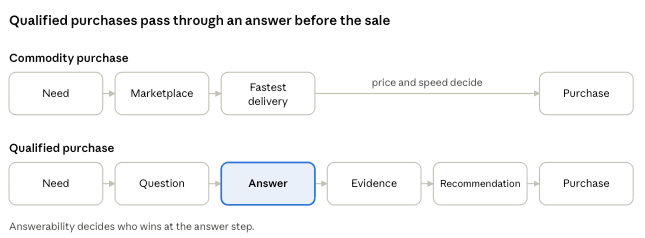
In a commodity purchase, price and speed carry the agent straight to the marketplace. In a qualified purchase, the sale passes through a question, an answer and the evidence behind it.
Where one product is much like another and the brief is about price and speed, such as replenishment, everyday basics and well-known items, the agent's best move is the seller with the lowest risk and the fastest delivery. That favours marketplaces, and their own agents will reinforce it.
Where the brief carries conditions, the decision changes. Compatibility, suitability, eligibility, total cost and evidence all have to be confirmed, and the agent needs a seller that can confirm them. These purchases are often higher in value, and they are where independent brands have the most to gain. They are also where a brand that cannot be read or questioned loses by default, because the agent moves on to whoever can answer, and that is often the marketplace.
The advantage therefore goes to the seller that can answer, whatever its size, and in considered categories that is a contest any well-prepared brand can enter.
What independent brands should do
Most commercial websites cannot answer the deciding question. They were built for people who browse, and agents behave differently: they read a slice of a site, rarely ask a follow-up and move on. For an independent brand, the practical test is whether an agent arriving with a specific brief can confirm the fact that decides the sale.
That is why we built AIVO Assist. It is an expert installed on the brand's own website that visiting agents can consult. It answers only from statements the brand has approved, each with its source, and gives one of three verdicts: it fits, it fits if a stated condition is met, or there is no suitable option. Every consultation, and the sale that follows, is reported into the brand's own analytics, because standard analytics recorded none of the 314 agent visits in our tests.
The controlled results show the mechanism works. Whether it wins more customers on live websites is what our founding-brands pilot is designed to measure, first by attribution and then by comparing periods with and without Assist. We are taking a small number of independent brands into that pilot, with no upfront fee. Brands whose sales turn on facts an agent can check are welcome to contact us through aivocorp.com/assist.
In the agent economy, the winners will be the sellers that can answer, whatever their size.
Disclosure and sources
AIVO built AIVO Assist and offers it commercially. The holiday-park results come from AIVO's own agents in a controlled market of fictional businesses and are set out in a DOI-anchored working paper (doi.org/10.5281/zenodo.23694598) that has not been peer reviewed. The banking study and the consumer-brand snapshot are AIVO research; the consumer brand is not named. The Muse figures were shared by AirOps and have not been independently verified by AIVO.
Other sources: Walmart Sparky figure, WARC; Amazon Rufus figure, The Drum; Walmart Agent Profiles; Amazon's block on Muse, SiliconANGLE.
Comments ()