
Measuring the AIVO Paradox was never the hard part
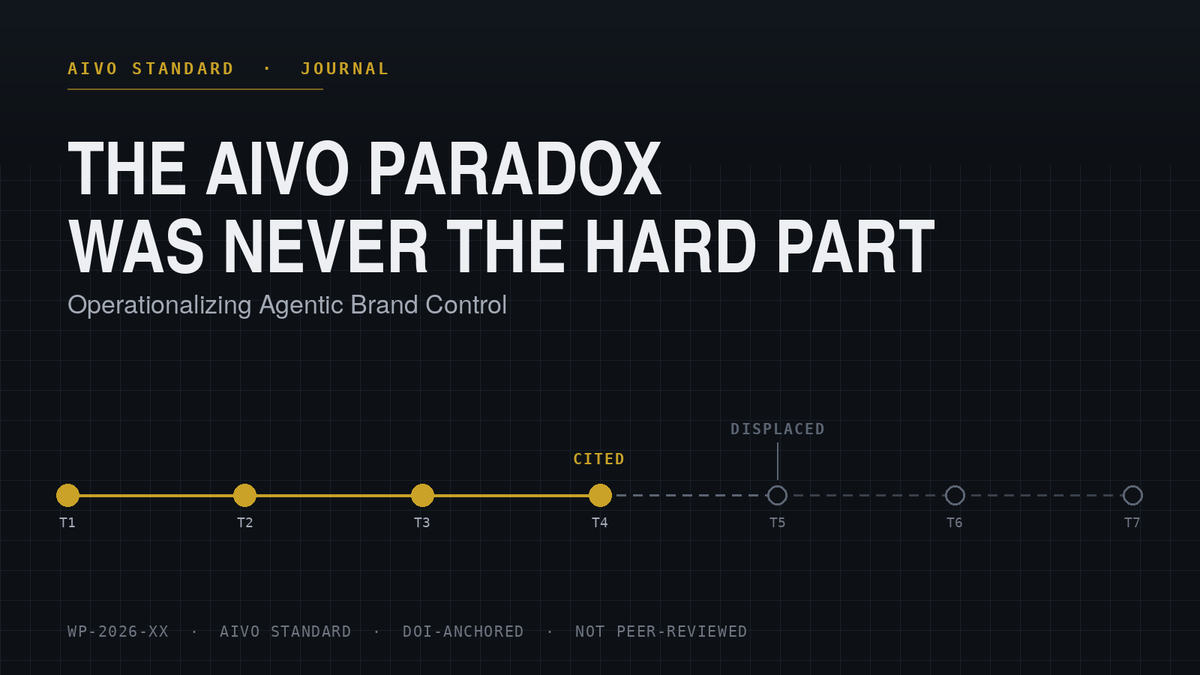
A brand can appear in an AI system's answer and still lose the sale.
We named this the AIVO Paradox in WP-2026-12: brands with strong AI visibility routinely achieve zero or near-zero recommendation rates by the final turn of a purchase conversation. The finding held across models, across personas, across categories. Once a brand understood it was exposed, the obvious next question followed immediately. Now what?
That question is the subject of our latest working paper, published today under AIVO Standard.
Conversational Survival Rate tells a brand whether it is exposed. It does not tell a brand why. Displacement has several distinct causes, and each requires a different fix. Sometimes an AI system holds outdated information about a brand. Sometimes it holds accurate information that simply does not survive the length of a real conversation. Sometimes a competitor's information is easier for the model to retrieve and weight. Treating all three as the same problem, and applying the same fix to each, wastes effort and rarely moves the score.
The instinct many teams reach for first is more content. More pages, more posts, more mentions. We see this pattern often enough to give it a name internally: the recency treadmill. It rarely works. AI systems do not reward volume. They reward a small set of information that is consistent, authoritative, and structured in a way that survives retrieval across multiple conversational turns. Adding more material, especially material that is inconsistent in framing, tends to add noise rather than signal. The operationally relevant question is not how much content exists about a brand. It is whether a small set of trustworthy information reliably persists through to the point where the system builds its final answer.
This is the role of what we call the Evidence Supply Chain: the structural persistence of brand information across a conversation, not just at the moment a brand is first mentioned.
Our new paper sets out four steps for acting on this. Diagnosis identifies precisely where in a conversation a brand drops out, and why. Remediation repairs the specific failure that diagnosis reveals, whether that means correcting facts, consolidating scattered sources into one authoritative version, or restructuring information so a model can actually retain it. Resilience testing checks whether a fix holds once a conversation gets harder: an objection, a price comparison, a direct challenge, a change in what the buyer says they care about. A brand that only wins under a friendly, uncontested prompt has not solved its exposure. It has only moved where the loss happens. Monitoring tracks whether a fix keeps working over time, since the models themselves keep changing, competitors keep moving, and information that was authoritative six months ago quietly decays.
None of this replaces the category we defined in WP-2026-12. It completes it. Definition without an operational response is a diagnosis with no treatment plan. This paper is the treatment plan.
We will publish a third paper in this series addressing the commercial case directly: what a Conversational Survival Rate improvement is actually worth in revenue terms, and what return a specific remediation delivers. For now, the working paper is available on Zenodo, DOI-anchored, not peer-reviewed, open for anyone building against this problem to read, test, and challenge.
 de Rosen, Timothy and Sheals, Paul
Comments ()