
Measuring the Wrong Era: Why the IAB's New Visibility Framework Can't See Past the Query
Summary
On August 3, 2026, the Interactive Advertising Bureau published Measuring Visibility in the AI Era, the industry's first attempt at a shared vocabulary for AI visibility measurement. It is a genuinely useful document in the narrow sense: it gives brands, agencies, and publishers common terms — Mention Rate, Citation Rate, Share of Voice, Position — and a two-tier quality standard (Directional vs. Decision-Grade) that will improve how the market evaluates the twenty-plus vendors currently selling AI visibility tools.
It is also, by its own admission, a framework for a discovery model that no longer describes how AI-native consumers actually behave. This article lays out why, using the document's own numbers, structure, and stated limitations as evidence.
1. A Causal Hierarchy Built for Single-Turn Search
The IAB framework organizes its metrics into what it calls the "4 P's of AI Visibility": Presence, Prominence, Portrayal, and Persuasion. Each answers a question about a single AI response:
- Presence — Does the brand appear or is the publisher cited?
- Prominence — Where and how prominently?
- Portrayal — In what context, and with what accuracy?
- Persuasion — Does visibility drive action?
This is a faithful, well-constructed model of search engine result page mechanics: query in, ranked list out, click or no click. It is not a model of what actually happens when a consumer uses ChatGPT, Gemini, Claude, or Perplexity to make a decision.
The document's own market-context section undercuts its methodology. It cites ChatGPT's 900 million weekly active users and Google AI Overviews' 2.5 billion monthly users, and notes AI Overviews now appear on almost half of all searches. What it does not reckon with structurally is how those users interact with AI systems: not as a single query answered once, but as an extended exchange — refining constraints, ruling out options, asking follow-up questions — that plays out over several turns inside one session before a decision is reached.
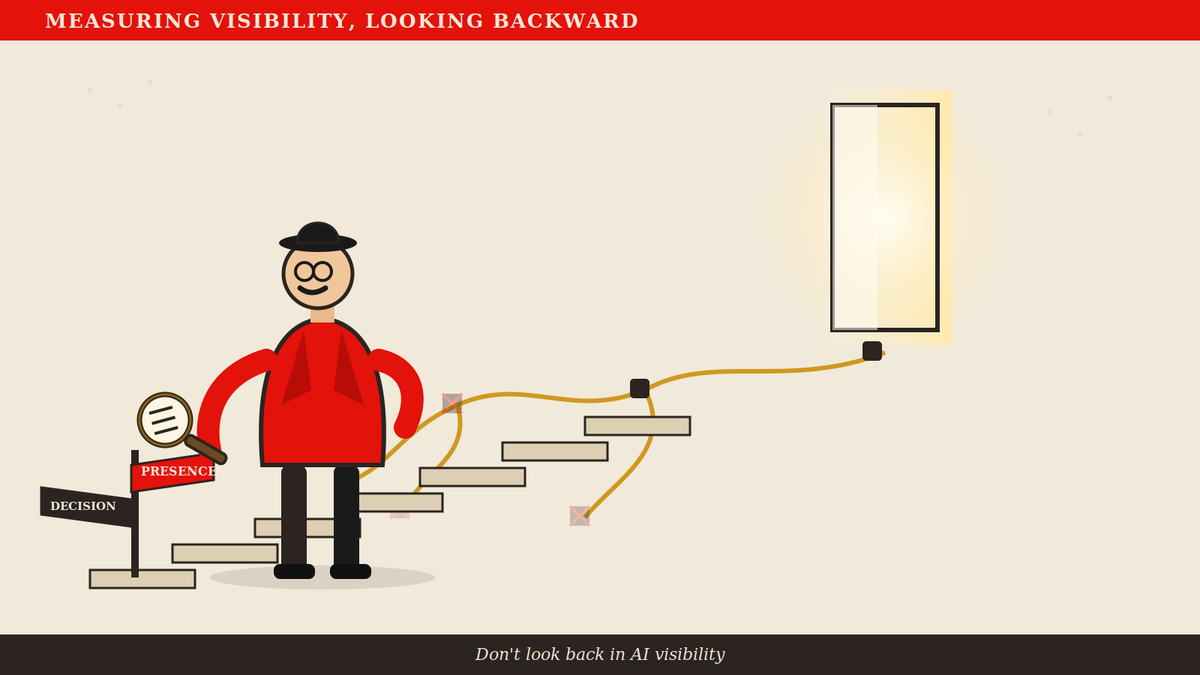
A metrics hierarchy anchored entirely to "does the brand appear in a response" cannot see the thing that actually determines commercial outcomes in a multi-turn medium: whether the brand is still there by the last one.
2. The Turn-Three Problem
Consider a realistic buying sequence:
Turn 1: "What are the top enterprise CRM platforms?"
Five brands surface. All five are named with specific, confident language — high Recommendation Strength by the IAB framework's own definition. A vendor measuring Persuasion at this point would report a strong result for every brand in the list.
Turn 3: "Which of these have native HIPAA compliance and cost under $50 per seat?"
Two of the five brands quietly disappear. Not because their Presence, Prominence, or Portrayal metrics changed — nothing about how they were described in turn one was wrong or diminished. They simply did not survive the constraint the consumer introduced next.
Under the IAB framework, this failure is invisible. Persuasion is scored against a single response — Recommendation Strength and Post-Citation CTR are both defined and measured within one AI answer, in isolation. A brand that wins turn one and vanishes by turn three registers as a Persuasion success, because no metric in the hierarchy is designed to look past the response it was measured in.
This is not a hypothetical edge case. It is the ordinary shape of how AI systems handle any query complex enough to require follow-up — which is most commercial and consideration-stage queries, by definition.
3. The Denominator Problem, By the IAB's Own Admission
The clearest evidence that the IAB working group saw this gap and could not close it sits in the document's "Emerging Metrics" section, under Competitive Displacement Rate:
"The frequency with which a brand is mentioned in AI responses while a direct competitor is not... the denominator is interpretively unreliable: A competitor's absence from a response could mean the AI preferred the focal brand, or it could mean the query did not surface the category at all. The metric cannot distinguish between those two cases, which makes standardization difficult."
Put concretely: if a consumer asks for "durable marathon shoes" and the model surfaces Nike and Hoka while never mentioning Adidas, was Adidas displaced — actively considered and rejected by the model's reasoning — or was it simply never in the running because the query's internal clustering never touched Adidas's category positioning at all? Those are two entirely different events for a brand: one is a measurable loss at the decision layer, the other is noise. The IAB framework cannot tell them apart, and says so directly.
This is not a footnote. It is the central open problem of AI visibility measurement — the one question that, if answered, would tell a brand whether it is actually losing ground to a named competitor inside the reasoning chain, rather than simply being in a query set the competitor also isn't in. Filing it as "not ready for standardization" in a document that otherwise positions itself as defining the state of the art is a tell, not an oversight: the working group encountered the boundary between visibility and outcome, and stopped there.
4. Same Category Error, New Channel
Search analytics spent roughly a decade over-indexing on the metric that was easiest to instrument — impressions, rank position, click-through — before the industry broadly accepted that presence in a result set was necessary but not sufficient to explain revenue. Attribution, incrementality, and outcome-based measurement arrived because visibility metrics alone kept failing to explain why some highly "visible" brands weren't actually winning business.
The IAB framework repeats the first half of that cycle for AI discovery: Mention Rate, Citation Rate, Share of Voice, and Position are, functionally, Impressions and Rank Position rebuilt for a conversational medium. They are useful, disclosure-able, comparable across vendors — and they answer the same question search analytics answered for fifteen years: did the brand show up.
They do not answer the question that has become the actual site of competitive loss in an AI-mediated purchase journey: does a brand that shows up survive the reasoning chain to the recommendation that actually gets acted on. A brand can carry a 90% Mention Rate under the IAB's own methodology and still be eliminated before the final answer in the overwhelming majority of buying sequences that involve more than one turn.
5. What a Framework for This Era Would Need to Measure
Closing the gap the IAB has correctly identified but not solved requires methodology built around the reasoning chain itself, not the individual response:
- Survival, not presence — whether a brand named early in a multi-turn exchange is still present, and still recommended, at the point a consumer would act.
- Displacement with a resolvable denominator — distinguishing a brand that was actively considered and dropped from a brand that was never in the model's candidate set to begin with, which requires probing the reasoning chain itself rather than scoring isolated responses.
- Turn-level attribution of loss — identifying where in a sequence a brand drops out, since a brand eliminated at turn two by a price constraint has a different, more actionable problem than one eliminated at turn four by a feature comparison.
This is the boundary AIVO's own published research has been built around since the original Linkage Gap working paper (WP-2026-14): visibility and decision-stage survival are different measurements, correlate less than intuition suggests, and require different instrumentation. A brand's citation rate says almost nothing about whether it makes the final cut.
6. Where This Leaves the Market
Measuring Visibility in the AI Era is a legitimate and useful step for the narrow problem it set out to solve: giving brands, agencies, and publishers comparable vocabulary and disclosure standards for presence-level measurement, in a market that badly needed both. On that problem, the document delivers.
But it should be read for what it is: a standard for the query-and-response era of AI discovery, arriving at the moment that era is already giving way to something more conversational, more iterative, and considerably harder to instrument. The industry now has good, comparable ways to measure whether a brand shows up. It still has no standard for the question that actually decides outcomes — whether the brand is still there when the conversation ends.
That gap won't close by treating it as future work. It closes by building measurement around the reasoning chain instead of the response.
 AIVO Standard
AIVO Journal publishes original research and analysis on AI representation, decision-stage measurement, and the discipline of Agentic Brand Control. For methodology and published working papers, see the AIVO Standard Zenodo community.
Comments ()