
No One Is Watching the Purchase Order Fire
Consumer AI shopping still has a human in the loop. B2B procurement may already be past that point, and that changes what a displacement failure actually costs
Nearly everything published about AI displacement, including our own research, has measured a world where a human still clicks confirm. That world is not the only one operating today. In corporate procurement, a narrower but more consequential form of agentic commerce is already running without that click, and it deserves to be treated as a distinct, more urgent exposure, not a variant of the consumer story.
Two Different Operating Models
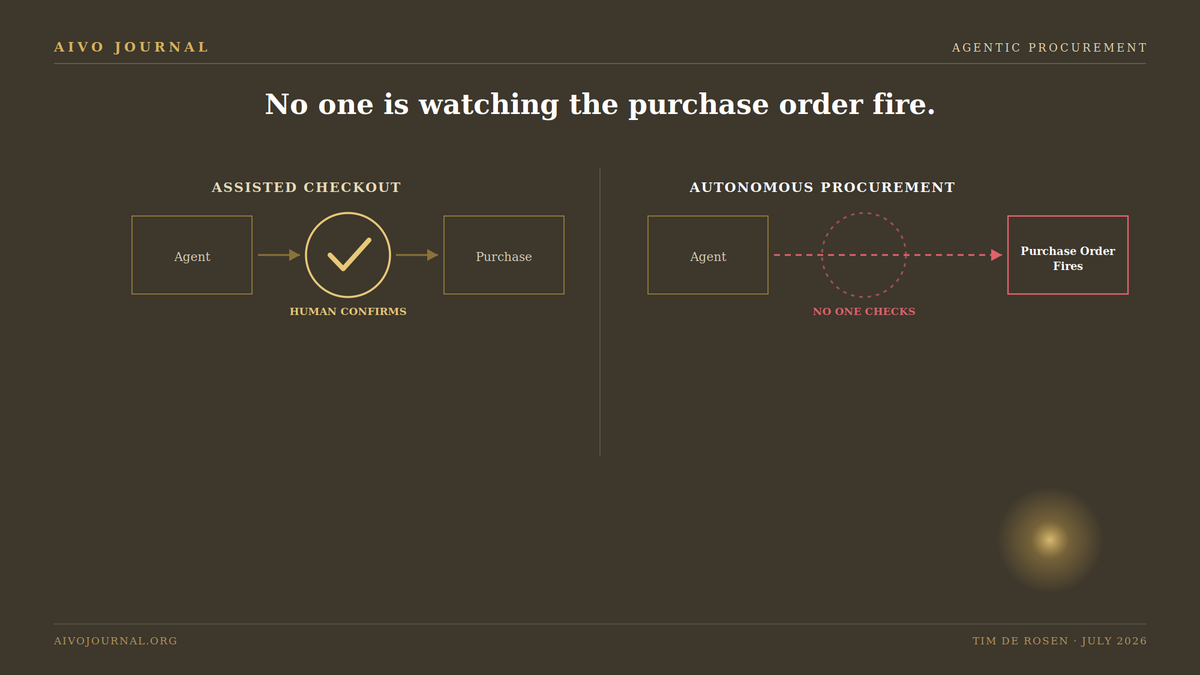
Agentic commerce is currently running in two structurally different modes, and the distinction matters more than the shared label suggests. The first, assisted checkout, is where nearly every consumer-facing protocol sits today: an agent searches, compares, authenticates the user, and pre-populates a cart, then waits for a human to authorize the transaction. This is the world ChatGPT's Agentic Commerce Protocol, Google's Universal Commerce Protocol, and Perplexity's shopping features currently occupy. A human remains the last check, however imperfect that check may be in practice.
The second mode, fully delegated autonomous commerce, removes that check entirely. An agent operates under a digitally signed authorization specifying budget, timing, and payment method, and executes the transaction without a human reviewing the individual decision. This is not a future scenario. It is already how procurement agents operate in corporate environments today, enforcing spending policy through virtual cards with preset limits, automatically triggering purchase orders once inventory crosses a threshold, and processing invoice payments instantly against an approved budget.
A missed consumer recommendation is a lost chance to be chosen. A missed procurement recommendation, in a fully autonomous system, is a transaction that already happened.
Why the Difference Matters
Our research measures whether a brand present early in a conversation survives to a model's final recommendation. Across 1,427 brand probes, 87.3% do not, and in most cases the model already possessed the relevant facts. It simply failed to carry them to the decision turn. That figure, and every figure like it currently published in this category, describes the assisted-checkout world, because that is the only world running at meaningful scale for consumer purchases today. It says nothing yet about what happens when the human step is removed entirely.
In the assisted model, a Linkage Gap failure is bad but recoverable. The customer sees a narrower set of options than they should have, and a human, however briefly, still has the chance to notice something is missing, ask a follow-up question, or seek a second opinion. In a fully autonomous procurement system, none of that applies. If a vendor the model already knows about does not get carried to the moment a purchase order fires automatically, the failure is not a worse recommendation. It is a completed transaction with no one positioned to have caught the omission, because no one was reviewing that specific decision at all.
A More Advanced, Less Visible Frontier
It is a reasonable, testable hypothesis that B2B procurement is further along toward full autonomy than any consumer shopping experience currently is. Spend policy enforcement through virtual cards, threshold-triggered purchase orders, and instant invoice processing against pre-approved budgets are described as current, not speculative, capabilities in procurement-agent deployments already in production. Consumer agentic commerce is still, by comparison, cautiously human-supervised.
This has a direct and underappreciated implication for enterprise risk. A CFO evaluating AI-mediated revenue exposure on the customer-facing side of the business, the RaR-AID framing, is looking at one half of the picture. The other half is the exposure created by the company's own procurement agents making, or failing to make, correct vendor decisions without human review, at a moment when there is no equivalent of a customer's second thought to catch the error.
What This Suggests for Measurement
Decision-stage measurement built for consumer contexts is not automatically the right instrument for procurement contexts, and it would be a mistake to treat them as interchangeable. A consumer buying conversation runs over a handful of turns and ends with a recommendation a person accepts or declines. A procurement agent operates continuously against a standing policy, with authority granted in advance rather than confirmed at the point of decision. Measuring displacement in that environment means testing whether a vendor known to the system is actually being selected when the automated trigger fires, not whether it survives a single conversational exchange.
This is a distinct research question from the one our published work has answered to date, and we are treating it as exactly that: an open, important direction, not a settled extension of existing findings. The stakes are different enough, irreversible, automated, and largely invisible to the people who would otherwise catch the mistake, that it deserves its own dedicated measurement, not an assumption that consumer-side displacement rates simply carry over.
The Question Worth Asking Now
Most companies can currently answer, at least approximately, how their brand performs when a customer asks an AI assistant for a recommendation. Very few can answer the equivalent question on the other side of their own business: when our procurement agents evaluate vendors under standing authorization, which ones get selected, which get quietly excluded, and is anyone checking. That second question has no human safety net built into the system by design. It is worth asking before it is answered by an audit finding rather than a deliberate one.
Comments ()