
Owning the AI Recommendation Before the Hold Period Ends
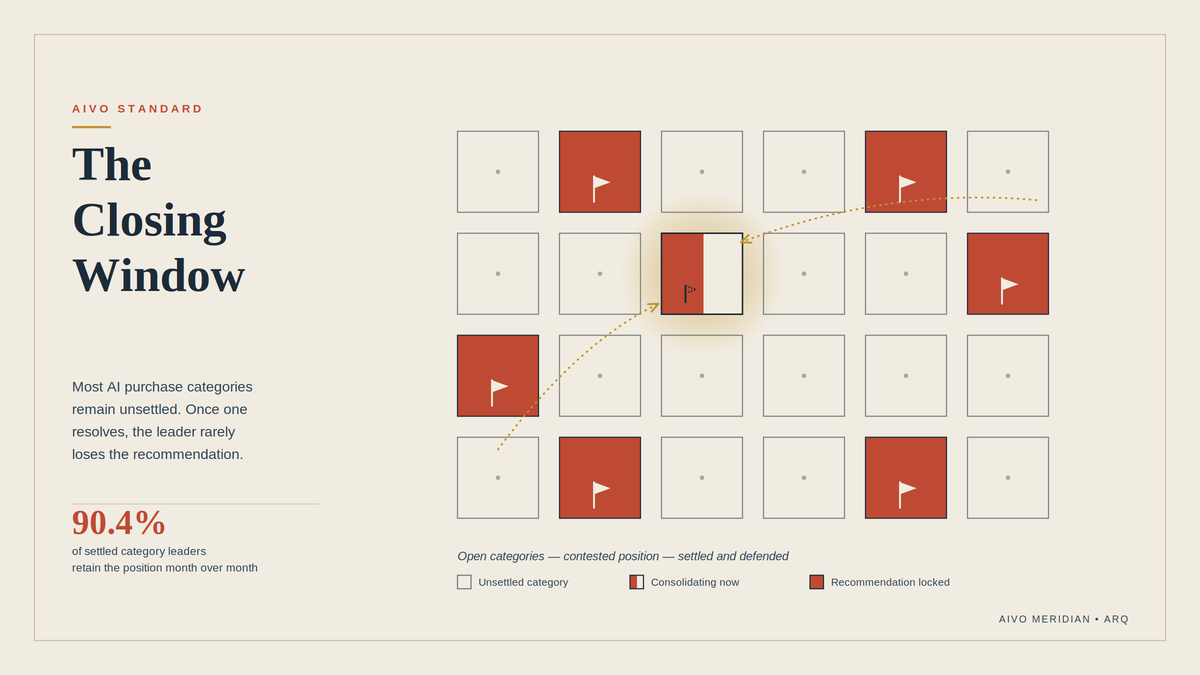
AI assistants have not yet decided who wins in most buying categories. Across the brands AIVO Meridian tracks, 53.7 percent of categories still show no consistent recommendation leader across repeated purchase-decision prompts. But in our month-over-month observations, once a clear recommendation leader did emerge, that position persisted in 90.4 percent of subsequent observations.
That gap, between categories still open and categories already decided, is the finding this article is about, and why it belongs in a private equity firm's diligence and value creation playbook rather than only a marketing dashboard.
Why the position holds
A settled AI recommendation is not simply sentiment that happens to be sticky. It appears to behave as a self-reinforcing advantage. When a model has repeatedly found dense, consistent corroboration for one brand across its retrieval sources, that consistency itself becomes evidence the model weighs in future turns, and each recommendation strengthens the pattern the next query draws on. The result looks less like a static rank and more like the increasing returns familiar from platform and network competition, where an early lead becomes progressively cheaper to defend and progressively more expensive for a challenger to overturn.
This is a different shape of advantage than traditional brand equity, which moves gradually and can be contested continuously. It is also why timing matters more here than it does in most brand work. A category that is still unsettled today will not necessarily stay that way through a typical hold period.
Most diligence does not currently measure this
Standard commercial diligence tracks brand awareness, revenue growth, sentiment, and traditional share metrics. None of these currently establish whether a target is actually being recommended by AI assistants at the point of decision, as distinct from being mentioned earlier in a buyer's research. AIVO's research has documented that gap directly: brands are cited by AI systems earlier in a buying conversation 87.3 percent of the time before the assistant ultimately recommends a competitor instead. A target can look strong on every conventional measure and still be losing the recommendation that actually drives the sale, and that gap sits invisible inside a growth story unless someone measures for it specifically.
Two different plays, not one
The 100-day plan this data supports splits cleanly into two, and the split matters because a settled category and an unsettled one call for opposite postures. Where a category is still unresolved, the work is offensive: close the gap between what a target's site and public content actually support and what the model surfaces at decision, and move to consolidate the position before a competitor does. Where a portfolio company already holds a settled category, the work is defensive: reinforce and monitor the corroboration pattern that earned the position, since the same reinforcing dynamic that protects an incumbent can also erode quietly if left unattended. Confusing the two is the most common mistake, since a challenger trying to dislodge an already-settled incumbent is fighting the 90.4 percent, not exploiting it.
Capital allocation changes when timing matters
A portfolio of several brands rarely has the same story in every category. Two companies may each need AI-layer work, but only one may be competing in a category still genuinely open. Measuring recommendation status across a portfolio, rather than brand by brand, tells an operating team where scarce attention actually buys a durable position and where it is defending ground already held. That is a capital allocation question as much as a marketing one.
What this means at exit
An acquirer buying future cash flows increasingly needs confidence that a company will keep appearing as the default recommendation inside AI-mediated buying journeys, not only inside a traditional funnel. A documented, defended recommendation position is evidence of that resilience, and it is the kind of evidence that belongs in a vendor due diligence pack alongside traditional brand equity, not as a marketing appendix but as proof that a meaningful share of future demand is not sitting exposed to a competitor's move.
The window is closing category by category
In every category still unsettled, some brand will eventually consolidate the recommendation and, on current evidence, hold it. That will happen whether or not its owner is paying attention. The question for a private equity buyer is not whether this dynamic exists. It is whether their target becomes the brand AI learns to recommend, or the brand it quietly learns to pass over.
AIVO Standard research referenced above is DOI-anchored and available on Zenodo. ARQ, the AI Recommendation Quotient, is AIVO's public benchmark for AI-layer brand performance.
#AIVisibility #PrivateEquity #BrandValue
Comments ()