
Profoundly Wrong: Why AEO (and GEO) are not the answer
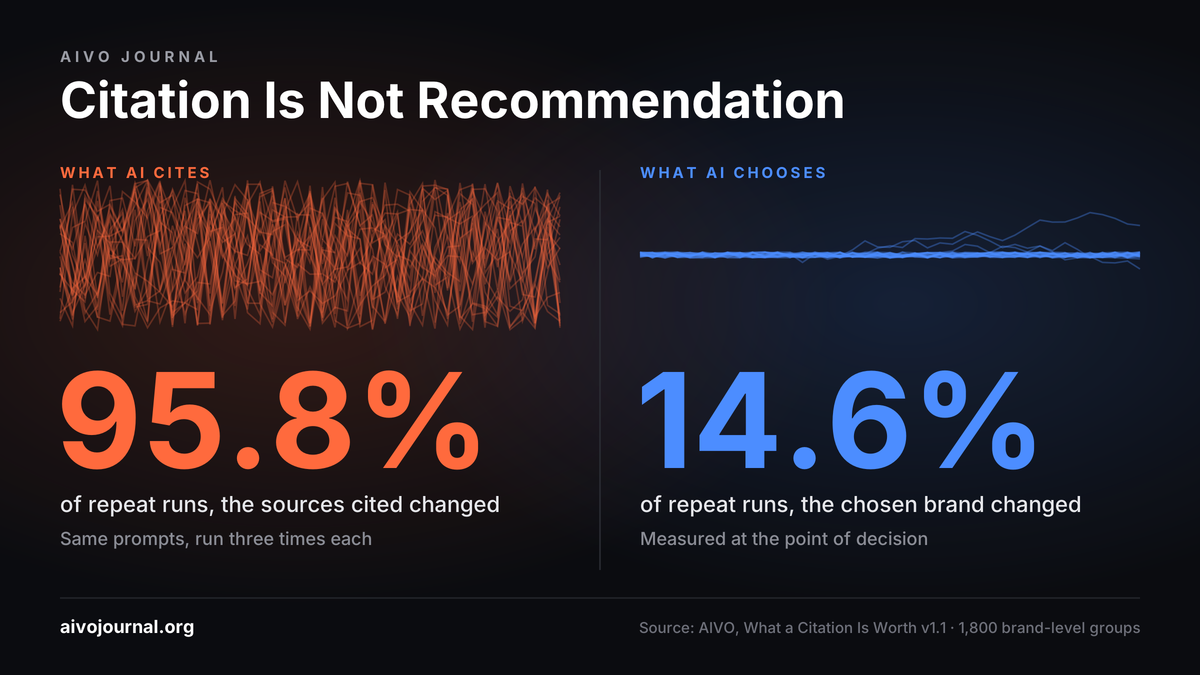
Citation counts and AI visibility scores describe the first response in a conversation. In AIVO's multi-turn testing, they did not predict which brand an AI system recommended by the point of decision. In AIVO's testing, the sources an AI system cited changed on 95.8% of identical repeated prompts, while its final brand decision changed on only 14.6%. AIVO has asked an independent marketing scientist to try to falsify this finding, and is now testing whether AI Win-Rate is stable enough for brands to manage against.
Key findings. Across 1,800 brand-level groups, each run three times with identical prompts, the set of cited sources changed 95.8% of the time and the recommended brand changed 14.6% of the time. Across more than 20,000 multi-turn probes covering over 200 brands, AI systems displaced a brand they had already cited in 87.3% of cases before reaching a recommendation. In our data, final decisions were far more stable than citations.
The visibility thesis
For the past year, much of the market has measured AI search the way it once measured Google: by how often a brand appears and how often it is cited. Answer engine optimisation (AEO) and generative engine optimisation (GEO) promise to raise those numbers.
The case for both rests on one assumption: that citation frequency and visibility are a sufficiently reliable proxy for the probability that an AI system recommends a brand. AIVO tests that assumption where it matters commercially: across a multi-turn conversation, from the first prompt to the point of decision. Visibility tools answer an important question: whether an AI system can retrieve a brand. Visibility is necessary, because a brand that cannot be retrieved cannot be recommended. The question here is whether it is sufficient.
We have spent the past year testing that link. In our multi-turn research, first-prompt visibility and citation did not predict the final recommendation. The test any measure must pass is simple.
If a metric changes when nothing has changed, it cannot measure improvement.
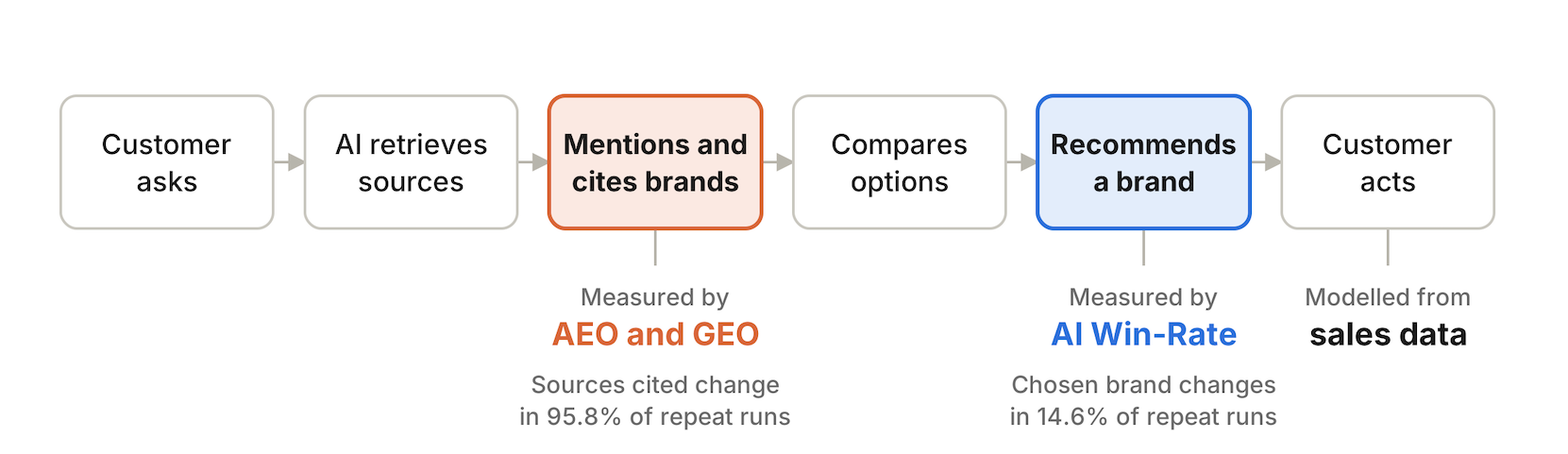
AEO and GEO measure a step in the middle of the chain. AI Win-Rate measures the decision stage; whether the customer then buys is modelled separately against sales data.
Where we started
Our own early work took the visibility approach further than most. Our first measurement framework tracked how much of an AI assistant's answer space a brand occupied across prompt variations, weighted for position and consistency. It was a more sophisticated instrument than a citation count.
It ran into the same wall. Visibility scores were hard to hold stable across a time series. The same brand, asked about in the same way, moved for reasons unrelated to anything the brand had done. A metric that moves when nothing has changed cannot tell a brand whether its actions worked.
That problem sent us looking further down the conversation, to the point where an AI system stops describing options and makes a choice.
Citations move, decisions hold
In What a Citation Is Worth, AIVO co-founder Paul Sheals ran 1,800 brand-level groups three times each with identical prompts. The set of sources cited changed 95.8% of the time. The brand the AI system finally recommended changed only 14.6% of the time, and in 85.4% of groups the outcome was the same across all three runs.
A citation-based metric therefore measures the noisiest part of the system. Optimising for it means chasing a signal that moves on its own, and reporting progress that may be nothing more than resampling. Noise inflates false positives: teams believe an optimisation worked because the measurement moved, when the underlying recommendation behaviour did not. Stable metrics also improve statistical power, because genuine change is easier to distinguish from measurement variation.
The second finding is the Linkage Gap. In AIVO working paper WP-2026-14, across more than 20,000 multi-turn probes covering over 200 brands, AI systems displaced a brand they had already cited in 87.3% of cases before reaching a recommendation. A brand present in the opening response was usually gone by the time the AI system made its choice. Appearing in the conversation rarely means surviving to the recommendation.
This is why we treat citation targets as a risk to brand health rather than a neutral measure. A dashboard that rises while recommendation share falls tells a brand team it is winning when it is losing. Budgets, content plans and agency fees then follow the dashboard.
What we are not claiming
We are not claiming that citations never matter. AI systems clearly retrieve and use information, and published research shows that content an AI system has already retrieved can change what it recommends. Our findings concern multi-turn conversations, and we make no claim about single-response answers. Our claim is narrower and commercially more important: citation frequency is not a stable or reliable enough proxy for recommendation behaviour to manage a brand against.
It remains entirely possible that increasing citations eventually increases recommendation. If so, that relationship should be demonstrated empirically rather than assumed.
Trying to falsify the result
On 14 October 2026 we met a leading and widely published marketing scientist and asked for two things: an attempt to falsify our research on citation instability, and a test of the AI Win-Rate methodology on its own terms.
Our hypothesis is that recommendation, rather than citation, is the commercially relevant variable. Our implementation of that measurement is AI Win-Rate: how often AI systems select a brand at the decision stage, in multi-turn conversations across models and repeated runs, against a defined set of customer criteria. It is published under AI Win-Rate Methodology v1.0.
The real question is whether AI Win-Rate is itself a stable metric. Any measure has to pass that test before a brand can manage against it. The evidence above points the right way, since final decisions are far steadier than citations, but it is not proof. We have asked for the methodology to be examined as if we were wrong.
Joining the stability test
We are now testing the stability of AI Win-Rate with a select group of global brands. Each participant receives its AI Win-Rate across the leading AI systems, measured repeatedly through the test period, alongside the stability results for its category.
A limited number of places remain. Brands that want to take part can contact tim@aivostandard.org.
The test for every AI metric
The AI era will produce many new metrics. The test for any metric is whether it predicts the business outcome it claims to measure.
Until first-prompt citation metrics show that they predict recommendation at the point of decision, brands should treat them as descriptive diagnostics, useful for confirming that AI systems can find them, and not as measures of competitive performance.
Method note
Linkage Gap findings are from AIVO working paper WP-2026-14. AI Win-Rate is defined in AI Win-Rate Methodology v2.0 https://zenodo.org/records/22663407
AIVO Standard papers are DOI-anchored and openly available for critique; they are not peer-reviewed. The independent review described above is in progress, and its findings will be published whatever they show.
Comments ()