
Reading GEO Vendor Claims: A Buyer's Guide to the Numbers
The AI-visibility category has moved fast. In the space of a year, GEO and AEO vendors have gone from a handful of early entrants to a crowded field, each publishing case studies, launch-week pipeline figures, and traffic multipliers meant to signal product traction. Buyers evaluating this category are being asked to trust numbers that, on closer inspection, often do not mean what they appear to mean. This is not an argument that the category is fraudulent. It is an argument that the category has not yet developed the reading habits its own claims require, and that a few recurring patterns are worth naming so buyers can evaluate them with the same rigor they would apply to any other vendor claim.
The base-rate multiplier
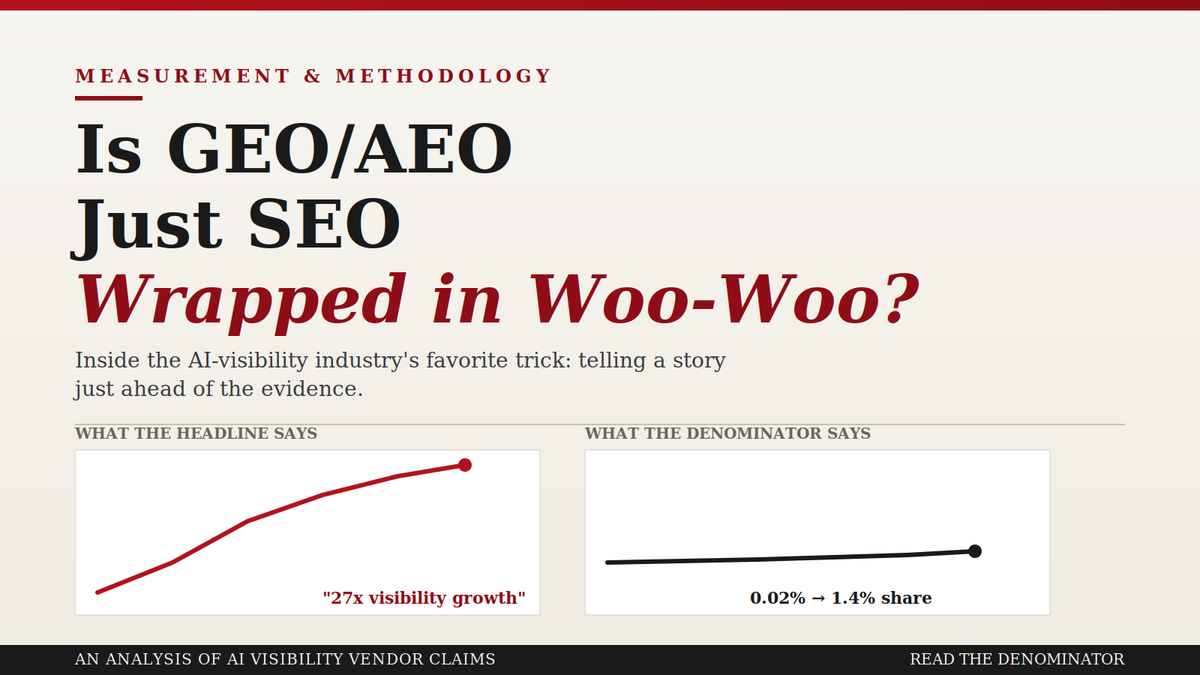
The most common pattern is the base-rate trick. A vendor reports a multiplier, twenty-seven times growth, ten times growth, and the multiplier is technically accurate. What it omits is the starting point. Going from a visibility share of 0.02 percent to 1.4 percent is a real twenty-seven times increase, and it is also a move from statistically invisible to still small. Multipliers computed against a near-zero base will always look dramatic regardless of whether the underlying share is commercially meaningful. The corrective is simple. Ask for the absolute share, not the ratio. A vendor confident in its results will show the share. A vendor that leads with the multiplier and resists the absolute number is telling you something about which number actually supports the claim.
The flagship case study with no metrics
A second pattern shows up in how case study libraries are structured. The best-known logo in a vendor's portfolio, the one doing the most reputational work, is frequently the one with no quantified result attached to it. No visibility percentage, no traffic lift, no revenue figure, just a warm quote about trust or brand voice. Meanwhile, smaller or less recognizable accounts several entries down the page carry two or three hard statistics each. This is worth noticing because it inverts the expected relationship between prominence and evidence. If the flagship account cannot produce a number, that is informative about what actually happened in that engagement, not merely a gap in the marketing copy.
The founder-quote gap
The third pattern is a discrepancy between the headline statistic in a case study and the customer's own words elsewhere in the same document or in a related interview. One case study reviewed for this piece carried a headline claim of sixty-five percent of leads originating from AI search, while the founder quoted directly in the body of the same piece described the figure as, in his own words, anecdotally about a quarter. Case studies are rarely fact-checked by anyone outside the vendor's marketing function, which means a buyer who reads only the pull-stat at the top of the page will miss a contradiction sitting a few paragraphs below it. Reading the quotes, not just the callouts, is a cheap and effective check.
Manufactured momentum
The fourth pattern is momentum manufactured through coordinated content rather than earned through product adoption. Some vendors have been explicit, in public posts describing their own launch strategy, about assigning team members specific personas and posting cadences timed to funding announcements, engineered to create the appearance of organic buzz around a launch week. This is a standard growth-marketing tactic and is not disqualifying on its own. It becomes relevant to a buyer's evaluation when the resulting engagement is visibly confined to the vendor's own employees and immediate supporters rather than picked up by independent observers, journalists, investors, or prospective customers outside the company's orbit. A pipeline or ARR figure announced in the same week as a coordinated internal posting campaign should be weighed as top-of-funnel noise until it converts into signed, referenceable, retained revenue over subsequent quarters. That is the number that actually validates enterprise-tier pricing, not the launch-week spike.
What this means for evaluation
None of these four patterns, taken individually, proves bad faith. Multipliers, flagship testimonials, selective quoting, and coordinated launch marketing are all standard tools of early-stage go-to-market, and every vendor in a young category, including AIVO, is building its narrative and its evidence base at the same time. What distinguishes a durable claim from a fragile one is whether it survives the four checks above: the absolute number behind the multiplier, the metric behind the flagship logo, the founder's own words against the headline stat, and the independent pickup behind the momentum. Buyers evaluating AI-visibility vendors, and AI-visibility vendors evaluating their own claims before publishing them, would do well to run their numbers through the same four checks before putting them in front of a market that has not yet learned to ask.
Comments ()