Stable Visibility, Collapsing Selection: The Inertia Trap in AI-Mediated Decision Making

Case Study
Case Type: Anonymised
Sector: Over-the-Counter Healthcare
Risk Class: Externally Mediated Representation Risk
Primary Failure Mode: PSOS–ASOS Divergence
Status: Canonical Reference Case
1. Case Definition
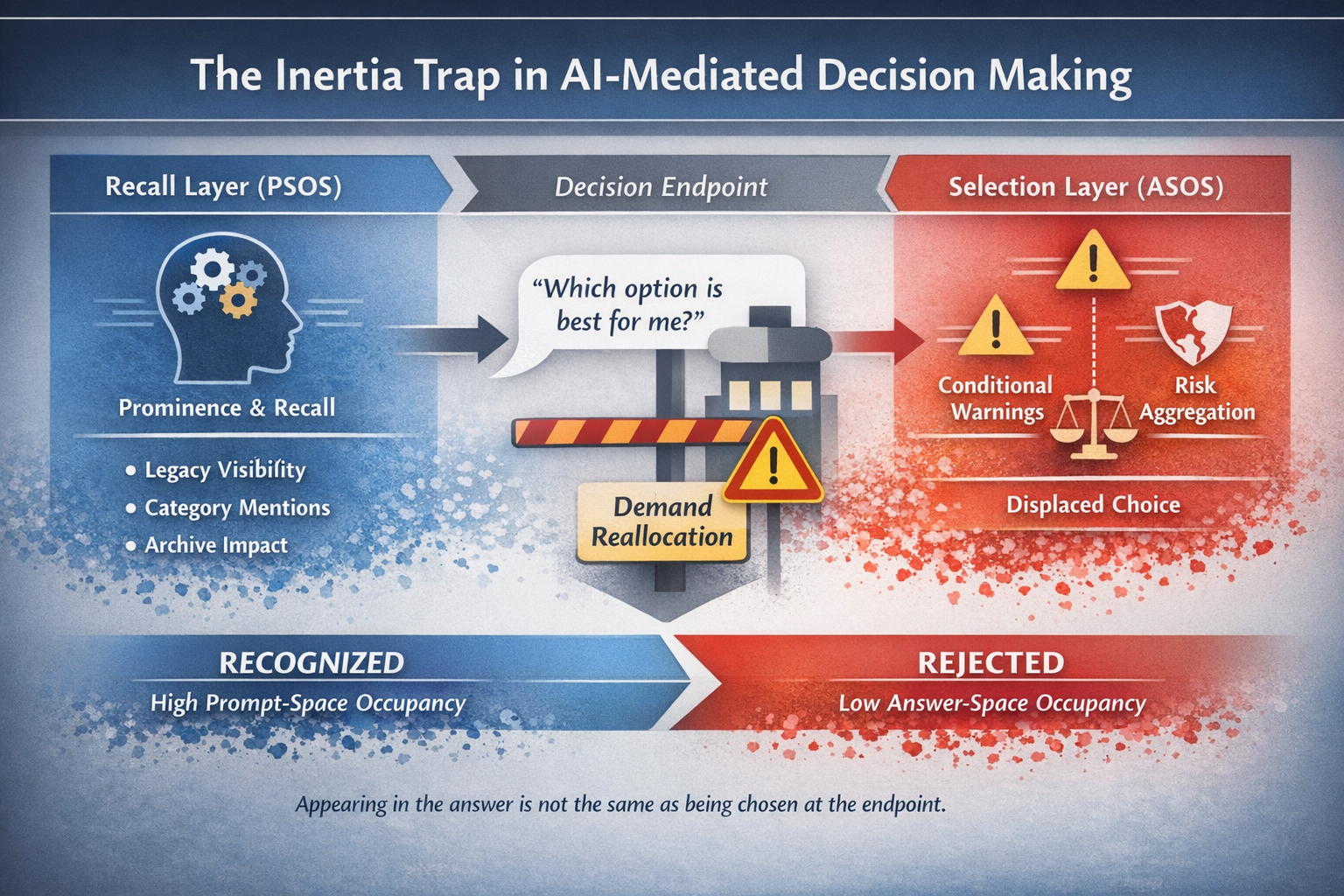
This case examines a category-defining, highly trusted, regulated consumer brand that maintains persistent visibility in AI assistant responses while systematically failing to be selected as a recommendation endpoint.
The observed condition is not loss of awareness, but loss of authority.
2. Metric Framework (Standard Definitions)
Prompt-Space Occupancy (PSOS)
Measures whether a brand appears at all within AI responses to relevant prompts.
PSOS reflects historical presence, training-data density, and category anchoring.
Answer-Space Occupancy (ASOS)
Measures whether a brand is selected, recommended, or framed as the default outcome when the assistant converges on an answer.
ASOS reflects real-time reasoning under uncertainty.
Decision Endpoint
The point at which the AI assistant resolves a prompt into a recommended action, product, or option.
Demand allocation begins here.
3. Observed Pattern
- PSOS: High and stable across time
- ASOS: Persistently low, declining in recommendation and comparison prompts
This divergence is structural, not temporary.
4. The Inertia Trap (Canonical Failure Mode)
Definition:
The Inertia Trap occurs when historical brand prominence preserves recall inside AI systems while contemporaneous reasoning logic removes the brand from decision endpoints.
What appears healthy
- Continued mentions
- Stable inclusion in category explanations
- No reputational shock
What is actually occurring
- Recall is preserved by archival data
- Selection authority collapses due to probabilistic reasoning
- Visibility masks irrelevance
PSOS remains high because the brand is embedded in the archive.
ASOS collapses because the brand no longer resolves uncertainty.
5. PSOS Preservation Mechanisms
The brand reliably appears due to:
- Training-data inertia accumulated over decades
- Canonical anchoring in category definitions
- Regulatory and medical citation density
This is archival presence, not live authority.
6. ASOS Failure Mechanisms
6.1 Conditional Framing Suppression
The brand is consistently introduced with qualifiers:
- “Safe if used correctly”
- “Appropriate in limited circumstances”
Conditional language prevents decisiveness.
Decisiveness is required for selection.
6.2 Comparative Reasoning Displacement
In prompts requiring choice, alternatives are favored because they:
- Offer broader applicability
- Address more dimensions of the problem
- Require fewer caveats
The brand is acknowledged, then reasoned past.
6.3 Risk Aggregation Penalty
AI systems compress decades of:
- Edge-case warnings
- Regulatory phrasing
- Rare adverse events
- Consumer anecdotes
into a single defensive synthesis.
The brand is not judged unsafe.
It is judged fragile.
Fragility suppresses recommendation confidence.
7. Demand Leakage Pathways
AI assistants act as decision pre-filters.
If the brand is not selected at the Decision Endpoint, demand reallocates immediately.
In regulated healthcare contexts, leakage typically flows to:
- A competing brand framed as more broadly applicable, or
- A generic molecule or category-level recommendation
The second pathway represents loss not to a competitor, but to generic reasoning.
8. Why This Is Not a Marketing or SEO Issue
This failure state is not caused by:
- Messaging quality
- Content gaps
- SEO performance
- Public relations errors
The reasoning layer is external and uncontrollable.
The assistant synthesises from third-party sources, regulatory language, and comparative logic.
The enterprise cannot intervene in real time or prevent cumulative risk framing.
This is externally mediated representation risk.
9. Why Defensive Reasoning Dominates
AI assistants are optimised to minimise regret under uncertainty.
In health domains, this produces:
- Hedged recommendations
- Preference for broader applicability
- Avoidance of singular branded endpoints
Incumbents with extensive safety narratives are systematically disadvantaged.
10. Internal Blind Spot
Traditional indicators remain stable:
- Awareness
- Mentions
- Recall
These track PSOS, not ASOS.
ASOS reveals:
- Loss of default status
- Upstream substitution
- Demand reallocation before owned channels
This is the quiet phase of displacement.
11. Governance Implications
- Visibility metrics are insufficient
- Mention tracking does not equal influence
- Decision authority has shifted upstream of enterprise control
By the time revenue impact is visible, the reasoning shift has already hardened.
PSOS without ASOS is not safety.
It is delayed exposure.
12. Canonical Conclusion
The brand still appears.
The assistant still knows it.
But the assistant no longer chooses it.
That moment marks the transition from marketing concern to governance risk.