
Still Not Looking: Gartner Names the Category It's Already Leaving Behind
Summary
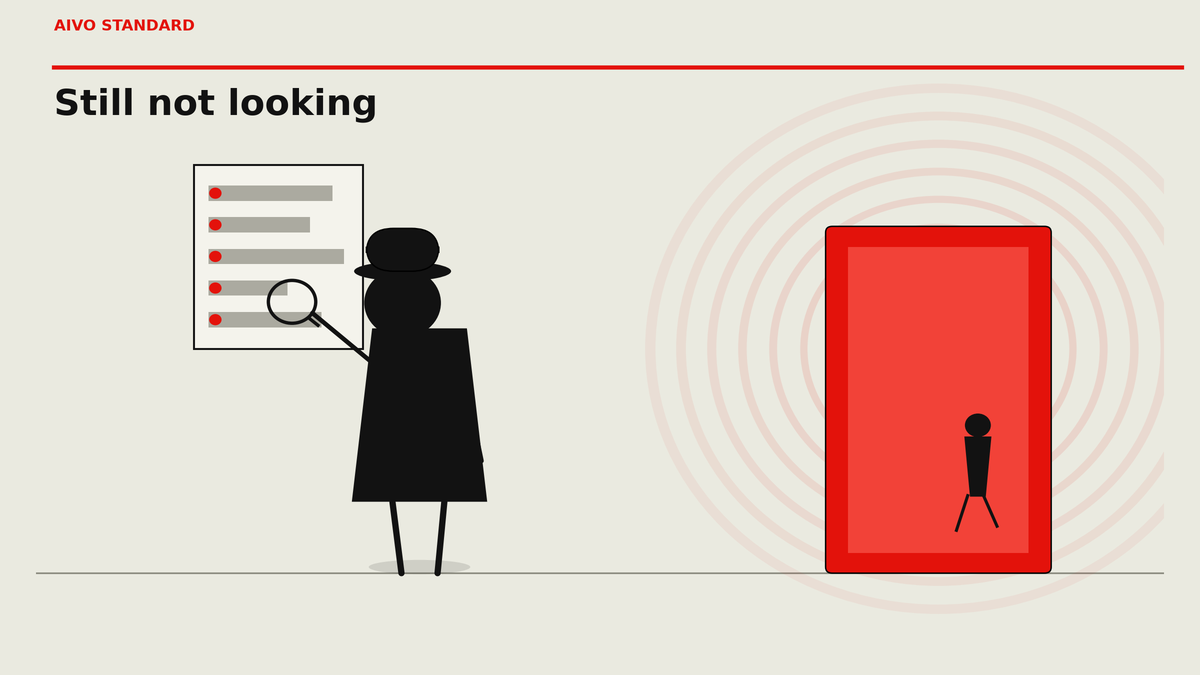
On August 6, 2026, Gartner published its first Market Guide for Answer Engine Visibility Tools, naming Profound a Representative Vendor. The report is a genuine milestone: it is the first time a major analyst firm has formally recognized that brands need dedicated instrumentation for how they appear inside AI-mediated search and answer engines. It is also, on its own terms, a description of a market Gartner already believes is ending. The guide centers its evaluation on informational visibility, the discipline of tracking whether a brand is cited, how prominently, and in what tone. In the same report, Gartner names the shift it sees coming: agentic systems that move past retrieval into task execution on a user's behalf. The category has been drawn one layer too early, and the report's own language proves it knows so.
What the guide measures
Answer Engine Visibility Tools, as Gartner defines the category, address a real and now-mainstream problem. Brands need to know whether they are surfaced when a consumer or an AI model searches a category, how they are described, and how that compares to competitors. This is presence and prominence work, the AI-era equivalent of search visibility and share of voice. It is necessary. It has also always been a leading indicator, not the outcome that matters commercially.
Citation and recommendation are different events. A brand can be named accurately, favorably, and frequently across every answer engine response in a category and still lose the purchase decision by the time a multi-turn buying conversation reaches its conclusion.
This is the finding at the center of AIVO's research program: across more than 12,500 multi-turn probes spanning 195-plus brands, 87.3 percent of brands present at the first turn of a buying conversation are displaced before the model reaches its final recommendation. Visibility at the top of a reasoning chain predicts almost nothing about survival to the bottom of it.
The report already says this
Gartner's own characterization of where the market is headed makes the case better than any outside critique could. The guide frames today's tooling as built for informational visibility and flags a coming shift toward agentic systems that execute tasks rather than simply answer questions.
That is a description, in analyst language, of the same distinction AIVO has been measuring since its earliest working papers: the difference between a model informing a user and a model deciding on a user's behalf. Gartner has correctly identified that the ground is moving. It has not yet built a category for where it is moving to.
This is not a small omission. Decision-turn survival, the question of whether a brand holds its position through comparison, criteria-setting, and final recommendation, is not a more advanced version of citation tracking. It requires different instrumentation entirely: multi-turn reasoning chain analysis, displacement timing, and commercial handoff measurement, none of which a presence-and-prominence framework is built to capture. A vendor evaluation built for one layer will not surface strength or weakness at the other, no matter how mature the tooling becomes within its own category.
A pattern, not an incident
This is the second time in 2026 that a standards body has drawn this exact line in the exact same place. The IAB's own AI visibility framework, published earlier this year, structured its evaluation around a similar presence-based hierarchy and acknowledged directly, in its methodology notes, that Competitive Displacement Rate remains an unsolved metric because there is no stable denominator for it yet. Gartner has now published a market taxonomy with the identical structural gap, a few months later, from a different institution, evaluating an overlapping set of vendors.
Two independent bodies reaching the same boundary and stopping in the same place is not a coincidence of judgment. It suggests the instrumentation to measure decision-turn survival at scale has not yet reached the standards-setting layer of the industry, even as the underlying shift both reports describe is already underway in the products being evaluated.
Why this matters to buyers now
Analyst categories are durable. Once a Market Guide exists, procurement teams build RFPs around its structure, vendors position against its criteria, and budget follows its taxonomy for years. A category built around informational visibility will produce a generation of enterprise AI-visibility purchasing decisions optimized for citation and presence, at the exact moment the market itself, by Gartner's own account, is moving toward agentic execution. The brands that treat this guide as the finish line rather than the current chapter will be well instrumented for the layer they are already leaving.
The next Market Guide needs a name for the layer both reports can see coming. Until one exists, brand and marketing leaders evaluating tools against this guide should ask a second question alongside it: not only whether a brand is visible, but whether it survives.
Related: AIVO Standard Working Paper WP-2026-14, The Linkage Gap. Full Meridian methodology at aivomeridian.com.
Comments ()