
The Agentic Economy Atlas: Mapping Access, Choice and Execution
Abstract
AIVO has launched the Agentic Economy Atlas at aivoatlas.com, an open, evidence-labelled map of the agents, products, protocols and commercial relationships shaping agent-mediated commerce. The Atlas holds 205 records, of which 142 have been reviewed and 63 are candidates awaiting verification, together with 95 source-qualified relationship claims across 148 organisations. Every record and every relationship carries its own evidence label, and two draft industry editions trace how agents are reaching banks and insurers.
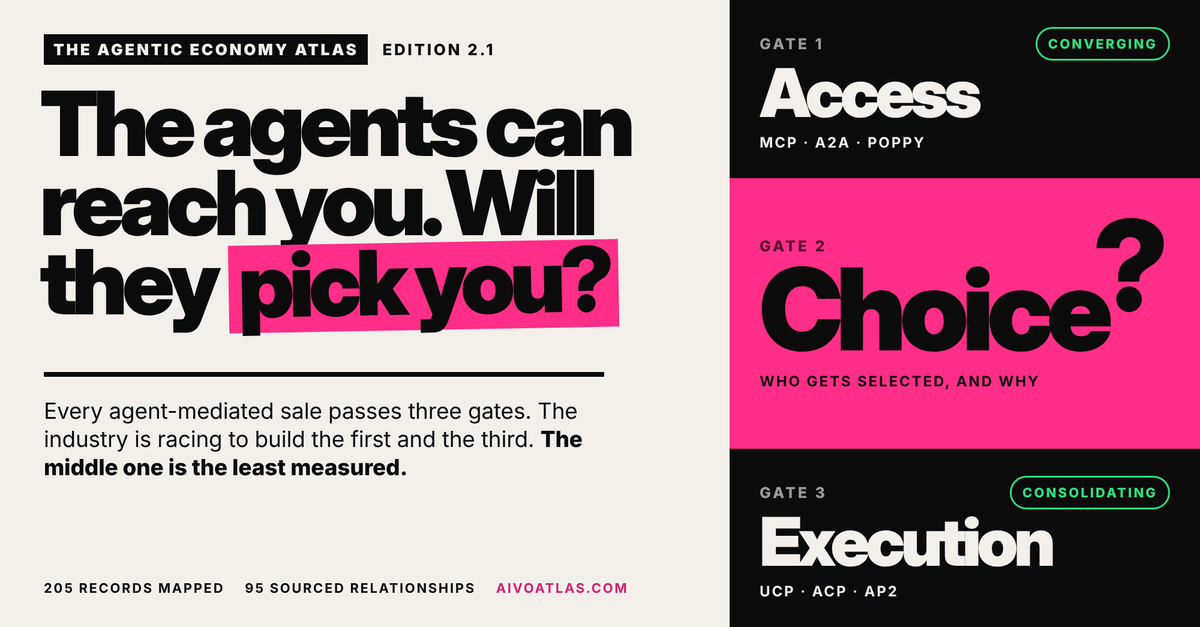
Viewed through the framework of the three gates of agentic commerce, the map shows increasing convergence in how agents reach businesses (Access) and complete intended actions (Execution). It shows far less about how agents select one business over another (Choice).
Despite rapid investment in protocols that let agents reach businesses and complete transactions, comparatively little infrastructure exists for measuring why one business is selected over another when several could satisfy the user's request.
AIVO's working thesis is that this Choice gate carries the greatest commercial consequence of the three. This article sets out what the Atlas covers, how it is edited, what it does not establish, and how AIVO will test the thesis.
The three gates
In an earlier Journal article, Chosen, Then Blocked: The Three Gates of Agentic Commerce, AIVO proposed that every agent-mediated sale passes three gates. Access asks whether an agent can reach a business, its information and its transaction interfaces.
Choice asks whether, when alternatives are available, the agent selects that business and what determines the outcome. Execution asks whether the selected business fulfils the action the agent intended.
The gates are distinct commercial questions. A business can be reachable by an agent and able to complete a transaction, yet still lose the selection to a competitor.
The Atlas applies this model to the market as a whole, asking which products and standards operate at each gate and what evidence supports their claims. GEO and AEO practice largely addresses the Access gate. AIVO's category of Agentic Brand Control concerns Choice and Execution.
What the Atlas maps
The Atlas organises its records into twelve territories, from models and personal agents to payment rails, agent builders, and markets and assurance. Records are unique products, standards and concepts, so the total is not a count of agents.
Of the 205 records, 199 sit within a territory and six are general concepts outside them. The 63 candidates stay off the default views until they are verified, and twelve earlier entries were removed because they failed the Atlas's agentic scope test, among them content assistants, robotics and self-driving systems.
| Measure | Count | What it means |
|---|---|---|
| Records | 205 | 142 reviewed and 63 candidates awaiting verification |
| Territories | 12 | 199 records placed in a territory; 6 general concepts sit outside them |
| Relationship claims | 95 | Each has a specific source and its own evidence label; none independently tested |
| Organisations | 148 | Providers, parties to a documented relationship, and named standards participants |
| Poppy design participants | 44 | Sierra and Meta, 7 launch partners and 35 design partners; not counted as integrations |
| Industry pathways | 63 | Banking 20 and insurance 43, both draft editions |
Together these records describe the documented architecture of agent-mediated commerce. They are not a measure of the size of the agent ecosystem.
Evidence is labelled separately for every record and every relationship, and labels are never merged into a single "supported" badge. The Atlas uses eight labels: independently tested, documented live integration, vendor documented, demonstrated or pilot, specification, design participation, candidate or unreviewed, and analysis or scenario.
Maturity, meaning whether something is in use, in preview or still a draft, is recorded separately from the evidence for it. No relationship yet carries the independently tested label. AIVO has not run independent end-to-end compatibility tests, so documented support in the Atlas should not be read as certified compatibility. The label exists as the standard against which claims will be held as testing begins.
How the Atlas is edited
AIVO, Inc. publishes the Atlas and also offers AIVO Meridian, a measurement product that appears in it. The Atlas states that relationship openly. Meridian is classified under the same evidence rules as every other provider, carries the vendor documented label, and is listed alphabetically wherever it is relevant. A publisher disclosure on the method page records what Meridian does not claim, including execution-stage and transactional telemetry, and distinguishes controlled research outcomes from real-world sales.
Inclusion follows published criteria that apply equally to AIVO's own products. Measurement providers must publish a methodology, results with sample sizes, the number of runs, and either independent review or verifiable data. Products, protocols and infrastructure must fall within the agentic scope, be documented by their provider with a source, and be live or clearly labelled as pilot, preview or draft. There is no paid inclusion, no purchasable verified status and no paid ranking.
Monitoring of vendor, protocol and regulator sources can propose changes, but AIVO reviews and approves every material change before publication, and nothing AI-written is published automatically. Every claim keeps its source, the date it was checked and its evidence label, and claims not re-checked within the review period are flagged for review instead of being left to look current.
Observations from Edition 2.1
The Access gate shows increasing convergence. MCP connects agents to tools and data and is now stewarded by the Linux Foundation's Agentic AI Foundation. A2A lets agents discover one another and delegate work. Registries from Google and Microsoft let enterprises publish, find and govern their agents.
The most consequential new entrant is Poppy, the Personal Agent Protocol announced by Sierra and Meta on 6 October 2026 with seven launch partners, followed on 9 October by a first draft and 35 design partners.
Poppy defines how a customer's personal agent identifies itself to a business, obtains the customer's consent and opens a session. Design participation in Poppy does not establish that any participant has implemented it.
The Execution gate is consolidating around a small number of commerce and payment standards. UCP, from Google and Shopify, covers checkout and the order lifecycle for shopping agents. ACP, from OpenAI and Stripe, now serves mainly for merchant product feeds and Microsoft Copilot Checkout, after OpenAI ended checkout inside ChatGPT in March 2026 and moved purchases to retailer-run apps.
AP2, donated by Google to the FIDO Alliance in April 2026, uses signed mandates to prove that a customer authorised a specific purchase, while x402 and MPP let agents pay per request over HTTP. The first live transactions are appearing. In July 2026 BBVA completed an agent-initiated card transaction with real card details at a live merchant through Visa Intelligent Commerce.
Regulators and central banks are now addressing the Execution gate directly. In July 2026 the Bank of England identified authorisation, traceability, liability and operational resilience as emerging concerns in agentic payments, and the FCA's Mills Review mapped how AI is changing retail finance.
In September and October the IMF and Federal Reserve Governor Christopher Waller each set out how agent-initiated payments could reshape payment systems and their risks.
The Choice gate is thinly represented. No protocol reviewed explicitly specifies how an agent should rank or select between competing businesses. Where selection happens inside a single platform, as in marketplace shopping assistants, the platform governs it and the businesses being compared cannot see it.
The Atlas's measurement records show the same pattern. Its general entry for independent decision measurement is an analysis entry, and within the Atlas's published inclusion criteria relatively few providers currently address independent measurement of final recommendation outcomes. At present the only providers listed for that function are AIVO's own, Meridian and Win Rate, and other providers that meet the criteria are invited to submit.
Measuring Choice is intrinsically harder than documenting Access or Execution. A protocol can be read from its specification and a payment rail from its documentation, while a recommendation exists only in the conversation that produced it.
Outcomes vary with the model and its version, the wording of the request, the turns that precede the decision and the date of the run, and the reasoning behind a selection is rarely disclosed. Establishing what an agent chooses, and how consistently, requires repeated controlled conversations with every condition recorded. That cost helps explain why the documented record is so much thinner at this gate than at the other two.
The gap between announcement and operation is wide. Of the 44 Poppy design participants, only one agent-to-agent interaction is documented: Sierra's demonstration of Meta's Muse obtaining a mortgage pre-approval from Rocket's agent with the customer's permission. It shows the direction of travel. It does not show general availability.
Revolut's chief executive has described plans to let customer-authenticated third-party agents reach Revolut's own agents through MCP, and those too are plans, with no live endpoints yet.
Industry editions
Two draft industry editions read the map from inside a sector, setting out the pathways through which agents reach the business, the executive question behind each, and what to measure. Banking in the Agentic Era covers 20 pathways in six clusters and Insurance in the Agentic Era covers 43 in eight.
Individual pathways remain marked as research candidates until a reviewer approves them, and editions for consumer packaged goods, beauty and travel are planned next. A dated change log records each development that alters what the Atlas says, with its source and the pathways it affects.
The Choice thesis
AIVO's working thesis is that Choice is the least measured of the three gates and the one with the greatest commercial consequence. The Atlas supports the first half descriptively, since standards and products cluster at Access and Execution. It does not prove either half. That requires original measurement.
AIVO will test the thesis through documented agent decision journeys, measured under the AI Win-Rate Methodology v2.0 (DOI 10.5281/zenodo.22663407). Each journey records the task given to the agent, the agent and model, the date, every conversational turn, the businesses considered and how the conversation ends: an outright pick, a shared shortlist, a referral elsewhere or no pick. Journeys are repeated to measure how consistently the outcome holds.
AIVO's September 2026 study of small-business banking, 2,160 conversations across three assistants, is the first such evidence linked to the map, and it found a clear difference between being mentioned and winning the final recommendation.
Further journeys will draw on categories where Poppy design partners operate, including retail, banking, insurance and travel, so the evidence connects directly to the map.
The thesis would be weakened if selection outcomes proved largely predictable from Access readiness, for example if businesses supporting the newest protocols were consistently chosen ahead of those that do not. AIVO will publish journeys that cut against the thesis on the same basis as those that support it.
Limitations and next edition
The Atlas is a curated guide drawn from English-language public vendor and project documentation, regulator and central-bank publications, and selected examples. It is not an exhaustive global census. Relationship claims are sourced but untested, and no cross-product compatibility, security or country-by-country availability tests were performed.
Claims can vary by account, region, plan and beta access. Candidate entries are kept off the default views and their capabilities have not been verified. Retired features are kept as relationship changes instead of being deleted, and every claim carries its source and the date it was checked.
The next edition will prioritise evidence over coverage. AIVO will review the 63 candidate entries and reclassify or remove those that cannot be substantiated, secure independent review of the banking and insurance editions, add the consumer packaged goods, beauty and travel editions, and publish further agent decision journeys alongside the map.
Companies and industry experts can submit products, insights and corrections through the Atlas. Accepted insights carry the contributor's byline and affiliation, self-submission never earns a stronger evidence label, and corrections are dated and kept in the public change history.
Conclusion
Whether the Choice gate proves as commercially significant as AIVO's working thesis suggests remains an empirical question. The Atlas does not settle it. Its purpose is to establish a documented, dated and evidence-labelled map against which that question can be tested, edition by edition, in public.
Access and citation
The Atlas is free to use at aivoatlas.com.
It is published by AIVO, Inc. and powered by AIVO Meridian, and its editorial rules are set out on the method and evidence page.
Corrections and requests can be sent to info@aivoatlas.com. This article is DOI-anchored through AIVO Standard on Zenodo. It is not peer-reviewed.
Suggested citation: AIVO Standard (2026). The Agentic Economy Atlas: Mapping Access, Choice and Execution. Edition 2.1. DOI: 10.5281/zenodo.23339827.
Primary sources referenced: Sierra, Poppy announcement, Personal Agent Protocol specification and AI Win-Rate Methodology v2.0.
All other sources are linked per record in the Atlas.
Comments ()