
The Assistant Can't Keep a Secret
Luxury has spent a century teaching customers to read between the lines. A model built to answer questions plainly may be structurally unable to
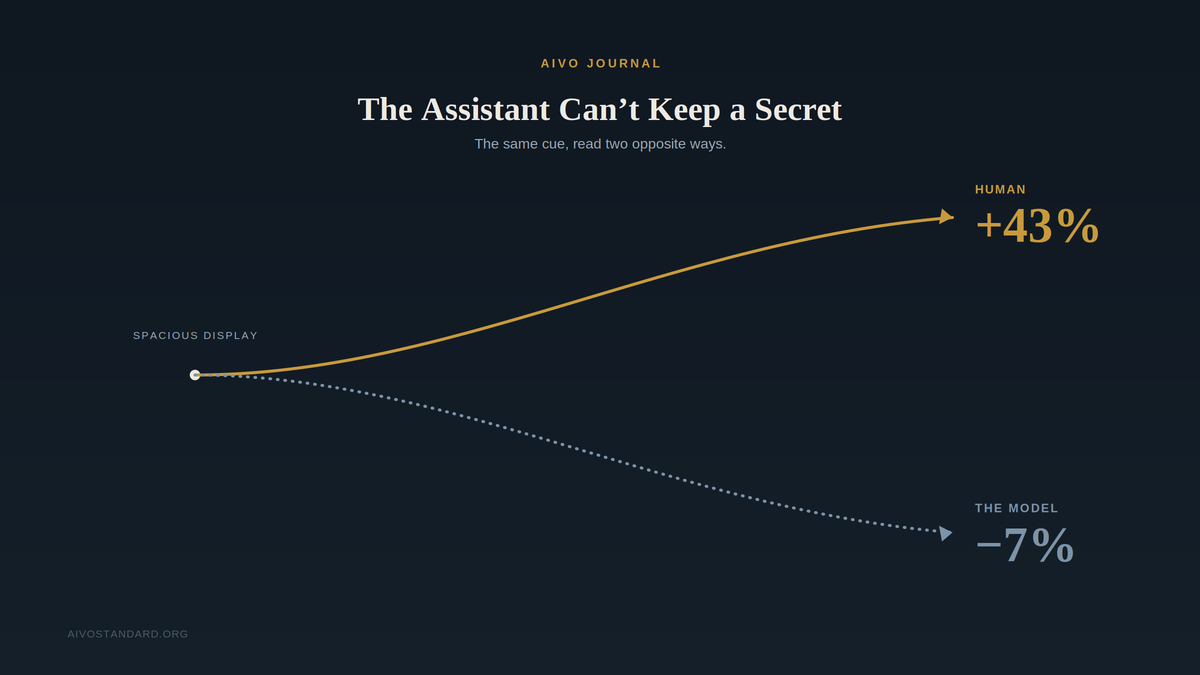
Take away the label and show a product against a blank, spacious background, more room than the object needs, nothing crowding it. To a human, that emptiness reads as confidence. The brand didn't need to fill the frame with reasons to buy. A recent study testing this exact cue found people rate a product as 43% more luxurious when it's displayed this way. The same image, shown to three current AI models, moved the other direction, down 7%. Elevated positioning, a classic cue for status, scored negatively too. Association with fine art, another long-standing signal, registered as close to nothing at all.
Something specific and structural is happening here, not just a gap in training data that a bigger model closes next year.
What the models actually reward
The study, run by an INSEAD researcher and a commercial AI-measurement team, tested four cues with decades of evidence behind them in human research: elevated display, spacious framing, art association, and slender product design. Each was sampled across three current models, repeatedly, to separate a real pattern from noise. The pattern held. Every implicit cue either failed to move the model's judgment or moved it backward.
One cue overperformed, and it's the least subtle one available: the brand's own name. Recognition lifted the models' sense of a product's luxury status by 41%, more than double the lift it gave human raters. Where imagery mattered to the models at all, they favored literal photographs, especially of recognizable faces, over paintings or abstract association.
A second experiment, valuing six car brands shown against plain versus ornate backdrops, made the inconsistency concrete. Dress the scene with fine art, and one model's valuation of a performance car went up. Another shrugged. A third marked it down. A luxury nameplate that reliably outranks a mainstream one in human perception didn't reliably separate at all in some of the model outputs, the authors note the two can come out reading as equally premium.
Why this isn't just a data problem
It's worth asking why the gap runs in this particular direction, not just that a gap exists.
Luxury signaling works on people precisely because it withholds. A sparse product page, a waitlist instead of a price, no comparison offered, no discount mentioned, all of it functions as a costly signal: only someone already fluent in the code understands what the absence means. The indirection is not a flaw in the communication. It is the entire communication.
A model optimized to be a helpful, direct assistant is working against that logic by design. It doesn't gatekeep meaning the way silence gatekeeps meaning for a human walking into an empty, spare boutique. It just answers the question it was asked, as clearly as it can, using whatever signal is most explicit and most repeated in what it has seen. When the cue is implicit, the model has nothing legible to hold onto, so it falls back to the most literal thing available. Usually, that's just the name.
This shows up beyond product photography. The same research team separately scored advertising creative twice, once by human raters, once by the models, and found almost no correlation between what each audience rated highly. Humans preferred work built on emotion. The models preferred work that was descriptive and product-forward. In a third piece of the same research, a ski brand's defining attribute, the rigidity racers specifically prize, was read by the models as a weakness, not a feature, absent the surrounding context that tells a person why stiffness is the point.
The pattern is consistent across all three: models are strong where meaning is explicit and propositional, and weak, sometimes actively wrong, where meaning depends on cultural fluency and what's deliberately left unsaid.
A second, separate failure hiding in the same category
None of this requires a brand to be absent for the misreading to happen, the cues above were tested on content the models could actually see. But a related, distinct problem is showing up across the luxury sector right now: brands that are genuinely invisible, not misread, because the content was never retrievable in the first place. Some block AI crawlers outright, protecting imagery and brand voice from unauthorized use. Others gate real product information behind an email signup or a boutique visit, the same restraint that signals exclusivity to a person removes the substance a retrieval system needs to work with at all.
That's not a misinterpretation problem. It's a possession problem, wearing the same aesthetic as the one above, but requiring a different fix. And it carries its own sharp cost: when a brand's own voice is unavailable, AI systems don't return silence. They fill the gap with whatever else has been written, resellers, forums, secondhand marketplaces, competitors. Blocking access doesn't preserve mystique. It just hands the story to whoever else is willing to tell it.
The bind this creates
There isn't a clean fix sitting underneath all this. Luxury brands are being asked, implicitly, to encode the very thing that makes them luxury into the kind of explicit, structured evidence a model can actually use, without destroying the indirection that gave the signal its meaning to a human in the first place. Write too plainly about why the waitlist matters, and the mystique the waitlist was creating starts to evaporate under its own explanation. Say nothing, and the model fills the silence with whatever the resale market and the dupe forums have already said.
Where a real path forward exists
The bind is real, but it isn't unsolvable, and the shape of the fix is worth naming plainly rather than leaving as an open problem.
The mistake is treating the implicit cue itself as the thing to encode. A model can't be taught to feel what spacious framing communicates, that's a connotative experience, not a fact. What it can do is retrieve and cite a specific, verifiable claim standing behind that feeling, the kind of evidence a person's cultural fluency lets them infer instantly, but a retrieval system has no way to infer at all.
Consider what "meticulous craftsmanship" is actually standing in for, on a typical luxury product page. It's an unfalsifiable, generic claim, and generic claims are exactly what gets matched or ignored by a comparison engine that has no way to verify them. The specific fact behind that phrase, hours of hand-stitching per piece, the name of the atelier, the actual waitlist length in months, the specific technique and its documented provenance, is a different kind of evidence entirely. It's concrete, checkable, and hard for a competitor to simply claim too. That last property matters more than it looks: a specific, verifiable fact is arguably a more rigorous version of the same costly signal luxury has always relied on, harder to fake than an implication, not softer than one.
This doesn't mean flattening the brand experience into a spec sheet. It means building two layers that carry the same meaning in different registers. The customer-facing presentation, the spare page, the waitlist, the unlabeled elegance, stays exactly as it is, doing the work it has always done on a human audience. Underneath it, a separate, explicit evidence layer carries the specific facts a retrieval system can actually work with: documented provenance, named craftspeople, production volume, verifiable history, real technical specification. The model gets something to cite. The customer never sees the machinery. This doesn't require an all-or-nothing choice about who sees what. A brand can serve that structured, factual layer specifically to AI systems while keeping imagery and brand voice protected from broader scraping, the same way a site already treats different visitors differently. Blocking everything and exposing everything were never the only two options.
One real risk sits inside this, worth naming rather than smoothing over. A specific, published fact invites specific, published comparison. The moment a brand states its hand-stitching hours, a competitor can publish a higher number, and the conversation collapses into exactly the kind of quantitative feature war luxury has spent decades staying out of. That argues for real judgment in what gets exposed on the explicit layer, not everything true is worth stating as a headline number. Provenance, named craftspeople, and documented history don't reduce cleanly to a scoreboard. Anything that does reduce that way is worth a second thought before it becomes the fact a brand leads with.
This is already happening in pockets of the industry, not as theory but as infrastructure. Reports on how some maisons deploy AI describe exactly this separation, systems that stay invisible to the shopping experience while doing real, structured work behind it. The same instinct, an explicit layer built to be legible to machines, sitting quietly behind an experience built to stay illegible to them, is the shape of a working answer, even before anyone has fully solved it.
What this isn't saying
This is based on one rigorous study, a small number of current models, at one point in time, and the researchers say plainly that the findings are perishable, the exact model versions tested have already been superseded once. A different architecture, trained differently, might close part of this gap, or might not, since the tension described here isn't obviously a scale problem. It's worth being honest, too, that part of the research team measures and sells AI brand visibility services commercially, a real reason to treat the specific numbers as a starting point for testing your own brand, not a settled fact to build a strategy on unexamined.
What seems durable, more than any individual figure, is the shape of the problem. An assistant whose entire function is to explain things clearly will keep sitting awkwardly against a communication style whose value depends on refusing to explain itself. Closing that gap, for any brand built on restraint, is not a content checklist. It's a genuinely hard translation problem, and right now, almost nobody in luxury has been asked to solve it before.
Source: Dubois, D., Hess, A., Dawson, J., & Jaiswal, A. (2026). LLMs Misunderstand Luxury Brands. Harvard Business Review, June 2026.
Comments ()