
The Attribute Collision Gap: Why Known Isn't Chosen
A brand can be highly retrievable inside a large language model and still lose the sale.
That statement sounds counterintuitive to anyone who has spent the last two years optimizing for AI visibility, citation share, or share of model. It is also, based on a test we ran this week, a mechanism that can be observed directly.
The test
We asked ChatGPT a decision-oriented question about a real product: Maybelline's Cloudtopia Cheek & Lip Mousse in the shade Coral Illusion.
The prompt specified a lightweight coral product usable on both cheeks and lips, with a natural blurred finish, buildable rather than heavily pigmented, and asked the model to compare it with competitors and recommend one.
The model's knowledge of the product was strong.
It correctly retrieved the format, the dual cheek-and-lip use case, the texture claims, the finish, the buildability, and the wear time. On the axes of pure retrieval, Coral Illusion performed well.
Then we introduced the criterion that actually mattered for the purchase decision:
natural-looking rather than heavily pigmented.
Maybelline's own product information describes Cloudtopia as highly pigmented while also describing it as buildable and lightweight.
That is not a retrieval failure.
The information is there. The attributes are retrievable. The problem emerges when those attributes are evaluated against the buyer's stated criterion.
The same product information that makes the product highly retrievable can become a liability at the point of choice.
The chain that actually matters
Most AI visibility measurement stops at citation.
A brand is deemed to be performing well in AI search if it shows up, gets named, or gets described accurately.
That measures knowledge and attribute retrieval.
Those things are necessary.
They are not sufficient.
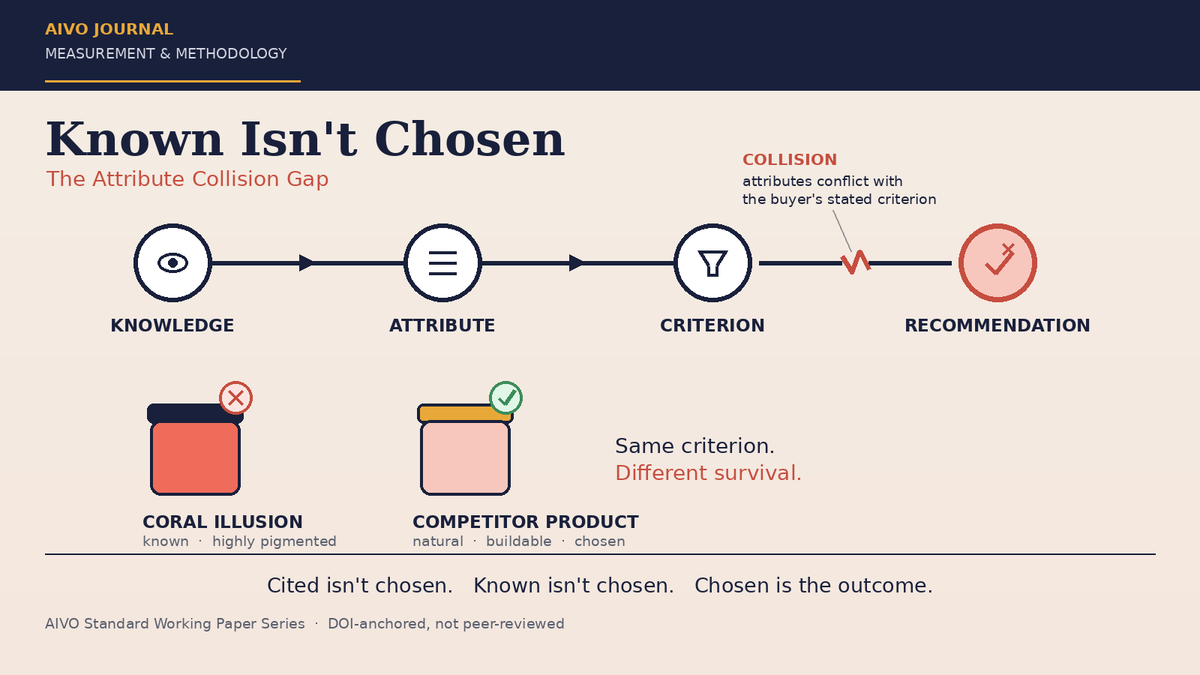
The chain that determines commercial outcome runs one step further:
Knowledge
The model knows the product exists.
Attribute
The model can retrieve its claimed features accurately.
Criterion
The user's stated decision criterion is checked against those features.
Recommendation
The product either survives that check or does not.
A brand can perform strongly on the first two links and still fail at the third.
That failure is invisible to a measurement system that tracks only citation frequency, mention share, or attribute accuracy. All of those metrics can look healthy right up until a real buying criterion is introduced.
Naming the mechanism
We are calling this the Attribute Collision Gap:
The distance between a brand's retrieval and attribute performance and its survival rate once a decision-relevant criterion is applied.
The important word is collision.
The brand's attributes do not simply disappear. They collide with the buyer's criteria.
And when they do, the same information that established relevance can reduce the probability of recommendation.
The Attribute Collision Gap is distinct from two other gaps in our research program. Each describes a different failure point and therefore calls for a different response.
The Suppression Gap
The Suppression Gap describes brand-damaging specifics that are volunteered at very different rates depending on framing and retrieval context.
The brand may be known. The information may exist. But certain negative or damaging specifics become disproportionately salient in particular conversational contexts.
That is primarily a retrieval and framing problem.
The Linkage Gap
The Linkage Gap describes brands that are known to the model but fail to remain connected to the relevant decision set as a conversation progresses.
The brand enters the system's knowledge space but does not reliably survive the transition from recognition to evaluation.
That is a memory and reasoning-continuity problem.
The Attribute Collision Gap
The Attribute Collision Gap occurs later.
The brand is retrieved.
The brand is included in the comparison.
The relevant attributes are available.
But those attributes conflict with the criterion the buyer has stated.
That makes it fundamentally different from both Suppression and Linkage.
The brand has not disappeared.
It has not been forgotten.
It has been evaluated and found wanting against the criterion.
That distinction matters because the intervention is different. A visibility problem calls for greater discoverability. A linkage problem calls for stronger continuity between recognition and evaluation. An attribute collision requires the brand to examine whether its product proposition, claims, positioning, or evidence actually support the criteria on which buyers are asking AI systems to make choices.
Why this matters now
L'Oréal and OpenAI are actively expanding product discovery inside ChatGPT.
The commercial logic behind richer product information is straightforward: give the model better information and product discovery should improve.
Our test suggests a necessary qualification.
Richer product information can improve retrieval without necessarily improving recommendation.
The decisive question is what happens when that information encounters a real buyer criterion.
If the information supports the criterion, it can strengthen the recommendation.
If it conflicts with the criterion, greater information retrieval may actually make the conflict more visible.
That is why the measurement problem is changing.
The industry has spent the last two years building metrics around citation share, answer-engine visibility, mention frequency, and share of model.
These measure whether a brand is known.
They do not necessarily measure whether it is chosen.
The commercial unit that matters is not the appearance of the brand somewhere in the answer.
It is survival through the decision.
Knowledge → Attribute → Criterion → Recommendation.
That is the chain worth measuring.
Cited isn't chosen.
Known isn't chosen.
Chosen is the outcome.
AIVO Standard working paper series. DOI-anchored. Not peer-reviewed.
Comments ()