
The Commodity Machine: What AI Makes Cheap, and What It Makes Valuable
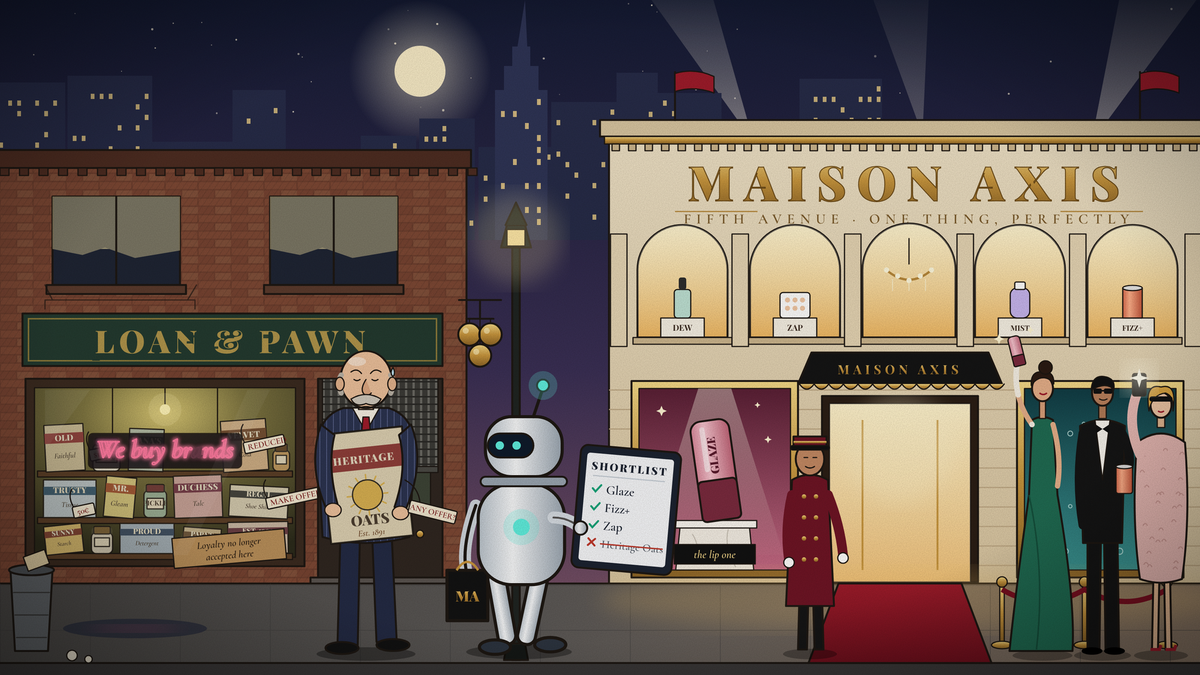
AI compresses the value of whatever it makes easy to reproduce, and raises the stakes for whatever stays hard to replicate or verify. In two years it has pushed a software category to a $60 entry price. It is now testing whether the emotional premium of iconic consumer brands survives a buyer that compares every option, every time.
Transformation has a second act
Every wave of automation follows the same arc. First it creates a new capability that commands a premium. Then it makes that capability cheap to reproduce, and the premium drains away to whoever owns the next scarce thing.
AI is running this arc faster than any technology before it. A large language model is a general-purpose engine for producing competent answers, and competence anyone can summon on demand stops commanding a premium. The same models also make alternatives cheaper to compare, which matters just as much.
This article traces that pressure at two altitudes. At the micro layer sits GEO and AEO, a two-year-old industry whose core product already sells at commodity prices. At the macro layer sits brand, where AI agents are beginning to weigh products on attributes and price at every purchase.
Neither story has a single cause. Software was getting cheaper and consumer groups were restructuring before agents mattered. AI adds a pressure that finds the weaknesses already there, and it finds them in the same place in both markets.
The micro layer: a two-year-old industry already at commodity prices
Generative engine optimisation, and its sibling answer engine optimisation, emerged in 2024 around one product: a dashboard that tells a brand how often ChatGPT, Gemini or Perplexity mentions it. The category attracted serious money. Profound raised a $96 million Series C early in 2026 at a $1 billion valuation, then a $180 million Series D on 15 September at $1.8 billion, co-led by Sequoia Capital and Kleiner Perkins.
The pricing tells a different story from the valuations. In June, review sites still listed Evertune's entry point at $3,000 a month. Its own pricing page now shows Pro at $800 and a Starter tier at $60 a month, billed annually, with 5,000 prompt credits across up to five models.
The detail matters. Evertune built its reputation on running each prompt up to 100 times for statistical confidence, and its pricing page reserves that sampling for Pro and Enterprise. Starter also bundles an agent that buys ChatGPT ads for 10% of media spend. The $60 tracker works partly as a door into ad buying.
Profound made a different move. In mid-September, the week of its Series D, it withdrew its $99 Starter and $399 Growth plans for brands, according to several independent pricing trackers. Its pricing page now offers brands a free seven-day trial and custom Enterprise pricing, and keeps a self-serve plan only for agencies. Profound left the low end of the market to others and repositioned around an agent product it calls AI Marketer.
Others are crowding into the space. Otterly sells a Lite plan at $29 a month, Peec starts at $95 and Semrush sells AI visibility at $99 per domain. Microsoft Clarity gives a basic AI visibility report away inside its analytics product. One September survey of 20 vendors found the cheapest paid plans ranged from $24.99 to $295 a month.
These are three different commercial responses: a price cut, a retreat from the entry tier and a free feature bundled into a larger product. They share one cause.
A visibility tracker sends prompts to public models and counts the brand names in the answers. A competent developer can rebuild that loop in weeks, and platforms with existing customers can add it as a feature. When a measurement is that easy to reproduce, its price drifts toward the cost of the API calls.
Counting mentions has stopped being a business on its own. What stays scarce is evidence of why a brand survives the decision or drops out of it, and what changes that outcome.
The macro layer: brand memory loses its guarantee
Brand equity has always been a shortcut. A shopper facing forty shampoos reaches for the one their mother used, the one from the advert, the one that feels safe. That reach is worth billions, and it rests on human memory and feeling.
An AI agent handles that memory differently. Asked for the best shampoo for fine hair under $15, it reads ingredients, reviews, price and availability, and returns a shortlist. A personal agent may know its user has bought the same brand for ten years and weigh that history as evidence. It can also test the incumbent against every alternative at every purchase, which a loyal shopper rarely bothers to do. Meta's Muse and its peers are moving from recommending products to completing checkout, which shortens the distance between shortlist and till.
Shoppers say they are open to this. In an Adobe survey published this month, 59% of 1,000 US consumers said they would leave a preferred brand for an unfamiliar competitor on an AI recommendation. Checkout.com found 57% would let an agent switch brands for better value. Accenture found 36% of loyal travellers would let an agent move them from a favourite hotel or airline.
These are stated intentions, gathered with different definitions, and none of them is observed purchasing. The counterweight is just as strong. In a study of 4,000 shoppers across four markets, 89% said recognising the seller's brand matters when they act on an AI recommendation.
Brand still decides at the final click. The exposure sits one step earlier: if the agent leaves a brand off the shortlist, recognition never gets its chance. Brand memory remains an asset, and it now has to pass a comparison it used to skip.
Reshuffling the deck
Large consumer groups were rearranging their portfolios long before shopping agents mattered. Kraft Heinz, formed in 2015 in a deal worth roughly $100 billion, wrote down $15.4 billion against Kraft and Oscar Mayer in 2019. It announced a split in September 2025, then reversed course in February 2026 and committed $600 million to marketing, sales and R&D instead.
Unilever spun off its ice cream business in 2025, and in March 2026 agreed to combine its Foods division with McCormick in a $44.8 billion deal expected to close by mid-2027. Kimberly-Clark's $48.7 billion purchase of Kenvue cleared EU review on 13 October, on condition that it sells its feminine care brands in Europe, and has yet to close. Keurig Dr Pepper completed its purchase of JDE Peet's in April and plans to separate into a beverage company and a coffee company in early 2027.
PwC found that deal value in the sector more than doubled year on year in the first quarter of 2026, even as deal volume kept falling.
The causes are familiar: GLP-1 drugs suppressing appetite, tariffs, activist investors and slow volume growth. Agentic commerce arrived after these pressures and adds one more, aimed at the same weak point. A portfolio of heritage brands defended by shelf space and advertising recall was built for a shopper who remembers. It is less ready for a buyer that compares.
The counter-current: single-axis brands
While the conglomerates take themselves apart, a different kind of brand is being bought at striking prices. Rhode launched in June 2022 with a handful of products and reached $212 million in net sales in the twelve months to March 2025, still with around ten SKUs and no physical retail. e.l.f. Beauty bought it for up to $1 billion, its largest deal, and Rhode has since been credited with lifting e.l.f.'s fiscal 2026 sales guidance to 22% to 23% growth.
Rhode is part of a pattern. Church & Dwight paid up to $880 million for Touchland, a hand sanitiser brand, three years after paying $630 million for Hero's Mighty Patch acne stickers. PepsiCo paid $1.95 billion for Poppi, a prebiotic soda. Unilever bought Dr. Squatch, a men's soap brand. Bain reports that deals under $2 billion made up 38% of consumer products M&A over the past five years, against 16% from 2014 to 2019.
We call these single-axis brands. Each owns one clear position: a lip treatment, a pimple patch, a sanitiser that smells good, a soda with fibre in it. That position can be stated in a sentence and checked against reviews, ingredients and price. These brands grew up on social media before shopping agents mattered, and the clarity that made them easy to share also makes them easy for a machine to match to a need.
Legibility gets a brand onto the shortlist. Keeping its place takes something harder to copy. A sanitiser that smells good is easy to describe, and a competitor can launch one within a season. What protects a single-axis brand is the advantage behind the axis: a formulation that measurably performs better, a clean safety record, repeat purchase that shows up in reviews and sales. An agent can verify those things, and a rival cannot reproduce them quickly. The single-axis brands that last will be those whose clarity rests on proof.
The heritage portfolio faces the opposite problem. Its value is spread across range, memory and mood, and much of it lives in the shopper's head where an agent has limited access. The large groups appear to understand this. They are buying clear, provable positions from founders, because building one inside a portfolio of hundreds has proved hard.
What keeps its value
The two stories point to the same shift. AI makes some capabilities cheap to reproduce and some differences cheap to compare. The first lose pricing power. The second matter more.
In AI visibility, counting mentions is now easy. Explaining why a brand wins or loses a recommendation, identifying what changes the outcome and demonstrating that change are all harder. Durable value sits in that gap between measurement and intervention, and the vendors that can show repeatable evidence across it will be able to price on it.
In consumer markets, awareness may no longer secure a place in the consideration set. A clear proposition gets a brand onto the shortlist. Proof that it holds up against alternatives keeps it there. Preference still has to close the sale.
Commoditisation changes what companies compete on. Advantage moves away from what anyone can reproduce and toward differences that a buyer, human or machine, can recognise, verify and value.
Disclosure: AIVO operates in the AI visibility category discussed above and prices some of its remediation work partly on performance.
Sources
- Evertune pricing page
- Profound pricing page
- Evertune review citing $3,000 entry price (June 2026), GrowthManager
- Profound Series D and pricing change, Strategi
- Profound pricing change, Stackaible
- Profound Series C, OpenLens Q1 2026 trends
- AI visibility software price survey, Cheers (23 Sep 2026)
- Profound alternatives and competitor prices, Eclincher
- Adobe survey on AI and brand loyalty, E-Commerce Times
- Checkout.com, Agentic Commerce 2026
- Accenture travel loyalty research, Fortune
- AI shopping and consumer trust, TechRadar
- Spreedly survey on agents and Meta Muse, PR Newswire
- Kraft Heinz history, Wikipedia
- Q1 2026 CPG M&A, Retail Brew
- Big Food breakups and Bain deal-size data, CNBC
- Unilever and McCormick deal terms, Food and Drink Technology
- Kimberly-Clark 10-Q, pending Kenvue acquisition, SEC
- Kimberly-Clark wins EU approval for Kenvue, Investing.com (13 Oct 2026)
- Keurig Dr Pepper separation timing, SEC 8-K (June 2026)
- Keurig Dr Pepper completes JDE Peet's deal, Food Business News
- CPG deals 2026 midyear outlook, PwC
- e.l.f. acquires Rhode, exchange4media
- Rhode and e.l.f. guidance, Webull
- Church & Dwight acquires Touchland, FashionNetwork
- Church & Dwight and Hero, Unilever and Dr. Squatch, PrivSource
- PepsiCo buys Poppi, Yahoo/CNBC
Comments ()