
The Cost of Capital Is Coming for AI Metrics
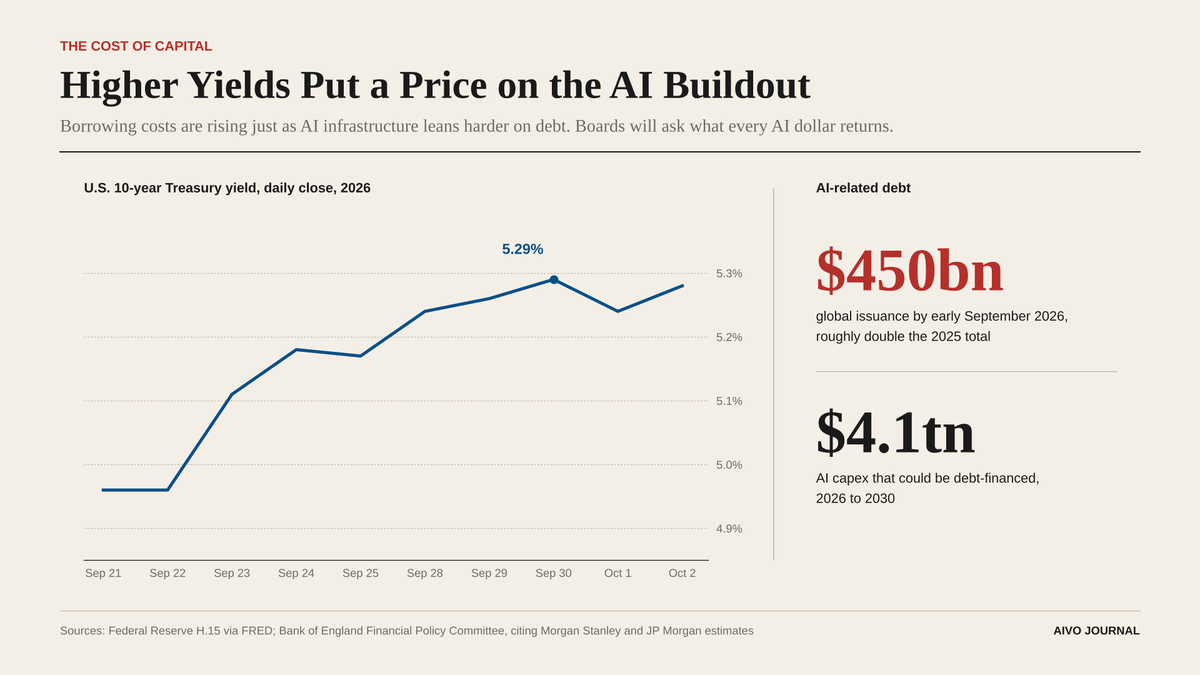
Higher bond yields are putting a price on the AI buildout. Boards will soon ask the same question of brand measurement.
Higher bond yields are putting a price on the AI buildout. The immediate effect is that financing data centres has become more expensive. The less obvious consequence is that every AI-related budget now faces a higher standard of proof, including the money brands spend trying to influence what AI systems recommend.
The numbers explain why. The US 10-year Treasury yield briefly rose above 5.3% at the end of September, and the 30-year closed above 5.6%. Both are levels last seen before the financial crisis. Meanwhile the AI buildout increasingly runs on borrowed money. In the record of its September meeting, the Bank of England's Financial Policy Committee cited a Morgan Stanley estimate that global AI-related debt issuance had reached around $450 billion by early September 2026, roughly double the total for 2025. It also cited JP Morgan analysts' estimate that debt could finance some $4.1 trillion of AI capital expenditure between 2026 and 2030. The Committee warned that a reassessment of expected AI earnings could trigger a sharper repricing of AI-related assets, with spillovers into sovereign bond markets.
The hyperscalers still generate enormous cash, so the buildout is unlikely to stall. What changes is the question asked of every dollar. When money was cheap, the operating question was whether something could be built. With real yields at current levels, it becomes what return the thing will produce. That question travels. It starts with data centres and works its way down to every budget line that claims a connection to AI. Cheap capital rewards experimentation. Expensive capital rewards measurement.
From visibility to choice
The first generation of AI brand measurement was built around discovery. Could a model find the brand, mention it, cite it? Could content and structured data raise the odds of appearing in an answer? These remain reasonable questions, and the tools that answer them have real uses. Their limitation is that they measure whether a brand is seen, while revenue depends on whether it is chosen.
Customers buy what an AI system recommends or selects after weighing the requirements of a journey. As assistants move from answering questions to shortlisting suppliers and completing purchases, the gap between being mentioned and being chosen becomes the gap between activity and revenue.
Why the cost of capital exposes weak metrics
In a period of abundant capital, organisations tolerate metrics that are directionally encouraging but economically remote. A rise in mentions, citations or share of answer can be reported as progress without anyone asking what it was worth.
Higher financing costs shift the burden of proof. A CFO reviewing AI spend will want to know what was spent, what changed, and whether customers behaved differently. The fourth question, which conventional brand measurement has largely ignored, is whether the AI systems making recommendations behaved differently. That behaviour can be observed directly. We run the journeys customers actually take and record which brands survive each step and which are eliminated.
Two economies
It helps to separate the AI economy into two layers. The first is the infrastructure economy. It is capital intensive by nature, consuming chips, power, land, construction and financing on a scale that now registers in central bank stability reports.
The second is the decision economy. It determines which supplier survives comparison, which product satisfies the customer's requirements, and which brand is ultimately recommended. Intelligence creates this economy; recommendation allocates its value. The bond market is pricing the first layer. Very few companies are yet measuring the second, even though that is where their revenue is decided.
The argument holds whichever way the spending cycle turns. If AI investment continues at its current pace, executives will need evidence that it is working in their favour. If investment slows, they will need to know where to concentrate what remains.
What that position is worth
AI Win-Rate measures whether brands survive AI-mediated buying journeys. AIVO Brand Alpha™ asks the next question: what is that position worth? It estimates the economic advantage or disadvantage a brand carries once AI systems become part of the purchase decision. We have published the methodology as an open working paper and welcome critique.
As the cost of AI rises, so does the standard of evidence required to justify AI investment. For brands, that evidence increasingly lies at the moment an AI system has to choose.
 Sheals, Paul and de Rosen, Tim
Comments ()