
The Differentiation That Doesn't Travel
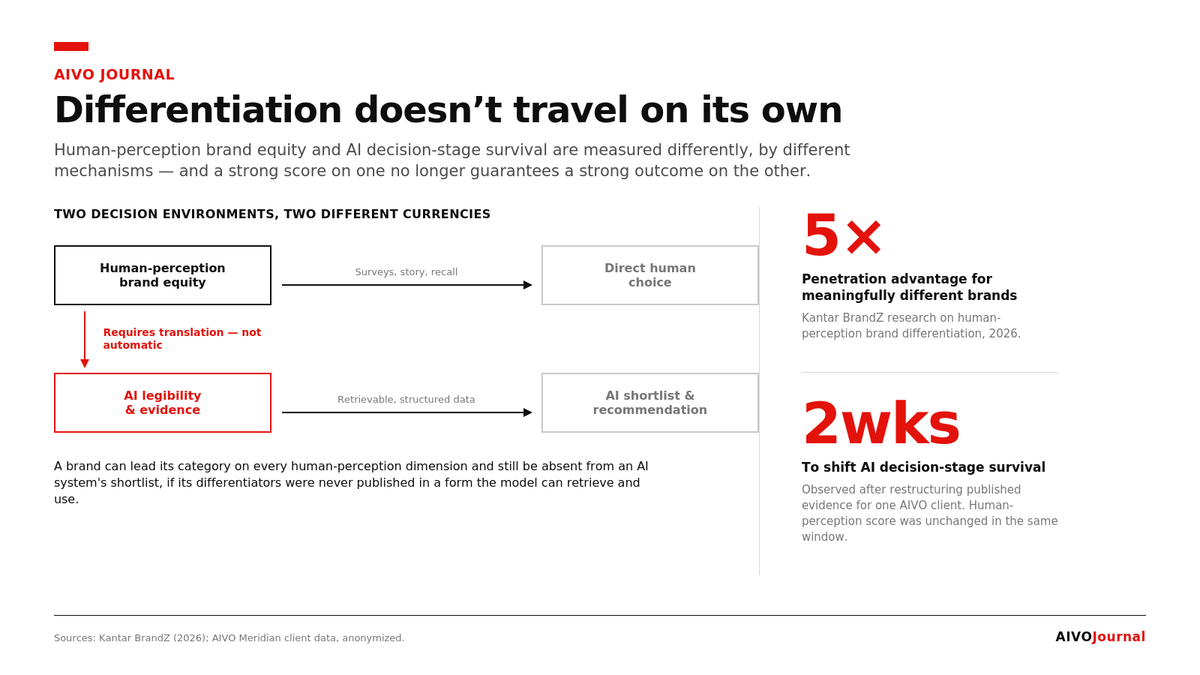
Kantar's BrandZ research makes a well-established case: brands that are meaningfully different from their competitors command a real, measurable advantage — up to five times the market penetration and as much as double the price point of weaker, less differentiated rivals. It's one of the most durable findings in brand measurement, built on decades of human-perception survey data across categories.
It's also, implicitly, a finding about how people choose. A shopper standing in an aisle, comparing options, weighing a brand's story against a competitor's — that's the decision environment BrandZ and instruments like it were built to measure. The question worth asking now is simpler than it sounds: does that same differentiation advantage survive when the comparison isn't happening in a person's head at all, but inside an AI system reasoning through options on a buyer's behalf?
A different kind of buyer is doing the comparing
An increasing share of purchase-relevant decisions now run through an AI intermediary before they reach a person at all. Someone asks which bank to use, which car to consider, which supplement to take — and a language model reasons across its available evidence and produces a shortlist, or a single recommendation, without necessarily surfacing every option a human survey respondent would have named as "meaningfully different."
That reasoning process doesn't work the way human perception does. It isn't persuaded by brand story, emotional resonance, or decades of advertising equity in the way a survey respondent might be. It works from evidence: structured data, verifiable claims, content the model can actually retrieve and reason over at the moment it's constructing an answer. A brand can be the clear, meaningfully-different leader in every human-perception dimension Kantar measures, and still be quietly absent from the shortlist an AI system produces, if that differentiation was never translated into the kind of evidence an AI reasoning chain can find and use.
Early evidence of the divergence
AIVO's own research points in this direction. Across early client work, brands with strong, well-established human reputations have shown measurable divergence between how they're perceived by people and how they fare in AI-mediated decision reasoning — sometimes stronger in the AI layer, more often weaker, and the direction isn't predictable from the human score alone. In one case, a consumer brand working with AIVO saw a measurable improvement in AI decision-stage survival within two weeks of restructuring how its evidence was published — the underlying human perception of the brand hadn't changed at all in that window; what changed was whether an AI system could find and use the proof points behind the brand's claims.
That's the core mechanism worth naming: differentiation that lives only in brand story, sentiment, or survey recall doesn't automatically travel into an AI reasoning chain. Differentiation that's backed by structured, retrievable evidence has a much better chance of surviving the translation.
Two caveats worth being honest about. First, AI systems don't reason from structured evidence alone — they also draw on the same unstructured web signal that's long shaped human perception: reviews, press coverage, forum discussion. A brand with a large, well-established web footprint isn't starting from zero. The distinction that matters commercially is control: unstructured sentiment accumulates slowly and isn't something a communications team can directly engineer, while structured evidence is a lever brands can act on immediately. Second, how much this matters varies by category. High-consideration, spec-heavy purchases — financial services, healthcare, electronics — lean more heavily on the kind of structured comparison AI reasoning chains are built to perform. Lower-consideration, emotionally-driven categories may still be carried largely by human perception for some time yet.
A gap, not a replacement
None of this displaces what BrandZ-style measurement does well. Human perception still drives a large share of purchase behavior, and a meaningfully-different brand story still matters enormously wherever a person is doing the choosing directly. The point is narrower: human-perception differentiation and AI decision-stage survival are two different things, measured two different ways, and a strong score on one doesn't guarantee a strong outcome on the other. Reputation and communications teams that only track the first are increasingly flying blind on the second — not because their research is wrong, but because it was never built to see this particular layer.
As AI systems take on a larger share of the comparing, evaluating, and shortlisting that used to happen entirely in people's heads, the brands that protect their advantage will be the ones that treat AI legibility as its own discipline — not a replacement for differentiation, but the mechanism that determines whether differentiation actually reaches the decision.
Access AIVO's research on AI decision-stage measurement, including the Algorithmic Reputation Equivalence methodology, at: https://zenodo.org/records/20535587
Comments ()