
The Gate Before KYA
The customer sent an agent
Simon Taylor's Brainfood has published the second part of its "Fintech is Dead" thesis, and it is the clearest map yet of what financial services looks like when the customer sends an agent. Taylor argues that all three primitives of finance are being rebuilt at once. Decisions become continuous, records become portable, and distribution becomes delegated.
His new customer is an agent such as Meta's Muse or Instinct, arriving with a mandate and money. The evidence is already here. Robinhood has let 100,000 users hand an agent a limited account. Stripe and Ramp both now treat model routing as a financial services business. Taylor's line on distribution captures the shift: "I don't want your agent. I want my agent to use your thing."
The essay is right about the direction and right about the plumbing. What it leaves unsaid is where competition moves. Banks will still open accounts, settle payments and fund loans, yet they no longer control the moment a provider is selected. Distribution moves into the customer's agent while execution stays with the institution, and those become two separate competitive problems.
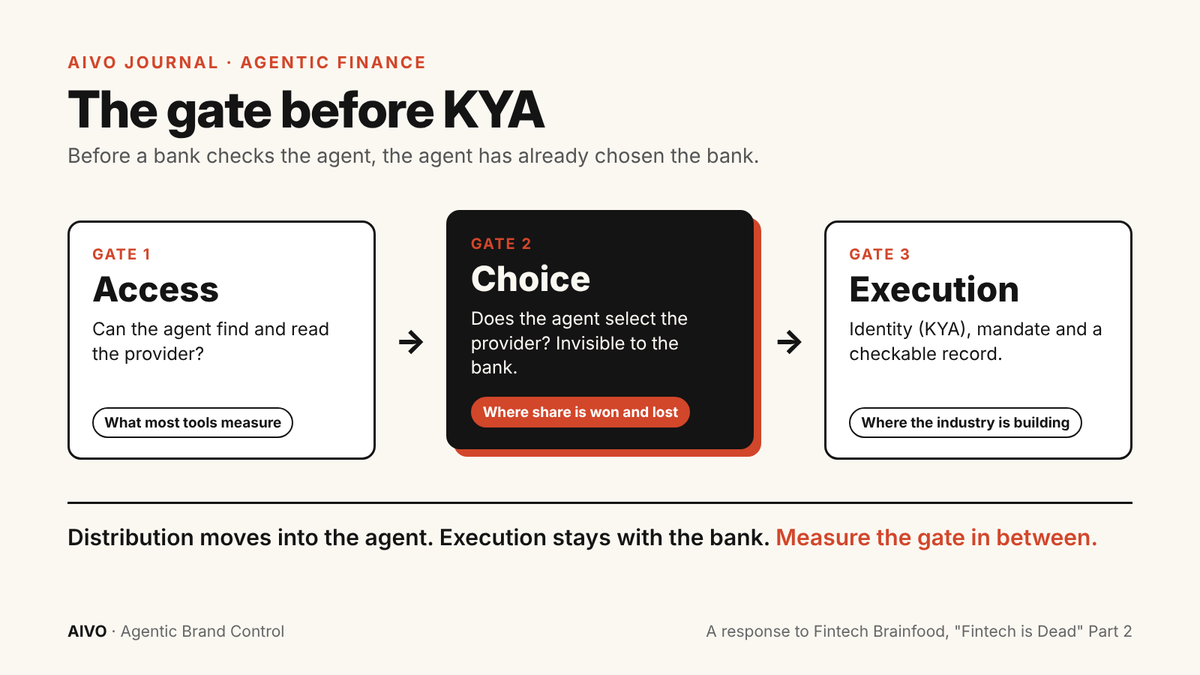
The gate before KYA
Taylor lists what a firm needs to serve the customer's agent. Identity, so know your customer becomes know your agent. A mandate, meaning a budget, a boundary and a right of recourse. And a record anyone can check.
In AIVO's three gates of agentic commerce, those are Execution controls. Access asks whether the agent can find a provider, Choice whether it selects one, Execution whether the transaction completes. KYA governs execution. It has nothing to say about selection.
Taylor's own examples sit at the Choice gate. A bill agent switches the customer to the cheapest energy tariff, a treasury agent sweeps between banks, a portfolio agent rebalances across three brokers. Each one ranks providers and picks before any identity check fires.
The decision nobody in the bank sees
Taylor notes in passing that each payment a bill agent handles is one the provider's app no longer sees. That is the point where a bank loses sight of its own customers.
In the app era, a lost customer left a trace in the bank's own funnel. In the delegated era the loss happens inside someone else's agent, against criteria the bank did not set and cannot inspect.
Because Taylor's decisions are continuous, so is Choice. An agent that sweeps cash every hour can reconsider its provider every hour. Quarterly brand tracking has no view of a decision made thousands of times a quarter.
Making Choice measurable
Replica agents make this measurable. Instead of inferring why recommendations change, they replay the journeys an autonomous financial agent would run, such as switching a current account, choosing a savings product or picking an insurer, and record who was considered, who was selected and why.
The pattern matches what AIVO's Beyond Visibility working paper (DOI 10.5281/zenodo.20848721) found in conversational AI: being present and being chosen are separate outcomes. A provider can sit in nearly every candidate set and still lose the selection, because the agent weighs evidence that provider has never published in a form the model trusts.
AIVO runs replica agents modelled on Muse, Instinct and Dots inside AIVO Meridian, alongside AI Win Rate, which tracks how often a brand is chosen at the point of decision across roughly 25,000 conversations and 250 brands.
Open item before publication: insert the headline replica-agent finding for financial services (selection rate against presence for the leading banks tested).
Delegated distribution starts with being chosen
Taylor's machine-native finance company serves agents, moves assets from anywhere and never closes. It also needs to know, continuously, whether agents choose it.
That means measuring Choice the way Taylor wants decisions made: in a loop, with people reviewing the exceptions. Run the journeys your customers' agents will run, record where you are selected and where you are passed over, fix the evidence behind each outcome, and measure again.
Execution determines whether an agent can become your customer. Choice determines whether it ever arrives.
Sources
Simon Taylor, "Fintech is Dead" Part 2, Brainfood, October 2026.
AIVO Journal, "Chosen, Then Blocked: The Three Gates of Agentic Commerce", September 2026.
AIVO Standard, "Beyond Visibility" working paper, DOI 10.5281/zenodo.20848721.
Comments ()