
The People Who Win Agentic Commerce Will Not Be SEOs
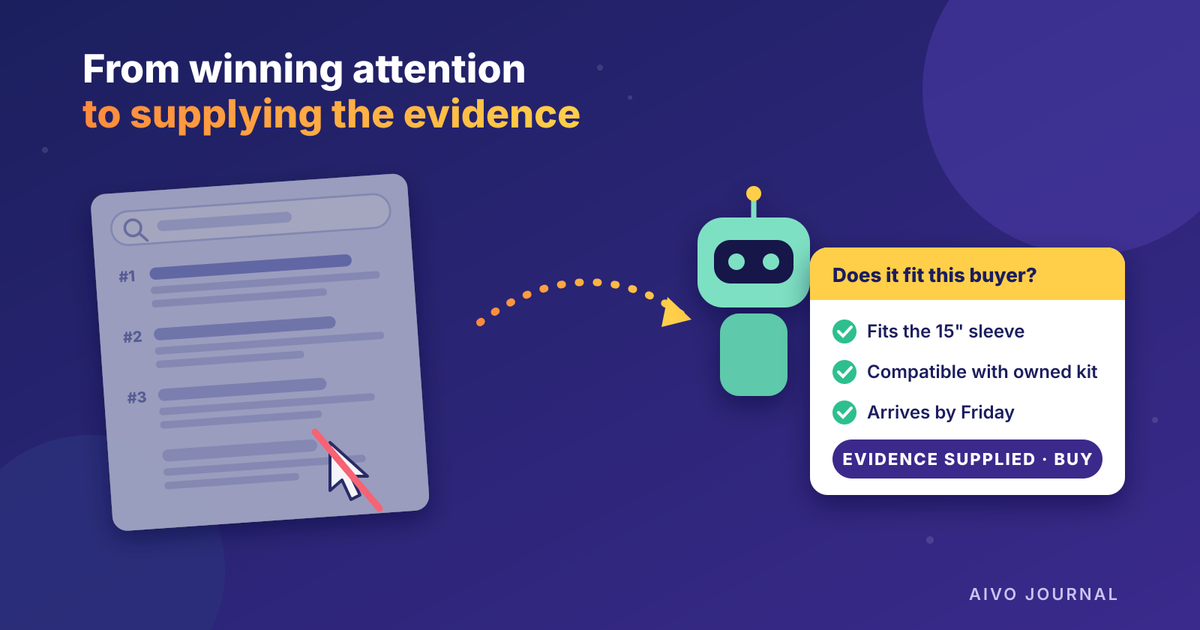
SEO is splitting into parts that other functions will own. A minority of practitioners will make the move. Most of the work that replaces it will be done by people who have never called themselves SEOs.
The scoreboard goes first
In agent-mediated shopping, the party doing the searching is an agent acting for a buyer. It reads, compares and, in a growing number of cases, completes the purchase. It never looks at a results page. Rankings, click-through rates and organic sessions were proxies for a human choosing to visit a site. The buyer may still approve the purchase, but the agent increasingly controls which products reach that decision.
The question a brand needs answered is whether the agent chose it. That is what AI Win-Rate℠ measures, and a conventional SEO report does not answer that question.
Zero-click search was the warning. Zero-sight is the destination: agents visit, evaluate and decide in places analytics cannot see, and a brand can lose share while its traffic dashboard reports a steady month.
What happens to the discipline
SEO as a business will break apart during the transition, and each of its components will go to a different owner.
The technical layer of crawlability, structured data and product feeds persists as plumbing. Agents still have to fetch, parse and trust a page. As platforms absorb more of this work, agencies will have to justify their fees through capabilities beyond implementation.
The authority layer of reviews, third-party mentions and expert sources moves toward PR, communications and retail media. Agents weigh these signals heavily, and they cross-check them. Contradictions between a brand's own site, its retailer listings and what customers say elsewhere now cost the brand trust with the agent.
For agent-mediated purchases, rankings cease to be an adequate scoreboard, and the monthly ranking report that justified the relationship loses its purpose.
The nearest precedent is classified advertising after online marketplaces arrived. Matching buyers to sellers continued and grew. The industry built around the old method of doing it did not.
Why most SEOs will not make the move
Three things stand in the way.
The first is incentives. SEO was organized around discoverability, rankings and visits. Agentic commerce requires responsibility for product suitability, evidence and transaction outcomes.
The second is authority inside the client. Making a brand answerable to an agent means correcting product data, return policies, compatibility claims and pricing. Those belong to product, merchandising, ecommerce and legal teams, where the SEO function has rarely had a seat.
The third is the buyer. SEO was sold to marketing managers on traffic. Agent readiness is sold to ecommerce, commercial and digital leaders on conversion and revenue, and the SEO agency seldom holds that relationship.
Some practitioners will cross. Their prospects depend on acquiring these capabilities and the client relationships needed to put them to work.
Who does the work instead
The teams that win will be assembled from five backgrounds.
Ecommerce and product data specialists who run PIM systems, feeds and marketplace operations will own the accuracy of what agents read.
Product and merchandising specialists will turn catalog information into answers to buying questions. Will this sleeve fit inside that bag? Is this component compatible with the equipment the buyer already owns? Can delivery meet the deadline? The agent needs a supported answer, a request for the missing detail, or a clear statement that the product does not fit.
AIVO Assist was built for this step. It acts as the brand's own product expert for shopping agents. An agent passes the buyer's need and receives a judged answer (Fits, Fits if, No suitable option, or Need a little more information) with the deciding facts and their sources, drawn from a knowledge repository the business has signed off. In a controlled test, agents chose the right business 93% of the time with Assist available, against 47% without it (working paper).
Developers who understand agent protocols and APIs will make brands transactable by agents. A seller that cannot support the next step risks losing the purchase to one that can.
Analysts comfortable with probabilistic outcomes will replace rank tracking with measurement of how often a brand is chosen across many runs of the same buying scenario.
Communications and reputation professionals will keep the story consistent across every source an agent consults.
The shift from television to digital advertising followed a similar course. Television people understood persuasion, yet programmatic was built largely by newcomers with different skills.
What this means for brands
Brands need to assign responsibility for what agents are told, whether those answers establish product suitability, and what happens when they do not.
The work begins with measurement: how often the brand wins when an agent shops its category, and which unanswered questions or inconsistencies cause the losses. Remediation follows, carried out by product, data and commerce teams with a clear target.
Some SEO practitioners will earn that responsibility. Others will remain valuable specialists in discovery. But neither the agency relationship nor a new acronym confers ownership of the buying decision. That will belong to teams that can measure where purchases are lost and fix the reasons.
Comments ()