
The Rise of Agentic Commerce: Why Winning the First AI Impression Is No Longer Enough
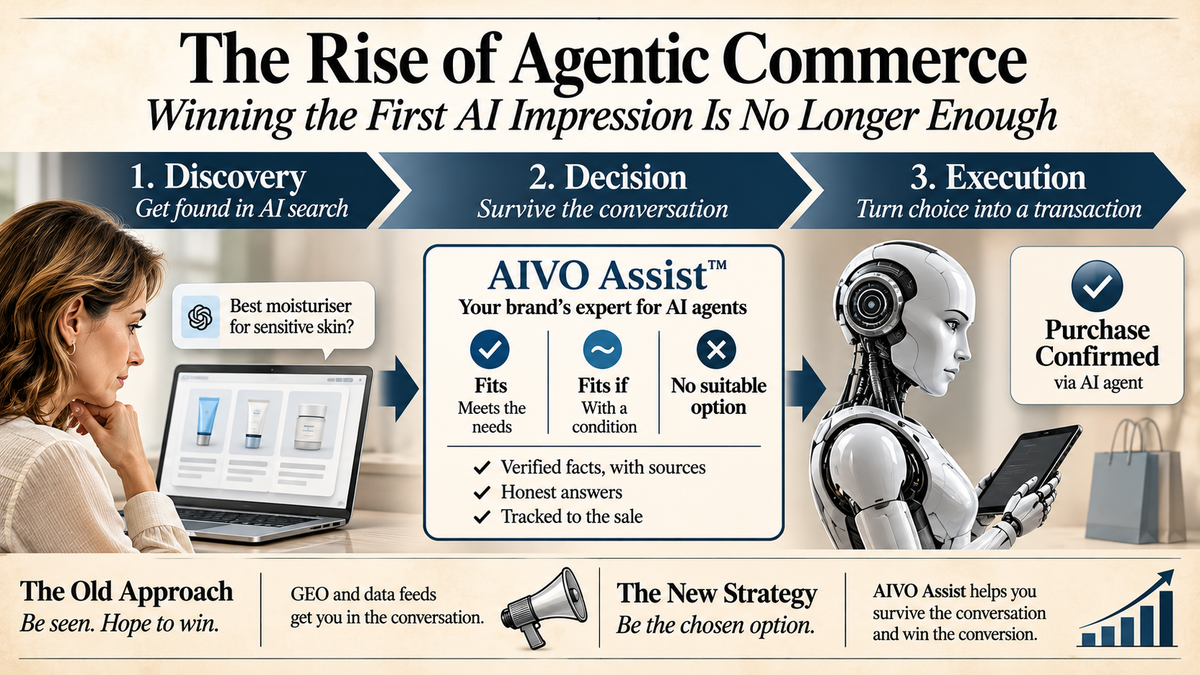
Product discoverability is becoming infrastructure. The competitive advantage is shifting to recommendation survival, decision control and transaction readiness.
The first impression is no longer the prize
In the early days of AI-powered product discovery, brands faced a relatively straightforward challenge: getting into the conversation.
As consumers began asking ChatGPT, Gemini and retail AI assistants for product recommendations, a new optimisation industry emerged. Generative Engine Optimization (GEO) promised to improve the probability that products and brands would appear in AI-generated answers. Product data was restructured, attributes enriched, catalogues cleaned and content distributed across the digital ecosystem.
Companies such as Azoma (formerly Ecomtent) built enterprise propositions around this emerging requirement. Their technology helped consumer brands improve product information, marketplace content and discoverability across an increasingly AI-mediated retail environment.
This was a necessary development. AI systems cannot reliably recommend products they cannot identify, understand or distinguish.
But the industry made an assumption that is now becoming increasingly questionable: that appearing in an AI answer was a reasonable proxy for commercial success.
It isn't.
A product can appear in an initial recommendation and disappear from the conversation a few exchanges later. It can be recognised, considered and even positively described without ultimately being selected.
The emergence of more sophisticated AI shopping assistants and autonomous purchasing agents makes this distinction commercially critical.
The new competitive challenge is not simply getting into the conversation. It is surviving the decision.
The disappearing recommendation
AIVO's research into AI-mediated brand selection has exposed a substantial gap between initial recognition and final recommendation.
Across a dataset of approximately 27,000 AI conversations involving 380+ brands, only 12.7% of brands initially recognised remained the final recommendation in the measured journeys. The resulting 87.3% displacement gap illustrates how frequently initial visibility fails to translate into final selection.
This is not simply a visibility problem. It is a decision problem.
Consider a consumer searching for a premium skincare product. An AI assistant initially identifies three moisturisers. The consumer then introduces additional requirements:
• Can I use this product alongside retinol?
• Is it suitable for sensitive skin?
• Does it contain ingredients I need to avoid?
• Is there a less expensive alternative with comparable performance?
Each new question changes the decision context. The AI system must reassess the available options against the evolving requirements.
A brand that initially appeared highly relevant may no longer satisfy the criteria. Another product may offer clearer evidence, more appropriate specifications or a stronger match to the consumer's stated needs.
The initial recommendation is therefore provisional.
The commercial consequence is significant. A brand can invest heavily in product feeds, content distribution and AI discoverability while remaining vulnerable at the point where the assistant actually has to choose.
Visibility tells a brand whether it entered the conversation. It does not establish whether it survived consideration, became the recommendation or won the final choice.
From discovery to decision
The emerging agentic commerce environment has three distinct layers.
Discovery: Can an AI system find the product, identify its attributes and understand what it offers?
Decision: Does the product satisfy the requirements of the buyer, survive comparison and become the preferred recommendation?
Execution: Can the buyer's agent interact with the merchant, verify the necessary information and complete the transaction?
These layers are connected, but they solve different problems.
Platforms such as Azoma operate across important parts of the discovery and product optimisation environment. Improving catalogue quality, product content and marketplace presence can influence how products are surfaced and evaluated by AI systems.
That work remains important. As AI agents become more sophisticated, accurate and accessible product information will become an increasingly fundamental requirement.
But discovery infrastructure does not, by itself, establish control over the final decision.
A product can have excellent structured data and still lose to a competitor. It can be prominently surfaced and subsequently displaced. It can satisfy the initial search while failing a more specific requirement introduced later.
This is where decision intelligence becomes important.
AIVO's approach is concerned with what happens between initial recognition and final selection: which brands are considered, which survive successive exchanges, why alternatives displace them and what can be done to improve their position.
The objective is not simply to increase the frequency with which a brand appears. It is to understand and improve its probability of becoming the answer.
The arrival of autonomous buyers
The next development is changing the architecture of digital commerce.
Consumers are beginning to delegate more of the shopping process to AI assistants. Instead of asking for a list of products and making every subsequent decision themselves, they increasingly expect their assistants to evaluate alternatives, verify compatibility, identify suitable merchants and help complete purchases.
The development of standards such as Google's Universal Commerce Protocol (UCP) and OpenAI's Agentic Commerce Protocol (ACP) reflects this transition.
These initiatives are developing the infrastructure through which AI systems, merchants and commerce platforms can exchange product information and support transactions.
The implications extend beyond a more convenient shopping interface.
A traditional website is designed primarily for human navigation. A buying agent has different requirements. It needs reliable product information, clear availability, accurate pricing, compatibility details and a means of interacting with the merchant's transaction infrastructure.
The merchant's ability to serve this information accurately and consistently will increasingly influence whether an agent can proceed with a purchase.
However, there is an important distinction between an AI agent making a purchasing decision and communicating directly with a merchant's own agent. Many decisions will continue to be made using information gathered from multiple sources, without any direct interaction with the brand.
Brands therefore face two related challenges: winning the decision wherever it is made, and being ready to support execution when an agent arrives to transact.
The missing facts: Why AI agents need a brand expert
There is a less obvious problem facing brands as AI agents become more involved in purchasing decisions. The information that determines whether a product is suitable is often the hardest information for an external agent to obtain.
Prices may sit behind booking engines. Product specifications may be buried in PDFs. Compatibility information may be scattered across descriptive copy. Important conditions and exclusions may be difficult to distinguish from general marketing language.
A product can therefore be discoverable without being sufficiently understood.
This matters because AI agents are not simply looking for product descriptions. They are evaluating suitability against the requirements of a particular buyer.
AIVO's response is AIVO Assist, a seller-side decision expert designed for visiting AI agents.
Rather than functioning as another consumer-facing chatbot, Assist gives external agents access to a business's approved knowledge base. The agent communicates the customer's requirements, and Assist responds with a verdict supported by relevant facts and their sources.
There are three possible outcomes.
Fits: The product satisfies the stated requirements.
Fits if: It satisfies them subject to a clearly defined condition, such as a particular size, plan or date.
No suitable option: Nothing in the business's offering meets the requirements.
The distinction is important. Assist is not designed simply to promote products or persuade an agent to buy. It provides verified information that allows the external agent to make a better-informed decision.
It states only facts approved by the business, identifies their sources and does not instruct the visiting agent what decision to make. It provides agents with the same facts available to human customers.
The principle is governed brand honesty: the business controls the accuracy of its own information, but the buying agent remains free to decide.
Assist can be accessed through a labelled Ask our Product Expert interface, WebMCP, API and MCP connections, or information published in advance for agents that only read.
This approach does not depend on a single commerce protocol or require every buying agent to communicate through the same technical architecture.
It creates a controlled way for a business to represent its products accurately wherever AI agents encounter them.
The invisible customer: Why conventional analytics are insufficient
There is another problem emerging alongside AI-mediated purchasing: the inability to see the activity.
Traditional website analytics were built around human visitors. They generally depend on browser execution, tracking scripts and familiar patterns of interaction.
AI agents do not necessarily behave in the same way.
In AIVO's controlled testing, a standard analytics script recorded none of 314 AI agent visits. The implication is potentially significant. A business may be receiving agent traffic without seeing it in its conventional analytics, making it difficult to understand whether agents are consulting its product information or progressing towards a transaction.
This creates a measurement gap at precisely the point when machine-mediated commerce is becoming more important.
AIVO Assist addresses this through server-side records of agent consultations, answers and subsequent activity, with the ability to connect those interactions to clicks, bookings and sales in the business's own analytics.
The objective is not simply to count agent visits. It is to establish whether those interactions lead to better recommendations and measurable commercial outcomes.
As autonomous agents become a more important part of the purchasing process, businesses will need to understand both human and machine activity.
From measurement to intervention: The AIVO approach
AIVO's proposition extends beyond deploying an agent-facing interface.
Its approach connects three capabilities.
AIVO Win Rate measures whether AI assistants and agents select a brand in response to a customer's stated requirements.
AIVO Prism separates a measured decision outcome into its underlying causes, helping identify why a brand is selected, displaced or overlooked.
AIVO Assist addresses the information deficiencies that can affect those decisions by making verified, approved facts available to visiting agents.
Together, they establish a measurement, diagnosis and remediation cycle.
First, AIVO measures the existing decision outcome. It identifies the facts and conditions influencing selection. The business then approves a knowledge base containing the relevant information and its sources. Assist is deployed, and the same customer requirements are used to measure performance again.
This matters because deploying another technology product is not, by itself, evidence of commercial improvement.
The relevant question is whether providing better information changes the agent's final recommendation.
AIVO's initial controlled tests provide an indication of what may be possible.
Across 1,512 test sessions using Claude, Gemini and Perplexity models between 24 and 26 October 2026, AIVO reported that correct recommendations on realistic test websites increased from 47% without Assist to 93% with Assist.
In 149 of 168 recommendations, the agent used a relevant fact supplied by Assist that it had not used without the system.
The tests also found that standard analytics recorded none of the 314 agent visits examined.
These are early controlled results using AIVO's own agents and test environments. They do not yet establish equivalent performance with independent consumer agents, live commercial websites or actual sales. Nevertheless, they provide an initial basis for testing whether a seller-side expert can improve the quality of agent recommendations.
The distinction between measuring a problem and intervening to address it is important. AIVO is attempting to connect the two, with the outcome measured rather than assumed.
The commercial importance of brand honesty
There is another consequence of agentic commerce that deserves more attention: the importance of knowing when not to recommend a product.
Traditional digital commerce has often been organised around conversion optimisation. The objective is to persuade the customer to buy, even where product suitability is not entirely clear.
That approach becomes less sustainable when the buyer is represented by an AI agent evaluating products against explicit requirements.
If a consumer needs a product that is fragrance-free, suitable for a particular application or compatible with a specific requirement, the agent needs a reliable answer.
If no product in the merchant's catalogue satisfies those requirements, the correct response may be that no suitable option exists.
This is not necessarily a lost opportunity. An unsuitable purchase can generate returns, complaints, reputational damage and unnecessary fulfilment costs.
Governed brand honesty means being able to provide accurate answers, acknowledge limitations and avoid making unsupported claims simply to secure a transaction.
For brands, this is both a customer-trust issue and an operational consideration.
It also creates an important distinction between a system that merely promotes products and one that helps an external decision-maker establish whether those products are genuinely appropriate.
Three layers of competitive advantage
The emerging architecture of agentic commerce can be understood through three complementary capabilities.
1. Discovery infrastructure
Product feeds, structured data, content distribution, marketplace optimisation and AI visibility platforms help ensure that products can be found and understood.
2. Decision intelligence
Measurement, diagnosis and remediation of AI-mediated consideration and recommendation help brands understand why they are selected, displaced or overlooked.
3. Execution infrastructure
Commerce protocols, APIs, authentication, agent interfaces, payment and fulfilment enable AI systems to act on purchasing decisions.
These capabilities are complementary. None makes the others redundant.
But they are not equally mature, and they do not create the same competitive advantage.
Discovery infrastructure is becoming an increasingly standard requirement. Execution infrastructure is developing through protocols and platform integrations. The measurement and control of AI-mediated choice remains a much less established discipline.
That is where the next competitive battleground lies.
The verdict: Being found is not the same as being chosen
The first phase of AI commerce was about visibility. Brands wanted to appear in answers, product recommendations and marketplace searches.
The next phase is about something more consequential.
As AI assistants become more capable of comparing products, evaluating requirements and acting on behalf of consumers, brands will need to understand not simply whether they are mentioned, but why they are selected or rejected.
They will also need reliable ways to communicate with the agents that increasingly mediate purchasing decisions.
These are connected challenges, but they should not be confused.
A brand needs to be discoverable. It needs to survive consideration. It needs to become the recommendation. And when the opportunity to transact arrives, it needs the infrastructure to support execution.
The companies that address only the first requirement risk mistaking visibility for competitive advantage.
The companies that address only the last risk building sophisticated transaction infrastructure for products that never get selected.
The strategic opportunity is to connect all three.
The agent is the new customer interface, but the brand still needs to own the expertise behind the answer.
In agentic commerce, the first AI impression gets a product into consideration. The final recommendation determines whether the brand wins. The ability to execute determines whether that win becomes a transaction.
Start with a 30-day pilot
Founding-brands pilot: from US$2,500 for 30 days, to establish your real engagement volume and full engagement costs. Engagements during the 30 days are included. The pilot fee can be credited against the full setup fee if you continue.
Learn more at https://aivocorp.com/assist
Comments ()