
Trust Breaks in Two Places, and Neither Is Visible
Why a recommendation can be trustworthy, sincere, and still not lead to a sale
A bank can be validated early in a conversation with an AI system, recognized, credible, genuinely a contender, and still be quietly eliminated by the time the system reaches its final answer. That's not a citation failure. The bank was there, named, taken seriously. Something happened between being considered and being chosen, and it happened without the bank, or the person asking the question, ever seeing it.
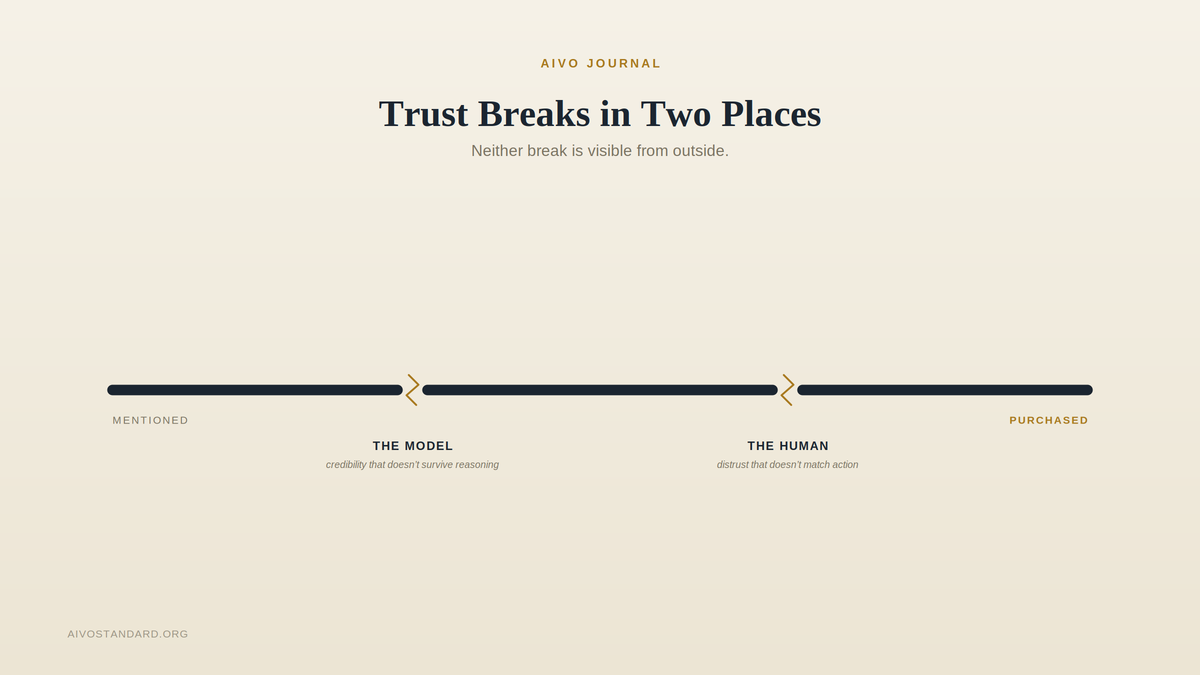
That single observation, drawn from testing how AI systems handle major banking institutions through a full decision journey, is the starting point for a bigger question worth asking plainly: what does trust actually do to the likelihood that an AI recommendation leads to a purchase. The honest answer is that trust breaks in at least two separate places, one inside the model's own reasoning, one inside the person reading its output, and neither failure is visible from outside.
The first break: credibility that doesn't survive the reasoning
AI systems resolve a comparative decision, "which bank should I use," "which vendor should I pick," across a sequence, not a single answer. An institution gets recognized. Alternatives get introduced. The system starts weighing specifics, fees, features, digital experience. One option gets selected, and it gets presented with total confidence, regardless of how close the alternatives actually were.
Most elimination happens at that middle stage, not because the losing brand lacked credibility, but because its credibility, real as it was, wasn't differentiated enough to survive the comparison. A generic claim, "well-established," "widely trusted," is easy for a competitor to match or exceed with an equally generic claim of its own. A specific, hard-to-relativize claim, being unambiguously the largest, holding a certification nobody else has, tends to survive the comparison because there's nothing for a competitor to match it with. The model isn't deciding the losing brand is untrustworthy. It's finding nothing to distinguish it once two credible options sit side by side, and defaulting to whichever one it can.
The part worth sitting with: the AI system's own confidence gives no signal that this happened. It doesn't present a close call as a close call. It presents one answer, decisively, whether the underlying result was stable across many runs or could easily have gone a different way on a different day. A person reading that answer has no way to tell the difference between a robust recommendation and a fragile one that happened to land on one side this time.
The second break: what people say versus what they do
Separately, and on the human side, stated trust in AI recommendations and actual behavior toward them don't match. Ask people directly whether they trust an AI system's recommendation over a human's, and a real, well-documented reluctance shows up, AI is seen as lacking lived experience, emotional engagement, and the kind of contextual judgment people associate with another person. That reluctance is genuine and measurable.
But look at what happens once an AI recommendation actually sends someone toward a purchase, and the picture reverses. Shoppers arriving at a retail site from an AI referral convert at meaningfully higher rates and spend more per visit than shoppers arriving through ordinary channels. People who say they don't trust AI's judgment are, in large numbers, acting on it anyway once it's already brought them to the point of decision.
The likely explanation isn't that the first finding is wrong and the second is right. It's that the two are measuring different moments. Stated distrust is about the abstract idea of letting AI decide something for you. Revealed behavior is about what happens once a brand, a real one, with a name, a price, and some proof of legitimacy, is standing on the other side of that AI recommendation, ready to answer the skepticism the moment it shows up. The AI gets someone to the door. Something else, largely outside anything an AI visibility tool measures, does the work of getting them through it.
Trust also isn't evenly distributed across platforms
One more piece worth adding, since it complicates any simple story further: people don't extend the same trust to every AI system equally. Independent survey data comparing major AI platforms on dimensions including trust, alongside accuracy and task handling, found real, measurable gaps between them, not just differences in output quality, differences in how much users are willing to rely on what they're told. Which platform mediates a brand's category, and how that platform is generally regarded on trust specifically, is a live variable in whether its recommendation actually converts, not a constant that can be assumed away.
What this means for purchase likelihood
Put together, this is a more complicated picture than "get cited and the sale follows." A brand can win the recommendation and lose the sale because its credibility, real as it was, didn't survive the reasoning that came after. A brand can also win the recommendation despite a buyer's stated skepticism about AI, because the moment of truth isn't the AI's output, it's whatever happens the instant a real, verifiable brand shows up to meet that skepticism. And the platform doing the recommending carries its own, unequal trust premium that most brands aren't accounting for at all.
None of these three failure points shows up in a citation dashboard. All three sit between being mentioned and being bought, which is where an increasing share of commercial outcomes are actually being decided.
Sources: AIVO, Inc., Global Banking AI Decision Index, Q1 2026. Kim, H., Shin, H.H., Yoon, H., & Shin, H. (2026), Tourism Management. Adobe Analytics, AI referral traffic and conversion reporting, 2026. American Customer Satisfaction Index, inaugural AI platform survey, 2026.
Comments ()