Unilever Just Paid $1.2B for Grüns. We Had the AI Diagnostic Data the Same Day.

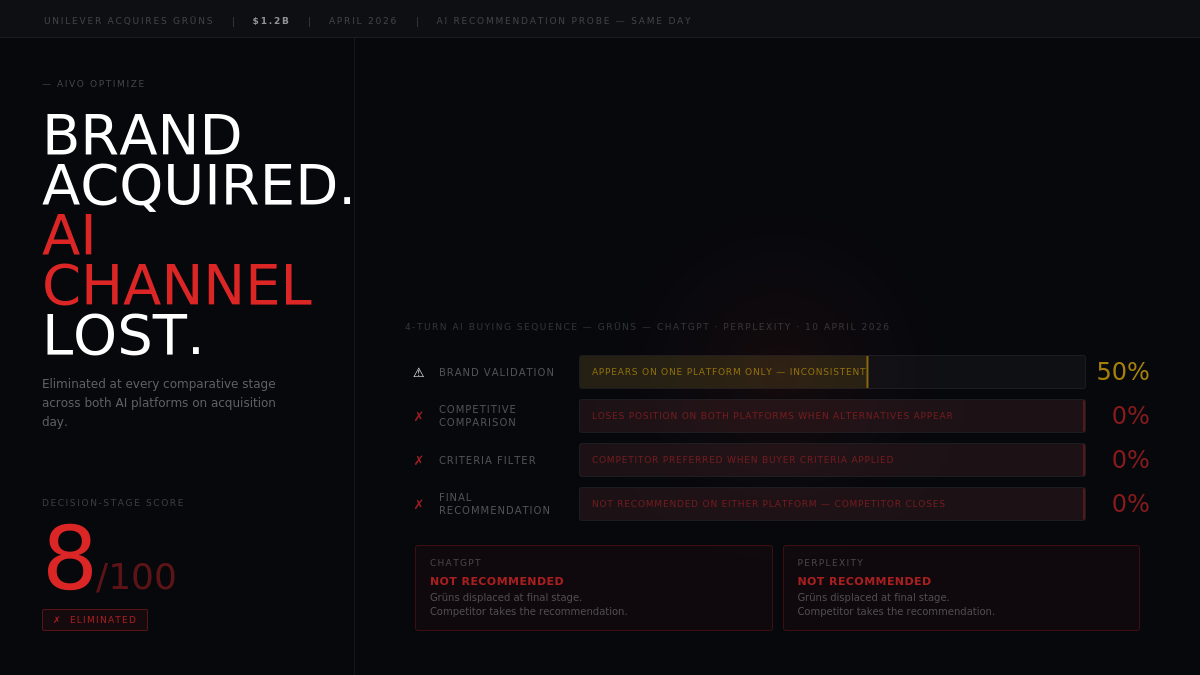
A CODA score of 8/100 on the day of acquisition. Here is what that means.
On the day Unilever announced the acquisition of Grüns for $1.2 billion, we had fresh probe data from a buying sequence we had run that morning.
We did not plan the timing. We run buying sequences continuously across our corpus of brands in the supplements and wellness category. Grüns was in the queue. The acquisition was announced while the data was being processed.
The result: CODA score 8/100. Eliminated on both platforms before the final buying recommendation.
Here is what the sequence showed, turn by turn.
The four-turn buying sequence
We run what we call a decision-path probe: a controlled four-turn conversation that mirrors how a real buyer moves from initial research to final purchase decision on an AI platform. The same sequence, the same structure, run across ChatGPT and Perplexity.
Turn 1: Brand validation. Does AI recognise Grüns as a legitimate option in the greens supplement category?
Grüns appeared on one platform but not both. Inconsistent opening signal. A brand that cannot establish consistent presence at the first turn is already in a structurally weaker position before comparison begins.
Turn 2: Competitive comparison. When alternatives are introduced, how does Grüns hold position?
On both platforms, Grüns lost position the moment competitors entered the conversation. The comparative framing exposed a positioning gap that the single-brand validation had not surfaced.
Turn 3: Criteria filter. When a buyer applies specific purchase criteria (ingredient quality, clinical evidence, bioavailability, third-party testing), which brand does the AI prefer?
A competitor was preferred on both platforms. Grüns was present in the conversation but was not the answer to the criteria question. This is the elimination step. It is where 87% of brands in our corpus exit the buying sequence.
Turn 4: Final recommendation. Which brand should the buyer purchase?
Neither ChatGPT nor Perplexity recommended Grüns. Both closed the sequence with a different brand.
CODA score: 8/100. Eliminated.
This is not a visibility problem
Grüns gets into early AI conversations. It appears at Turn 1 on at least one platform. The awareness infrastructure is working: the brand exists in the model’s knowledge base and surfaces when the category is queried.
The collapse happens at Turn 2, when the AI has to make a comparative judgment.
That is a positioning problem, not an awareness problem. And positioning problems require fundamentally different interventions than awareness problems.
The supplement category runs on a Type 1 filter: Clinical Evidence Binary. The AI evaluates which brand has the clearest, most verifiable, most consistently cited clinical evidence that its formulation is effective for the specific use case the buyer has described. Brands with peer-reviewed ingredient-level evidence structured for AI extraction survive this filter. Brands leading with lifestyle positioning, flavour, convenience, or broad wellness claims typically do not.
Grüns’ current positioning is greens in gummy form, designed for people who do not like vegetables. That is an awareness-layer claim. It communicates the product concept clearly. It does not provide the clinical evidence infrastructure the AI needs to recommend it over a competitor that has it.
What a CODA score of 8 means at $1.2B
Revenue at risk is calculated from category AI discovery share, the brand’s CODA score, and projected LLM market share in the category’s purchase decisions.
The supplement and wellness category is one of the highest-velocity AI purchase decision categories we track. Buyers in this category use AI extensively at the research and comparison stage. A brand with a CODA score of 8 in this category is losing the buying recommendation on essentially every AI-assisted purchase sequence.
At the scale Unilever is acquiring Grüns, the projected AI-influenced purchase volume over the next 36 months is significant. Unilever is buying brand momentum and retail distribution. Both are real assets with real value. But AI is increasingly where supplement purchase decisions get made, and right now Grüns is losing that channel at the exact moment a buyer is ready to purchase.
The question for Unilever’s brand team is straightforward: does the $1.2B acquisition include a plan to move the CODA score?
What moves a CODA score in this category
The Type 1 Clinical Evidence Binary filter is one of the more addressable filter types in the taxonomy, because the intervention is specific and verifiable. It requires three things in sequence.
First, ingredient-level clinical evidence that is structured for AI extraction. Not general wellness claims. Not testimonials. Peer-reviewed citations for specific active ingredients at specific efficacious doses, published in accessible sources that AI crawlers index and models weight as authoritative.
Second, entity infrastructure: Wikipedia presence, Wikidata entity records, consistent third-party citation in authoritative sources. This gives AI systems a structured knowledge base to draw from at Turn 3 when they are evaluating evidence claims.
Third, decision-instruction content that explicitly addresses the criteria language the AI applies at the filter step. Content that answers the question the AI is asking, in the language the AI uses to evaluate answers.
None of this is awareness-layer work. It is decision-layer work. The distinction matters because the programmes that improve awareness metrics can actively dilute the authority signals that decision-layer performance depends on.
The broader finding
Grüns is not unusual. It is representative.
Across 160+ brands tested over 12 months, the pattern is consistent: brands optimise for awareness metrics and lose the buying recommendation. The gap between AI visibility and AI recommendation win rate is the defining measurement problem in AI-influenced commerce right now.
The tools that measure awareness do not surface this gap. By the time a brand appears in AI referral analytics, the decision has already been made inside a process the analytics platform cannot see. The buyer who went to a competitor never arrived. There is no record of the loss.
CODA measures the gap. The free diagnostic runs in 60 seconds at aivooptimize.com.
On the Unilever acquisition
This is not a critique of Unilever’s acquisition rationale. The brand momentum, retail distribution, and category positioning Grüns brings are legitimate strategic assets. A $1.2B acquisition at this scale reflects factors well beyond AI recommendation performance.
The question we are raising is narrower: is AI recommendation performance part of the measurement framework for the brand going forward? Because if the answer is no, the channel where supplement purchase decisions are increasingly being made will continue to route buyers elsewhere, invisibly, without any signal in conventional analytics, until it is.
That is a solvable problem. But it has to be measured before it can be solved.
AIVO Optimize measures decision-stage AI performance. Free diagnostic at aivooptimize.com.
Filter Taxonomy working paper: zenodo.org/records/19401584 · WP-2026–01, CC BY 4.0.