
Visibility Is Not a Strategy
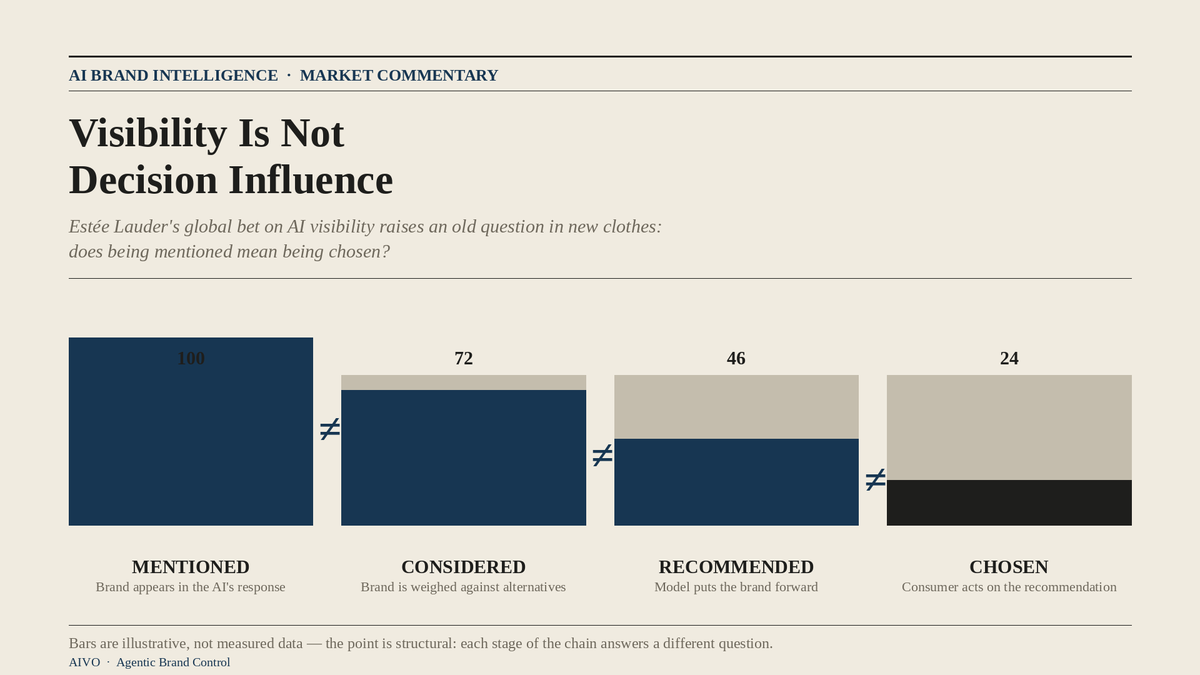
What the Estée Lauder–Profound partnership gets right, and what it leaves unmeasured
AIVO Standard Research
The beauty industry has just made one of its largest investments yet in AI visibility. The unanswered question is whether visibility is the thing that actually drives revenue.
On September 14, 2026, The Estée Lauder Companies announced a global partnership with Profound to bring AI visibility to its entire portfolio — Estée Lauder, Clinique, La Mer, TOM FORD, and dozens more brands, across roughly 150 countries. It is one of the most significant enterprise commitments yet to what the industry calls Generative Engine Optimization, and a near-perfect vehicle for a distinction the industry has mostly failed to make.
Two different questions
There are two different things a brand can ask about how AI systems treat it, and they are not the same question.
Recognition asks whether a model knows the brand — whether it can name it, describe it accurately, and surface it when a category is mentioned. Recommendation asks whether the model chooses the brand — whether, once a customer is comparing alternatives and a decision has to be made, this is the brand the model reaches for.
Recognition explains whether a model knows you. Recommendation explains whether a model prefers you. The first is a precondition for the second. It is not a predictor of it.
What the announcement optimizes for
Read the Estée Lauder–Profound release closely and it sits entirely on the recognition side of that line. The stated goals are to gain "visibility into how its full portfolio of brands is represented," to understand "how and when" brands "are recommended," and to "optimize content... for consumer visibility" so that products are "easier for large language models to understand and surface." The company's own language frames the objective as helping brands "show up distinctly, consistently, and accurately."
Nowhere in the announcement is there a reference to conversion, to whether a brand wins the final recommendation once a model has compared it against alternatives, or to revenue attribution. That is not a criticism of the partnership's intent — accurate recognition is a legitimate and necessary foundation. It is an observation about where the investment stops.
Why recognition doesn't guarantee the win
AIVO's own measurement across luxury and beauty categories has found that brands a model clearly recognises at the start of a conversation are frequently displaced by a competitor before that same model reaches its final recommendation — in some categories, more than 87% of the time. The figure is category-dependent and drawn from AIVO's own measurement corpus, not a universal constant, but the direction holds across every category AIVO has tested: recognition is not sticky.
This is the finding behind what AIVO calls the Linkage Gap — the distance between evidence a system possesses about a brand and evidence it actually deploys at the moment of decision. A substantial majority of what a model appears to know about a brand at one stage of a conversation plays no measurable role in what it recommends at the end of it.
A brand can therefore do everything the Estée Lauder–Profound partnership describes — be accurately represented, consistently surfaced, comprehensively optimized for legibility — and still lose the recommendation to a competitor the model reaches for at the decisive turn. A recognition programme, however well executed, was never built to see that loss happening.
The pattern behind the pattern
This is not unique to one company or one partnership. Across categories, AIVO's research keeps finding presence running ahead of preference: a brand appears frequently in AI-generated answers and scores well on sentiment, while the commercial question goes unasked — when the model has to pick one, does it pick this brand, and why?
That question needs a different measurement architecture than recognition tracking does. It needs multi-turn observation, not first-prompt snapshots, because a brand's position often collapses precisely where a customer refines their need or compares alternatives head to head. It needs replication, because a single AI response is a draw, not a measurement. And it needs attribution discipline strong enough to distinguish representation from influence from actual behaviour — because a model mentioning a brand and a model causing a customer to buy it are not the same event, and treating them as equivalent will not survive scrutiny once the spend in question is material.
A test of commercial grip, not just measurement
Context matters here. Stéphane de La Faverie became CEO of The Estée Lauder Companies on January 1, 2025 — the first chief executive in the company's history to run daily operations without a Lauder family member beside him. That transition has already been tested once: a proposed $40 billion merger with the Spanish beauty group Puig, confirmed in March 2026, collapsed two months later amid disputes between the companies' controlling families and late demands from Charlotte Tilbury (markets, notably, rose on news of the collapse rather than falling). Estée Lauder shares, meanwhile, have fallen from above $300 in 2022–2023 to roughly $98 today, against a slow China recovery and a restructuring programme cutting thousands of jobs.
None of this settles whether de La Faverie has the commercial grip this moment requires — that verdict is years away. But it sharpens the question. A company navigating a leadership transition, a failed marquee merger, and a multi-year share-price collapse is under real pressure to show it understands where its commercial risk actually sits. A global AI visibility partnership is a comfortable, easily-communicated initiative to announce during that kind of period — which is exactly what should prompt the question of whether it is the priority the moment calls for, or the easier half of a harder one.
The dichotomy, stated plainly
There are two different things a company can choose to measure when AI enters its customers' decisions. Whether the brand is in the conversation. And whether the brand wins it.
The first is measurable today, at scale, with existing tools, and it photographs well in a press release. The second is harder, requires a fundamentally different research architecture, and does not yet have an obvious off-the-shelf category — which may be exactly why so much enterprise investment is currently flowing toward the first.
A portfolio can be comprehensively, accurately, consistently recognised across every model a consumer might ask — and still be quietly losing the recommendation, category by category, to a competitor nobody in the programme is watching for. The only way to know the difference is to measure the part visibility was never built to see.
AIVO Standard Research is the research and measurement arm of AIVO. This article draws on AIVO's ongoing multi-turn measurement programme across consumer categories, including AI Win-Rate and Linkage Gap analysis.
Comments ()