
What Counts as an AI Recommendation
A word everyone uses and few define
Almost every AI visibility dashboard now claims to measure recommendation. Few publish what qualifies as one. Where a method is disclosed, the figure labelled recommendation is often a count of how often a brand appears in AI answers, which is a useful number describing a different event.
The distinction matters because recommendation is the event closest to revenue. A brand that is mentioned has appeared. A brand that is recommended has been selected by the AI. A brand that is purchased has converted that selection into a transaction. Boards, CMOs and investors are starting to ask which of these they are paying to measure, and the category needs definitions precise enough for another researcher to apply independently.
AIVO's working corpus covers roughly 25,000 unique buyer scenarios on 250 brands, each run five times. The most consistent pattern in that data is the distance between appearing in an answer and being selected as the answer. This note sets out the definition AIVO uses, the tests that classify a single response, and how recommendation is then measured.
The definition
An AI recommendation is an observable decision-stage response in which an AI assistant or agent selects a specific brand for a buyer's stated need and provides a reason for preferring it to relevant alternatives.
The definition is deliberately limited to what can be seen in the output. A model's internal deliberation is not observable, so the definition makes no claim about which competitors it weighed. It requires three observable elements: a choice, a buyer-relevant rationale, and a prompt that calls for a decision rather than a list of available options.
Classification and measurement are kept separate. The three elements decide whether a single response counts as a recommendation. How often, and how consistently, a brand earns one is measured across repeated, controlled runs of the same buyer scenario. Where an element is missing, something else has happened, which may well be worth measuring under its own name.
Five distinct events
Five different events are routinely reported under the word recommendation. They are distinct, and they are not all stages on a single path.
A mention is the brand appearing anywhere in an answer, perhaps in passing. Inclusion is the brand being one of several options listed for the buyer to consider. Citation is the system drawing on the brand's own content as a source, and it sits on a separate dimension from the other events. A brand can be cited without being recommended, and recommended without its own content being cited.
Recommendation, as defined above, is the AI selecting the brand with a reason at the moment the buyer asks what to do. Execution is an AI agent acting on a selection by adding a product to a basket, making a booking or completing a purchase. Neither is the same as the buyer's final decision. A buyer can ignore a recommendation, and an agent's action can be overridden or abandoned.
The commercial value concentrates in recommendation and execution. A brand can perform well on mentions, inclusion and citation and still lose most of the decisions that carry revenue, because being present and being selected answer different questions. As agents take on more of the buying, execution will matter more, since there may be no human reading the answer at all.
Three tests, then a measurement
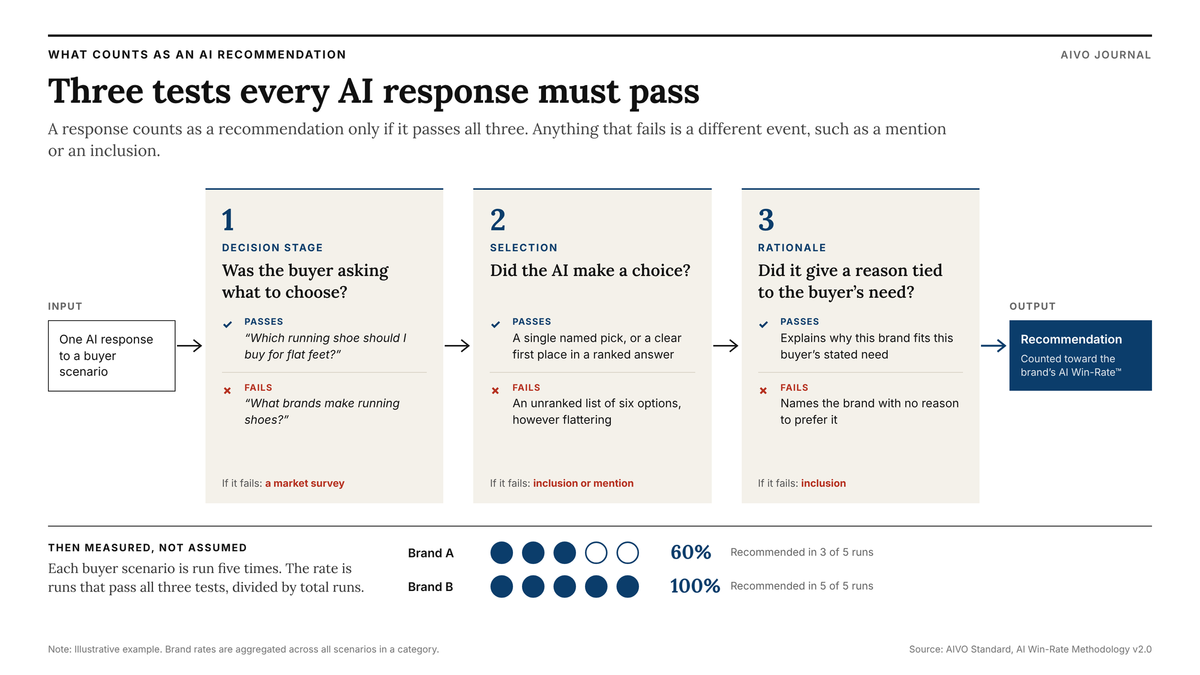
AIVO applies three tests to classify each response. A response must pass all three to be recorded as a recommendation.
The selection test asks whether the system made a choice. A single named pick passes. A clear first place in a ranked answer passes. An unranked list of options, however flattering, does not.
The rationale test asks whether the system gave a reason tied to the buyer's stated need. A recommendation explains why this brand fits this buyer. A name with no rationale is inclusion.
The decision-stage test asks whether the prompt was a choosing question. Questions such as which one should I buy, or which provider is best for my situation, put the system on the spot. Questions such as what brands make this product only invite a survey of the market, and a brand appearing there has not been chosen for anything.
Stability is then a property of the measurement rather than of any single response. AI answers vary from run to run, so AIVO runs each buyer scenario five times under controlled conditions. The recommendation rate is the number of runs that pass all three tests divided by the total number of runs, and a brand's rate is aggregated across all the scenarios in its category. A brand recommended in 3 of 5 runs and one recommended in 5 of 5 have both earned recommendations, but rates of 60% and 100% describe very different competitive positions.
Why the definition matters
A precise definition changes what a brand can learn and what it can fix. If recommendation is measured as presence, a brand can look healthy while competitors win the decisions. If it is measured as selection at the decision point, the losses become visible, along with the reasons the system gives for choosing someone else.
This is the event AI Win-Rate™ is built on. AI Win-Rate™ is the share of controlled runs of decision-stage buyer scenarios in which an AI assistant or agent recommends a brand, as classified by the three tests above. The full method is set out in AI Win-Rate: A Board Metric for AI-Mediated Buying (Methodology v2.0), published by AIVO Standard on Zenodo at zenodo.org/records/22663407.
We would encourage anyone reporting a recommendation figure, AIVO included, to state which of the five events they are measuring, how a single response is classified, and how many runs sit behind each rate. A standard is only worth adopting if others can check it. Buyers of measurement deserve to know whether they are being shown how often they appear, or how often they are selected.
Comments ()